

In the heart of Paris’s historic Left Bank, a district synonymous with intellectual history and architectural grandeur, Marthe Simon and Paul Peller of the firm Marthe Architecture have completed a rigorous two-year renovation that redefines the boundaries of modern maximalism. The project, which involved the amalgamation of two separate 1,100-square-foot apartments into a singular 2,200-square-foot residence, serves as a masterclass in how historical reverence can coexist with extravagant contemporary design. By leaning heavily into artisanal techniques such as gold leaf application, trompe l’oeil artistry, and bespoke metalwork, the duo has created a space that functions less like a standard dwelling and more like a curated "jewel box" overlooking the Seine’s storied southern bank.

The renovation represents a significant departure from the minimalist trends that have dominated high-end Parisian real estate for the past decade. Instead, Simon and Peller opted for a "warm maximalist" approach, a design philosophy that prioritizes texture, depth, and historical layering over starkness. This ambitious undertaking was made possible by what Simon describes as the "luxury of time"—a twenty-four-month window that allowed the architects to observe the natural light of the space across all four seasons, ensuring that every material choice was optimized for the specific atmospheric conditions of the Saint-Germain-des-Prés neighborhood.
The Chronology of a Transformation
The project began with a complex structural reconfiguration. The original site consisted of two independent units within a building dating back to the Napoleonic Second Empire (1852–1870). This era of French history, characterized by the massive urban renewals of Baron Haussmann, left an indelible mark on the building’s DNA, featuring high ceilings, imposing double doors, and expansive window openings.

The first six months of the project were dedicated to "de-partitioning" the space. Simon and Peller removed unnecessary internal walls to create a fluid floor plan that emphasizes volume. However, rather than creating a completely open-concept "loft," they maintained a sense of classical progression. They re-imagined the circulation of the home by designing hallways that are as wide as traditional rooms, ensuring that the transition between the public and private spheres of the home felt intentional and grand.
By the end of the first year, the structural framework was complete, allowing for the year-long "decorative phase." This period involved a global coordination of artisans, ranging from Milanese wallpaper studios to Lebanese metalworkers and Italian art students. The architects remained on-site frequently, adjusting the design as they "better understood the different spaces," according to Simon. This iterative process allowed them to tailor the layout to the specific daily rhythms of the inhabitants, balancing the building’s Second Empire origins with a 21st-century lifestyle.

Materiality and the "Jewel Box" Aesthetic
The defining characteristic of the residence is its uncompromising use of reflective and patinated surfaces. The architects sought to create a home that felt both ancient and futuristic, a goal achieved through a rigorous selection of materials.
In the living room, the walls are covered in a combination of patinated bronze and gold leaf. This choice serves to catch the shifting Parisian light, creating a glow that changes from a bright shimmer at midday to a deep, moody amber at sunset. The focal point of this room is a custom-designed fireplace featuring a brass surround with a tressé (woven) wicker pattern, executed by a specialist master metalworker. This element bridges the gap between industrial metalwork and traditional French decorative arts.

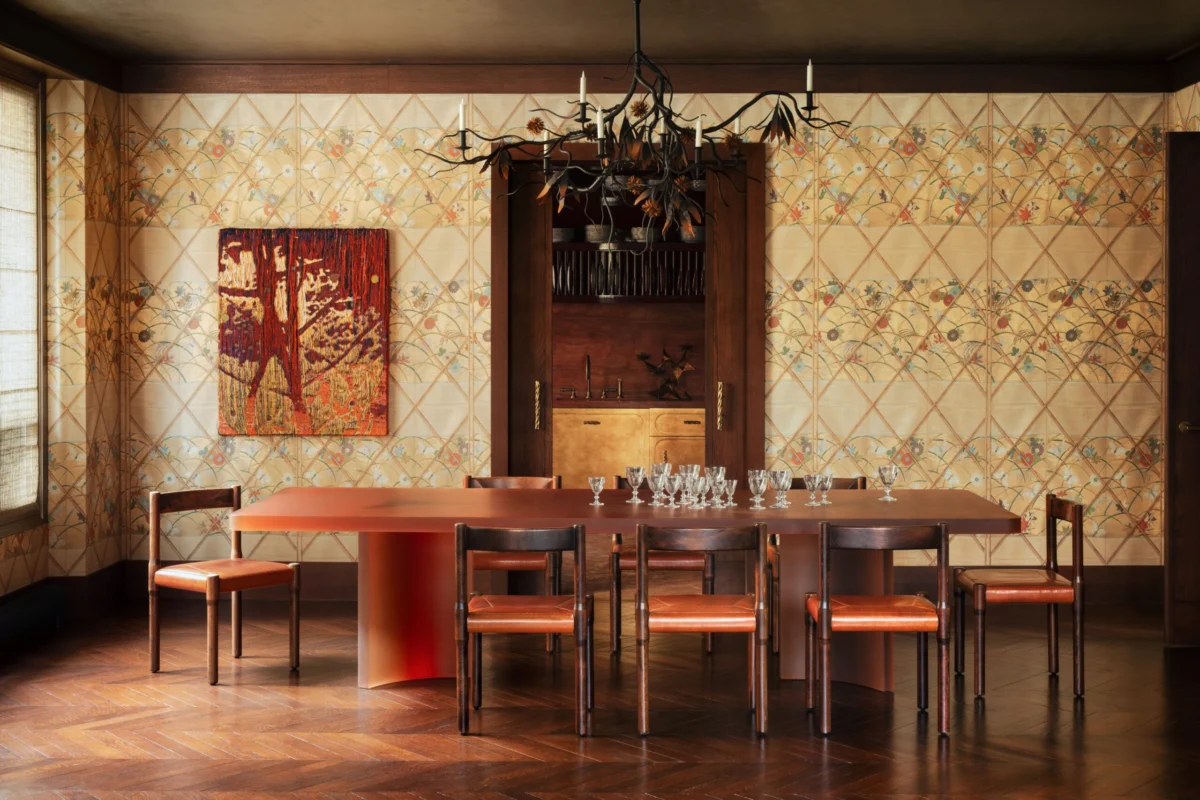
The dining room introduces a different texture: a custom, quilt-like wallpaper inspired by the work of the late Italian designer Gabriella Crespi. Crespi, known for her "Bohemian-Chic" aesthetic and her innovative use of rattan and brass in the 1970s, served as a primary inspiration for the home’s maximalist patterns. The wallpaper features three bands of friezes and a trompe l’oeil bamboo trellis, creating an illusion of depth and an indoor-outdoor connection that is rare in dense urban apartments.
The primary bathroom continues this theme of artisanal luxury. Italian art students were commissioned to hand-paint the mirrors with metallic hues, a technique that complements the brass basins. These basins were not mass-produced; they were hand-hammered by a Lebanese artist, bringing a tactile, human element to the most private space in the home.

Supporting Data: Curated Art and Design Inventory
The interior of the apartment functions as a gallery of 20th-century and contemporary design. The architects and their clients curated a selection of pieces that reflect a global perspective on modernism:
- Furniture: A pair of 1960s armchairs by the Brazilian modernist Joaquim Tenreiro anchor the living space. These are contrasted with a contemporary Sepia bench in solid walnut by Maërl and a Mario Bellini sofa, a staple of Italian 1970s design known for its modularity and comfort.
- Art and Sculpture: The space is punctuated by bronze walnuts by Clotilde Ancarani (sourced from L’Oeil de KO Gallery) and a Spiralé vase by Jacques and Dani Ruelland. A brass mask titled Returning the Gaze (2024) by Ali Cherri stands in the hallway, providing a contemporary focal point that engages with the apartment’s historical architecture.
- Textiles: Rugs were selected to provide a grounded, earthy counterpoint to the metallic walls. These include a Ladakh rug made of jute and wool from CFOC and a hemp-and-wool rug from the Carpet Society.
- Kitchen Finishes: The culinary space features a rare red Iranian travertine, antique-finished terra-cotta tiles, and a Chinese pendant light that echoes the gold leaf found in the living quarters.
Lighting Strategy: The Architecture of Intimacy
A critical component of the project’s success is its unconventional lighting design. Peller and Simon were "strict" about the avoidance of traditional overhead lighting. In high-end renovations, there is often a tendency to install recessed LED "cans" that provide even, but often flat, illumination. Marthe Architecture rejected this in favor of low-height light sources.

By placing lamps and sconces at eye level or lower, the architects created a series of intimate "pools of light" that emphasize the textures of the walls and furniture. The few overhead fixtures that were permitted are sculptural in nature. In the hallway, a black wrought-iron pendant light—hand-crafted in a London workshop—takes the form of a stylized tree branch. This organic motif repeats throughout the home, appearing in the floral wallpaper of the entryway and the hand-painted details of the bathroom mirrors.
"The materials were chosen to suit each room," Peller explains, noting that the lighting was the final layer that brought these materials to life. When the sun sets and the lamps are illuminated, the various textures—lacquer, wood grain, tortoiseshell, and metallic patina—coalesce into a singular, gilded sheen.

Broader Impact and Design Analysis
The Marthe Architecture project arrives at a time when the luxury interior design market is seeing a resurgence in "bespoke maximalism." For decades, the "Haussmannian" style—characterized by white walls, parquet de Versailles floors, and marble fireplaces—was the gold standard for Parisian apartments. However, as the global elite seek more personalized and unique living environments, architects are increasingly being asked to push beyond these traditional boundaries.
This project demonstrates that historical preservation does not have to mean aesthetic stagnation. By maintaining the "minimalist framework" of the Napoleonic openings and double doors while layering in maximalist textures, Simon and Peller have created a template for the "New Parisian" interior. This style is defined by a high degree of craftsmanship and a willingness to blend disparate eras—Brazilian modernism, Italian 1970s flair, and Napoleonic grandeur—into a cohesive narrative.

Furthermore, the project highlights the vital role of the international artisan economy in high-end architecture. The collaboration between French architects, London metalworkers, Milanese wallpaper designers, and Lebanese artists underscores the global nature of luxury design in 2024. As machine-learning and mass production continue to dominate the middle market, the "luxury of time" and the "hand of the artist" have become the ultimate indicators of prestige in the architectural world.
The Left Bank residence stands as a testament to the power of a patient, detail-oriented design process. It is a space that honors its 19th-century bones while looking forward to a more textured, expressive future. For Marthe Architecture, this project is not just a renovation; it is a statement on the enduring value of the decorative arts in the modern age.
