


The discourse surrounding Canada’s economic performance has reached a fever pitch in recent years, centered largely on a perceived "emergency" regarding labour productivity. Policymakers, central bankers, and editorial boards have increasingly sounded the alarm, pointing to a widening gap between Canadian and American output per hour. However, a growing body of economic analysis suggests that this national obsession may be rooted in ambiguous data, misleading international comparisons, and a narrow definition of success that ignores the actual drivers of human well-being. While the standard policy prescription—lowering taxes, slashing regulations, and expanding free trade—is frequently presented as the only cure, critics argue that this "zombie" orthodoxy fails to address the structural realities of the 21st-century economy.
The Productivity Narrative and the Official Alarm
In early 2024, Senior Deputy Governor of the Bank of Canada, Carolyn Rogers, characterized Canada’s low productivity as an "emergency," noting that the country has fallen behind most of its G7 peers. This sentiment has been echoed by various financial institutions and think tanks, creating a sense of urgency that often precedes calls for significant fiscal restructuring. The conventional argument suggests that if Canada cannot produce more value per hour of work, its standard of living will inevitably decline, leading to a "flood of red ink" in government deficits and an inability to fund essential services.
The standard recipe for "reigniting growth" usually involves a familiar trio: reducing corporate and personal income taxes to stimulate investment, tearing down inter-provincial trade barriers, and aggressive deregulation. Proponents of this approach argue that by making Canada more "business-friendly," the private sector will naturally innovate and close the productivity gap with the United States. However, this narrative often overlooks the complexity of how productivity is measured and what those measurements actually represent in terms of societal health.
The Challenge of Measurement: Why GDP is Not Gospel
At its core, labour productivity is a measure of economic output (GDP) divided by the total number of hours worked. While this is a straightforward calculation for a manufacturing plant producing physical goods, it becomes fraught with difficulty when applied to a modern, service-based economy. Economists like Jim Stanford have pointed out the "numerator-denominator" problem: if GDP (the numerator) is undervalued or if hours worked (the denominator) are over-reported, the resulting productivity figure is skewed.

The shift from manufacturing to services presents a significant measurement hurdle. In sectors like healthcare, education, and social services—which make up a massive portion of the Canadian economy—measuring "output" is notoriously difficult. How does one quantify the productivity of a nurse or a teacher in a way that is comparable to a factory worker? Furthermore, Canada’s heavy reliance on the natural resource sector introduces volatility. Resource extraction often involves high capital intensity but produces little "value-added" in the traditional sense, and its contribution to GDP is tethered to global commodity prices rather than internal efficiency.
Inflation adjustments also play a critical role in the narrative. To compare productivity over time, economists must convert nominal GDP into "real" GDP by removing the effects of inflation. However, the choice of price index can fundamentally change the conclusion. Using a Consumer Price Index (CPI) instead of a Producer Price Index (PPI) can transform a recorded decline in productivity into a modest gain. This statistical sensitivity suggests that policy decisions involving billions of dollars are being made based on data that is far from absolute.
Historical Context: A Chronology of Policy and Performance
To understand the current anxiety, one must look at the trajectory of Canadian economic policy over the last three decades.
- The Late 1990s and Early 2000s: Following the fiscal crisis of the mid-90s, the federal government under Jean Chrétien and Paul Martin implemented significant spending cuts and began a series of tax reductions. The goal was to create a "leaner" economy that would attract foreign investment.
- 2002–2012: The Resource Boom: During this decade, Canada’s real income per capita actually grew faster than that of the United States. A 2014 report from Statistics Canada highlighted that when terms of trade, investment income, and resource prices were factored in, the "panic" over Canadian lagging was largely unfounded. The high price of oil and minerals bolstered the Canadian dollar and national wealth, masking underlying structural weaknesses.
- The Post-2014 Slump: As global commodity prices cooled, the structural issues of the Canadian economy became more apparent. Business investment in research and development (R&D) remained low compared to other OECD nations, and the "branch plant" nature of Canadian manufacturing—where subsidiaries operate in Canada while R&D and strategic decisions are made at foreign headquarters—limited innovation.
- The 2020s and the Pandemic Recovery: The COVID-19 pandemic disrupted global supply chains and altered labour markets. As Canada emerged from the pandemic, the focus returned to productivity as a means to combat inflation and manage the growing national debt.
Misleading International Comparisons: The US vs. Europe
The most common benchmark for Canadian productivity is the United States. Critics argue this is a flawed comparison because the two economies are structured differently. The U.S. economy has a higher concentration of high-cost private services, such as healthcare and finance, which inflate GDP per capita figures.
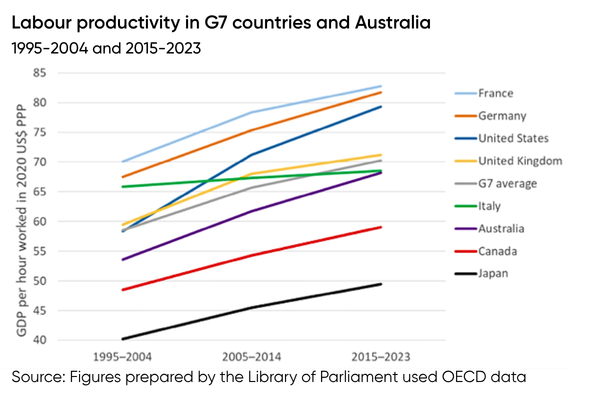
Furthermore, if the goal is high productivity, the "low-tax, low-regulation" model is not the only successful path. Data from the OECD shows that countries like France and Germany often lead the G7 in labour productivity (output per hour worked), despite having significantly higher taxes, more robust labour protections, and longer mandatory vacations than Canada or the U.S. These nations demonstrate that high productivity can coexist with—and perhaps be driven by—a strong social safety net and high public investment. Conversely, jurisdictions that follow the "low-wage, anti-union" model, such as certain states in the American South, often suffer from deep rural poverty and crumbling public infrastructure despite their "business-friendly" labels.
Structural Realities: The Branch Plant and the Oligopoly
A deeper analysis of Canada’s economic challenges reveals issues that tax cuts cannot solve. One such issue is the prevalence of protected oligopolies. In sectors like telecommunications, banking, and groceries, a handful of large firms dominate the market. Without the pressure of robust competition, these firms have less incentive to invest in the kind of breakthrough innovations that drive genuine productivity growth.
Additionally, the "branch plant" syndrome continues to plague Canadian industry. Much of Canada’s manufacturing sector is foreign-owned. When a multinational corporation looks to cut costs or invest in new technology, the Canadian subsidiary is often at the mercy of decisions made in Detroit, Tokyo, or Berlin. This leads to a lack of "value-added" activity within Canadian borders, as the most high-value R&D work is kept at the home office.
The Decoupling of Productivity and Wages
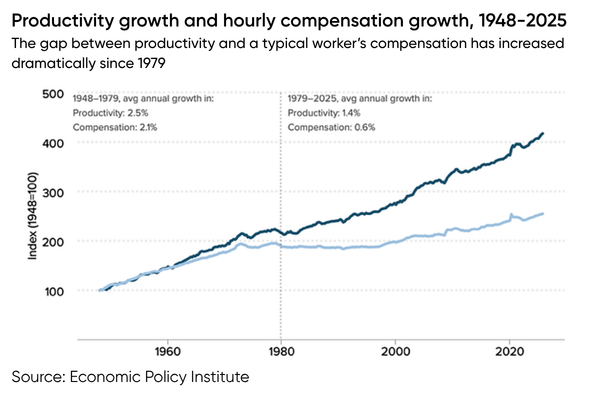
Perhaps the most significant critique of the productivity obsession is the historical decoupling of productivity growth from real wage growth. In the United States, this trend became stark during the 1980s. While productivity continued to climb, the real wages of the average worker stagnated. The wealth generated by increased efficiency did not "trickle down"; instead, it was concentrated among the top 10% of earners and corporate shareholders.
A similar, though slightly less extreme, trend has been observed in Canada. If the benefits of increased productivity are not shared with the workforce in the form of higher wages or better services, the public has little reason to support policies aimed at "reigniting growth." This decoupling is often cited by sociologists as a primary driver of the populist backlash seen across Western democracies, as workers feel increasingly alienated from the economic success of their nations.
Moving "Beyond GDP": The Quebec Initiative and Planetary Boundaries
In response to these critiques, a "Beyond GDP" movement has gained traction. In 2022, a coalition in Quebec known as the G15+ launched an initiative to measure economic well-being through a broader lens. They developed a set of 70 indicators across 10 themes, including social equity, environmental health, and housing affordability. This holistic approach recognizes that a rising GDP is meaningless if it coincides with a climate crisis, a mental health epidemic, or a housing shortage.
This shift is also necessitated by environmental realities. A recent report from the Potsdam Institute for Climate Impact Research warns that human economic activity has already breached seven of the nine "planetary boundaries" essential for maintaining a stable biosphere. An obsession with infinite GDP growth on a finite planet is increasingly viewed by scientists as a dangerous path. The "productivity panic" ignores the fact that true sustainability may require a transition to a "steady-state" economy, where the focus shifts from producing more to producing better and distributing wealth more equitably.
Implications for Public Policy
The fiscal argument that Canada "can’t afford" its social services without massive productivity gains is also being challenged. Some economists suggest that instead of cutting services, Canada should look at the revenue lost through decades of tax cuts. A study from Queen’s University estimated that federal income tax cuts implemented between the late 1990s and 2016 resulted in approximately $94 billion in "lost" revenue in 2016 alone. Recovering even a portion of this revenue could fund the transition to renewable energy, improve healthcare wait times, and address the infrastructure deficit without relying on the uncertain hope of a productivity miracle.
Ultimately, the debate over Canada’s labour productivity is a debate over the country’s future identity. If the nation remains fixated on a narrow, US-centric model of GDP growth, it risks ignoring the structural innovations and social investments that actually improve lives. By challenging the "productivity panic," Canada has the opportunity to imagine an economic system that prioritizes sustainability, equity, and the genuine well-being of its citizens over abstract statistical aggregates.
