

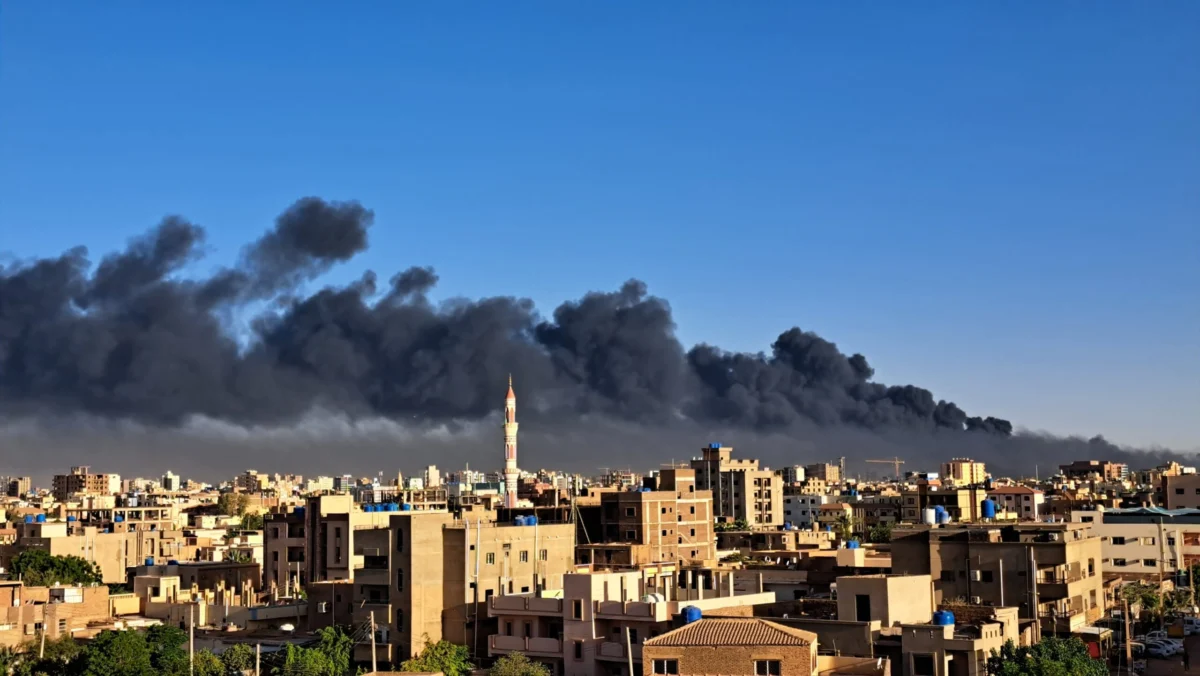
The Sudanese capital of Khartoum was rocked by a series of devastating explosions and relentless gunfire on Wednesday as the conflict between the Sudanese Armed Forces (SAF) and the paramilitary Rapid Support Forces (RSF) entered a perilous new phase. Despite a high-profile, United States-brokered attempt to establish a 24-hour humanitarian ceasefire, the truce disintegrated almost immediately, leaving millions of residents trapped in a crossfire that has turned residential neighborhoods into active battle zones. The failure of the diplomatic effort has not only exacerbated a burgeoning humanitarian catastrophe but has also paralyzed international attempts to evacuate foreign diplomats and citizens from the war-torn city.
Continuous bombardments and the deafening roar of heavy artillery echoed throughout central Khartoum, particularly around the sprawling compound that houses the army’s General Command. This strategic site, which serves as the nerve center for the regular military, has become the primary focus of the RSF’s offensive. Simultaneously, the Khartoum International Airport remained a contested wasteland, with satellite imagery showing multiple civilian aircraft destroyed on the tarmac, effectively severing the country’s main artery to the outside world.
A City Under Siege: The Civilian Toll
The human cost of the power struggle between General Abdel Fattah al-Burhan, the head of the SAF, and General Mohamed Hamdan Dagalo, the leader of the RSF known as Hemedti, has been staggering. According to the World Health Organization (WHO), citing figures from Sudan’s Ministry of Health, at least 270 people have been confirmed dead and over 2,600 injured since the violence erupted on Saturday. However, medical professionals on the ground warn that these figures are likely a significant undercount, as many bodies remain in the streets, unreachable due to the intensity of the fighting.
In Khartoum, a metropolis of roughly 5.5 million people, the situation has become increasingly desperate. Residents have been huddled in the interior rooms of their homes for five consecutive days, enduring sweltering heat without electricity and with dwindling supplies of clean water. "Today we were starting to run out of some essentials," said Hadeel Mohamed, an architect living in the city. Her story is emblematic of the fear gripping the population, as she described the terror of her brother venturing out into the streets simply to find food.
The psychological toll is amplified by the timing of the conflict, which has overshadowed the final days of the holy month of Ramadan. With the Eid al-Fitr festival approaching, many had hoped for a reprieve. Instead, those who could afford the risk began a perilous exodus, braving the shelling to flee toward the neighboring Al Gezira state to the south, where the fighting has yet to spread.
The Breakdown of the Transition and the Roots of Conflict
The current violence is not an isolated event but the violent culmination of months of simmering tensions over the future of Sudan’s governance. Following the 2019 popular uprising that ousted the long-term autocrat Omar al-Bashir, the military and civilian leaders entered a fragile power-sharing agreement. This arrangement was shattered in October 2021 when Burhan and Hemedti joined forces to carry out a military coup, dissolving the transitional government and seizing full control.
However, the alliance between the two generals was one of convenience rather than shared vision. The primary point of contention that led to the current warfare was the proposed integration of the RSF—a powerful paramilitary force with its origins in the Janjaweed militias of Darfur—into the regular Sudanese army. Disagreements over the timeline of this integration and the chain of command proved insurmountable. Burhan pushed for a rapid two-year integration period, while Hemedti sought a ten-year window that would allow him to maintain his independent power base.
This struggle for dominance has now evolved into a zero-sum game. General Burhan, operating from a presidential guesthouse within the army headquarters, has characterized the RSF as a "rebel militia" that must be dissolved. Conversely, Hemedti has labeled Burhan a "radical Islamist" and a criminal, vowing to continue the fight until the military leadership is brought to justice.
Chronology of the Escalation: April 15–19
The descent into civil war followed a rapid and violent trajectory:
- Saturday, April 15: Heavy fighting breaks out in Khartoum and several other cities. Both sides claim control of the presidential palace and the airport. The World Food Programme (WFP) suspends operations after three employees are killed in North Darfur.
- Sunday, April 16: The Sudanese Air Force begins conducting air strikes on RSF positions within the capital, marking a significant escalation in the use of heavy weaponry in urban areas.
- Monday, April 17: International pressure mounts for a ceasefire. Reports emerge of attacks on diplomatic personnel, including a domestic assault on the European Union’s ambassador to Sudan and a shooting involving a U.S. diplomatic convoy.
- Tuesday, April 18: A U.S.-brokered 24-hour ceasefire is scheduled to begin at 6 p.m. local time. Despite public commitments from both sides, the sounds of heavy artillery and jet engines continue unabated throughout the night.
- Wednesday, April 19: The SAF reports repelling a massive RSF wave directed at the General Command. Armed reinforcements from eastern Sudan are seen entering the capital. The RSF announces a new commitment to a ceasefire starting at 4 p.m. GMT, but skepticism remains high as the army does not immediately reciprocate.
International Evacuation Plans Thwarted
The persistence of the fighting has created a logistical nightmare for foreign governments attempting to rescue their citizens. The U.S. State Department has stated that there are currently no plans for a government-coordinated evacuation of American citizens due to the "uncertain security situation" and the closure of the airport.
Other nations have faced similar setbacks. Germany was forced to halt a mission involving three Luftwaffe A400M transport planes that were intended to fly out approximately 150 German citizens. Japan has announced plans to deploy military Self-Defense Forces aircraft to Djibouti to prepare for a potential evacuation of its 60 citizens, but the timing remains contingent on a lull in hostilities. Turkey and various European nations have also indicated that while plans are in place, the lack of a secure landing zone makes any immediate action impossible.
The targeting of humanitarian workers has further complicated the international response. The United Nations has reported instances of sexual violence against aid workers and the looting of humanitarian warehouses. Medecins Sans Frontieres (MSF) confirmed that armed men raided one of its supply facilities in the west of the country, stealing essential medical goods.
Geopolitical Implications and Regional Stability
The conflict in Sudan is not merely a domestic affair; it has the potential to destabilize the entire Horn of Africa and the Sahel region. Sudan occupies a vital strategic position, bordering seven countries and sitting along the Red Sea, a critical corridor for global trade.
Regional powers such as Egypt and Saudi Arabia have deep interests in the outcome. Egypt has traditionally supported the SAF and General Burhan, viewing the regular military as the guarantor of stability. Meanwhile, Hemedti has cultivated ties with various regional actors and has been linked to the Russian private military company, the Wagner Group, which has been active in Sudan’s gold mining sector.
The United States and its Western allies are concerned that a prolonged civil war will create a power vacuum that could be exploited by extremist groups or increase Russian influence in the region. There is also the looming threat of a massive refugee crisis; even before this conflict, Sudan hosted over 1.1 million refugees from neighboring countries and had 3.7 million internally displaced persons.
Analysis: A Nation at the Brink
The current trajectory suggests a protracted conflict rather than a swift victory for either side. The SAF possesses superior airpower and heavy weaponry, but the RSF is highly mobile, experienced in urban guerrilla tactics, and deeply embedded within the residential fabric of Khartoum. This dynamic often leads to "attrition warfare," where the civilian population bears the brunt of the suffering.
The collapse of the medical infrastructure is perhaps the most immediate concern. The Sudanese Doctors’ Trade Union has reported that nearly 70% of the hospitals in and around the conflict zones are out of service. Those that remain open are operating without sufficient blood supplies, anesthesia, or even basic bandages.
As the international community struggles to find a diplomatic lever that can force a cessation of hostilities, the people of Sudan are left to navigate a landscape of smoke and steel. The transition to democracy, which seemed within reach following the 2019 revolution, has been replaced by a grim struggle for survival. Without a sustained and enforced ceasefire, the "Breadbasket of Africa" faces the prospect of a total state collapse, with consequences that will resonate far beyond its borders.
