

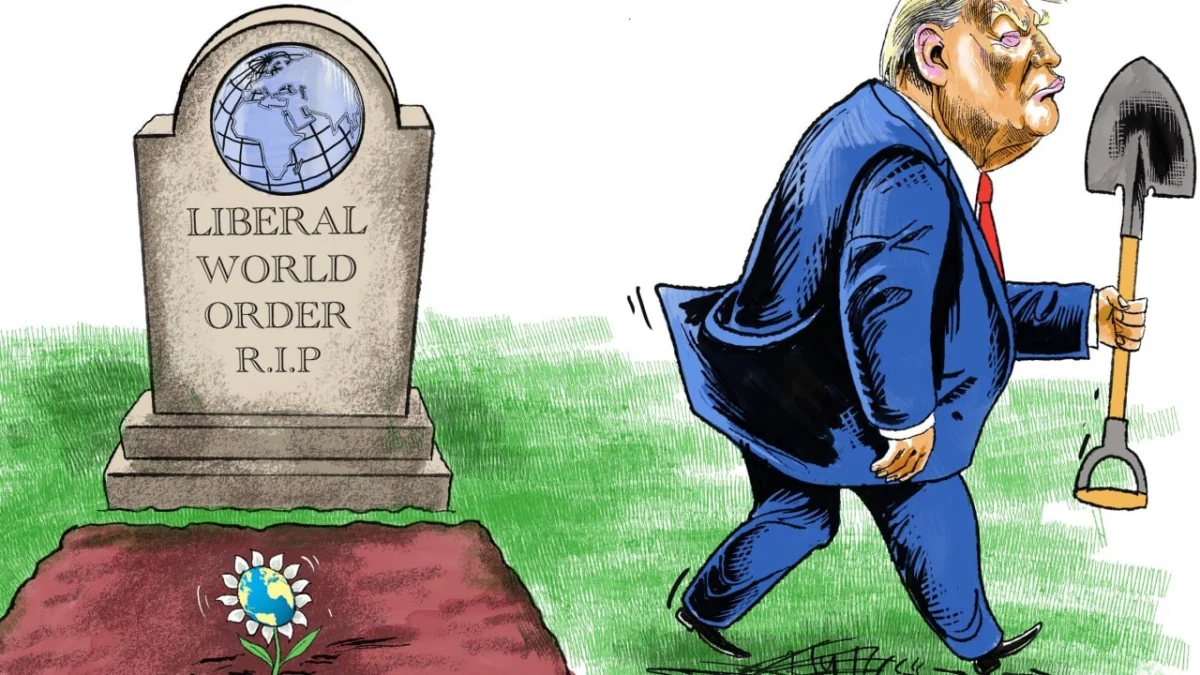
The global political landscape is undergoing a fundamental restructuring as the traditional foundations of US liberal internationalist leadership are replaced by a more transactional and sovereignty-centered approach. For nearly eight decades, the United States served as the primary architect and guarantor of a world order built on the promotion of democratic values, the expansion of open markets, and the stewardship of multilateral institutions. However, the tenure of US President Donald Trump has fundamentally challenged these norms, signaling a departure from the "universal project" of American power toward a realist framework that prioritizes national interest over ideological alignment. The recent summit between President Xi Jinping and Donald Trump in Beijing marks a critical juncture in this transition, suggesting that despite years of friction, both superpowers may be seeking a pragmatic "realistic framework" for coexistence, strategic stability, and managed competition.
The Erosion of Liberal Internationalism and the Rise of Transactional Realism
For the better part of the 20th and early 21st centuries, Washington’s foreign policy was guided by the tenets of liberal internationalism. This doctrine held that American security and prosperity were best served by a stable, rules-based international order. Successive administrations, regardless of party affiliation, invested heavily in alliances like NATO, trade agreements like the WTO, and the promotion of Western-style governance abroad.
The shift under the Trump administration represented more than a mere change in rhetoric; it was a systemic pivot. By embracing a "transactional" foreign policy, the United States began to evaluate its international engagements based on immediate, measurable gains rather than long-term ideological goals. This approach has been characterized by a heavy reliance on tariffs to address trade imbalances, a demand for increased "burden-sharing" from long-standing allies, and an open skepticism toward the post-war institutions that Washington itself helped create.
Crucially, this shift has altered the global narrative regarding American power. The idea that the United States acts as a "benevolent hegemon" serving a cause larger than itself has been largely discarded in favor of a model where the U.S. acts as a rational, self-interested actor. Even in a post-Trump political environment, analysts suggest that a return to the old-style liberal internationalism is increasingly unlikely, as the domestic and international conditions that supported it have permanently shifted.
The Beijing Summit: A Pivot Toward Strategic Stability
The recent high-stakes meeting between President Xi Jinping and Donald Trump in Beijing serves as the most prominent evidence of this new diplomatic reality. Unlike previous summits that often focused on human rights, democratic reforms, or ideological differences, the Beijing discussions centered on the practicalities of "managed competition."
According to sources familiar with the proceedings, the dialogue focused on creating "guardrails" for the bilateral relationship to prevent accidental escalation. This move toward a more realistic framework of coexistence acknowledges that neither power is likely to fundamentally change the other’s internal system. Instead, the focus has shifted toward:
- Economic Reciprocity: Moving beyond the "trade war" rhetoric toward a more structured, albeit protectionist, economic relationship defined by specific purchase agreements and sector-specific restrictions.
- De-securitization of Non-Essential Sectors: An attempt to distinguish between critical national security technologies (like AI and semiconductors) and general commerce, which both sides wish to maintain to ensure domestic economic stability.
- Direct Crisis Communication: Enhancing military-to-military links to avoid miscalculations in the South China Sea and the Taiwan Strait.
The summit suggests that while the "Great Power Competition" remains the defining feature of the era, it does not necessarily have to result in a total decoupling or an inevitable conflict.
A Chronology of Disruption: From Trade Wars to Strategic Autonomy
The path to the current state of affairs has been marked by several key milestones that have redefined the US role in the world:
- 2017-2018: The initiation of Section 301 investigations and the subsequent imposition of tariffs on hundreds of billions of dollars worth of Chinese goods, signaling the end of the "engagement" era.
- 2019: Increased pressure on NATO allies to meet the 2% GDP defense spending threshold, coupled with threats of withdrawal, which sowed seeds of doubt regarding the permanence of the US security umbrella.
- 2020: The signing of the "Phase One" trade deal, which, while limited in scope, established the precedent for transactional diplomacy over broad structural reform.
- Recent Years: The withdrawal of thousands of US troops from Germany and high-level diplomatic interference in European domestic politics—such as the support for nationalist movements in Hungary—further strained the transatlantic bond.
These events have forced America’s traditional partners to reconsider their own positions, leading to a significant shift in European and Asian security architectures.
The Transatlantic Fracture and the Quest for Strategic Autonomy
Nowhere is the shift away from US-led liberal internationalism more apparent than in the relationship between Washington and Brussels. The Trump administration’s vocal criticism of European reliability and its direct interference in European political landscapes have weakened the assumption that the Atlantic alliance is the unquestioned core of the global order.
In response, European leaders, most notably French President Emmanuel Macron, have accelerated the pursuit of "strategic autonomy." This concept envisions a Europe that is capable of defending its own interests—militarily, economically, and technologically—without being entirely dependent on the United States. The realization that American foreign policy can undergo radical shifts depending on the occupant of the White House has led to a wider reassessment of a world no longer disciplined by US-led blocs.
Data from recent European defense surveys indicates a marked increase in intra-European military cooperation and a surge in domestic defense spending, not as a tribute to Washington, but as a hedge against American volatility. The European Union is increasingly positioning itself as a "third pole" in a multipolar world, seeking to maintain economic ties with China while remaining ideologically aligned, but strategically independent, from the United States.
The Arrival of Multipolarity and the Role of Middle Powers
The decline of a unipolar world has paved the way for the rise of "Middle Powers"—nations like India, Brazil, Indonesia, and Turkey—that are increasingly unwilling to join fixed ideological camps. These nations are practicing a sophisticated form of "hedging," maintaining robust security ties with the West while expanding economic and infrastructure partnerships with China through initiatives like the Belt and Road or BRICS+.
This shift toward multipolarity has several key characteristics:
- Loose Alliances: Fixed, Cold War-style blocs are being replaced by flexible, issue-based coalitions.
- Regionalism: Institutions such as ASEAN, the African Union, and the Shanghai Cooperation Organization (SCO) are taking on greater roles in dispute resolution and economic integration.
- Resistance to Ideology: Countries across the Global South are increasingly prioritizing development and sovereignty over the "democracy vs. autocracy" narrative pushed by Washington.
This new environment creates both risks and opportunities. While it makes global consensus more difficult to achieve, it also allows for a more diversified and resilient international system where no single power can dictate global norms.
Navigating the Traps: Thucydides and Kindleberger
As the US and China navigate this new era, two theoretical frameworks dominate the discourse: the Thucydides Trap and the Kindleberger Trap.
The Thucydides Trap, popularized by Graham Allison, describes the inherent danger when a rising power (China) threatens to displace an established power (the US). Historically, such shifts have often resulted in war. However, as noted during the Beijing summit, this trap is a "subjective construct" rather than an ironclad law. By changing the narrative from "inevitable clash" to "managed competition" and by "de-securitizing" areas of cooperation, both nations are actively seeking to bypass this historical precedent.
Conversely, the Kindleberger Trap presents a different danger: a world where no power is willing or able to provide "global public goods." Named after the architect of the Marshall Plan, Charles Kindleberger, this theory suggests that the Great Depression was exacerbated because the UK could no longer lead and the US was not yet willing to. Today, as the US retreats from its role as the "global policeman" and China remains cautious about assuming the full costs of global leadership, there is a risk of a vacuum in leadership regarding climate change, pandemic response, and financial stability.
Implications for the Future Global Order
The shift toward a more transactional and multipolar world has profound implications for global governance and economic stability.
1. The End of Universalism: The era of a single, universal model for development and governance is likely over. The future will be defined by a "patchwork" of systems where different regions adhere to different norms.
2. Economic Fragmentation: The move toward "sovereignty-centered" policies suggests that global supply chains will continue to be reshaped by political considerations. "Friend-shoring" and "near-shoring" will become the norm as nations prioritize resilience over efficiency.
3. New Diplomatic Language: Diplomacy is moving away from the language of "values" and toward the language of "interests." This may lead to more frequent, short-term agreements but fewer long-term, comprehensive treaties.
4. Managed Competition as the New Normal: The US-China relationship will likely remain characterized by high tension, but the Beijing summit indicates a mutual desire to keep that tension within manageable bounds. The goal is no longer "victory" in the traditional sense, but the avoidance of catastrophe.
In conclusion, the two terms of Donald Trump have acted as a catalyst for a change that was perhaps already in motion. The "old style" of US liberal internationalism has been shaken to its core, but in its place, a more realistic, albeit more complex, framework is emerging. The ability of the United States and China to navigate this transition—avoiding the historical traps of rising and falling powers—will determine the stability of the 21st century. The Beijing summit suggests that while the doors to the old world are closing, the path to a new, more pragmatic era of global relations is beginning to open.
