

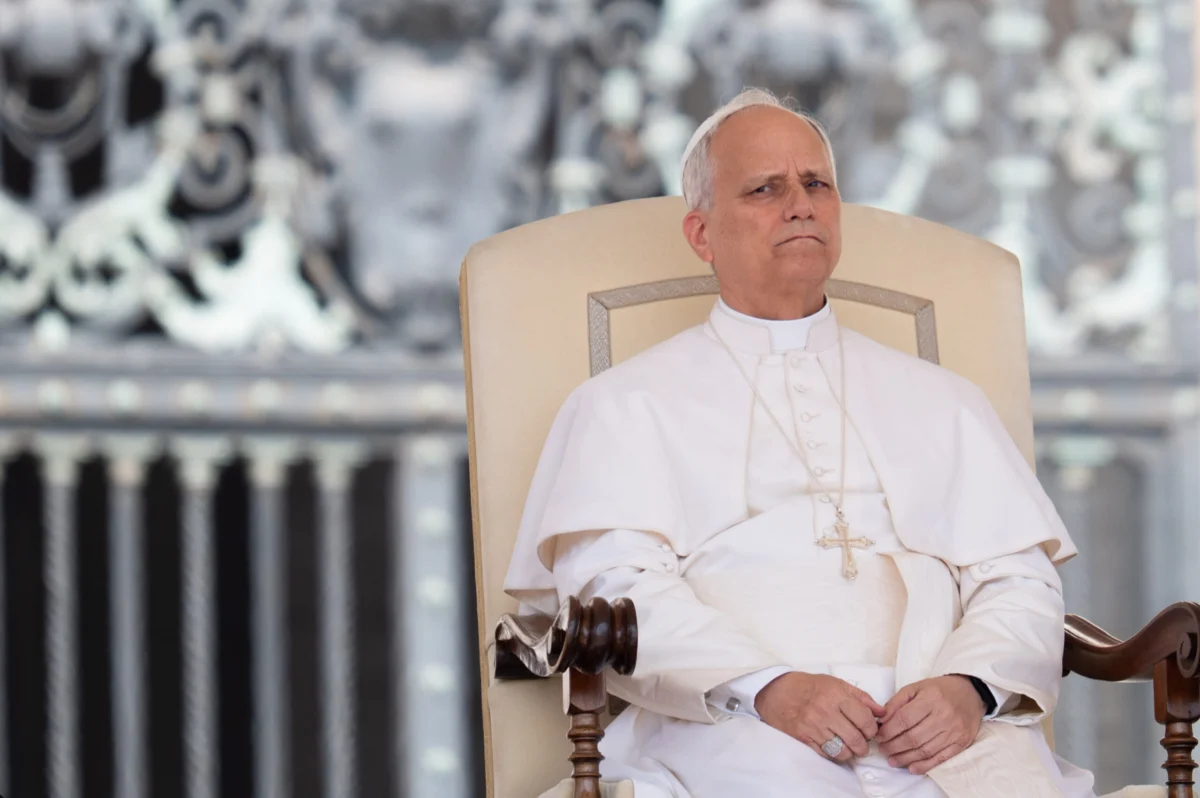
VATICAN CITY – Pope Leo XIV issued a stark warning over the weekend regarding a looming "social calamity" that could stem from widespread unemployment driven by the rapid adoption of artificial intelligence (AI) technologies. His pronouncement, delivered within his first encyclical, "Magnifica Humanitas," published on May 15, 2026, has resonated deeply within global discourse, especially as prediction market traders indicate a growing apprehension that these worries may be well-founded, projecting unprecedented levels of joblessness in the United States by the end of the decade.
The Supreme Pontiff, speaking from the moral authority of the Holy See, used his inaugural encyclical to directly address the ethical and societal challenges posed by AI. While holding his weekly general audience at St. Peter’s Square in Vatican City on June 11, 2025, a year prior to the encyclical’s release, the Pope had already signaled the Church’s increasing focus on the intersection of faith, technology, and human dignity. However, "Magnifica Humanitas" crystallizes these concerns into a comprehensive teaching document, urging global leaders and stakeholders to regulate AI proactively and consider its profound effects on the global labor market.
"Magnifica Humanitas": The Pope’s Moral Imperative
In "Magnifica Humanitas," Pope Leo XIV articulates a powerful ethical framework, emphasizing that "the pursuit of greater profits cannot justify choices that systematically sacrifice jobs, because the human person is an end, not a means, and the economic order must remain subordinate to human dignity and the common good." This statement serves as the cornerstone of his argument, positioning human well-being and purpose above mere economic efficiency or technological advancement. An encyclical, as a major teaching document from the Pope, carries significant weight within the Catholic Church, offering guidance on matters of faith and morals for the faithful and often addressing pressing global issues for the wider world. Pope Leo’s choice to dedicate his first such document to AI’s societal impact underscores the urgency with which the Vatican views this technological revolution.
The document meticulously outlines the potential for AI to exacerbate existing inequalities, create new forms of social exclusion, and fundamentally alter the fabric of human society. While acknowledging the potential benefits of AI in areas like healthcare, scientific research, and efficiency, the encyclical consistently returns to the principle of subsidiarity and the dignity of work. It calls for a "human-centered" approach to AI development and deployment, one that prioritizes the flourishing of individuals and communities over purely economic metrics. This aligns with a long tradition of Catholic social teaching, which has historically addressed the moral implications of industrialization, labor rights, and economic justice, from Pope Leo XIII’s Rerum Novarum in 1891 to Pope Francis’s Laudato Si’ on environmental ethics and Fratelli Tutti on fraternity and social friendship. "Magnifica Humanitas" extends this legacy into the digital age, framing AI as a challenge to humanity’s collective moral responsibility.
Economic Storm Clouds: Prediction Markets Sound Alarm
The Pope’s cautionary words are not mere theological abstraction but find an echo in the pragmatic world of financial markets, specifically prediction platforms. Traders on Kalshi, a leading prediction market, are assigning significant probabilities to scenarios of severe unemployment in the United States. Current odds suggest a 60% chance that the U.S. unemployment rate will surpass 8% at some point before 2030. Furthermore, the likelihood of it crossing the 9% threshold within the same period stands at a concerning 47%. These figures represent a stark outlook, suggesting a departure from recent economic norms.
To put these predictions into historical context, a 9% unemployment rate in the United States is an anomaly, typically indicative of profound economic distress. Excluding the extraordinary circumstances of the COVID-19 recession in 2020, there have been only three instances since World War II where the U.S. unemployment rate climbed above 9%. These include the severe recession of the early 1980s (peaking at 10.8% in 1982), the aftermath of the 1973 oil crisis (reaching 9.0% in 1975), and the Great Recession of 2008-2009 (hitting 10.0% in October 2009). The fact that prediction markets are now assigning such high probabilities to a similar economic downturn, potentially driven by technological rather than purely cyclical factors, underscores the unique nature of the current concerns surrounding AI.
A Timeline of Growing Concern and Anticipated Shifts
The path to Pope Leo XIV’s encyclical and the concurrent market apprehensions has been building over several years. The widespread public and commercial deployment of advanced AI, particularly large language models and generative AI tools, began accelerating rapidly in the early 2020s. Initial reactions ranged from awe at their capabilities to immediate concerns about job displacement.
- 2023-2024: Early reports from organizations like the World Economic Forum, McKinsey & Company, and PwC began to project significant job displacement in certain sectors due to AI, alongside the creation of new roles. However, the net effect and the speed of transition remained contentious. The dialogue often centered on "reskilling" and "upskilling" the workforce.
- June 11, 2025: Pope Leo XIV holds a general audience, making general remarks about the ethical use of technology and the importance of human work, laying groundwork for more detailed teachings.
- Late 2025: Several high-profile corporate layoffs are publicly attributed, in part, to AI adoption, leading to increased media scrutiny and public anxiety. Technology leaders, while generally optimistic about AI’s long-term benefits, begin to acknowledge the "temporary labor displacements" more openly.
- May 15, 2026: Pope Leo XIV releases his first encyclical, "Magnifica Humanitas," a comprehensive theological and ethical treatise on AI’s societal impact, specifically warning of "social calamity" from mass unemployment and urging global regulation.
- Late May 2026: Kalshi prediction markets reflect escalating concerns, with traders placing high odds on future unemployment spikes and attributing current job cuts to AI.
AI’s Immediate Impact: A Driver of Job Cuts?
Beyond long-term projections, prediction market traders are also pinpointing AI as a direct contributor to current economic shifts. Kalshi traders currently estimate a 78% chance that AI will be identified as the number one reason for job cuts in May 2026. This projection awaits confirmation or denial from upcoming data releases by Challenger, Gray & Christmas, a firm that tracks corporate layoffs. If confirmed, this would mark a significant milestone, indicating that AI’s influence on the labor market has moved beyond theoretical discussions into tangible, immediate impacts on employment figures.
This perspective challenges the often-cited narrative from some corners of the tech industry that while AI might cause "temporary labor displacements," it will ultimately create more jobs than it destroys, or that mass labor disruption is not a near-term threat. While Pope Leo XIV’s encyclical acknowledges that "any new technology leads to temporary labor displacements," he fundamentally questions the scale and consequences of such disruptions in the age of advanced AI. His concern stems from the potential for these "temporary" displacements to become systemic and prolonged, leading to the "human and cultural impoverishment" he describes.
Industry Perspectives: Innovation vs. Displacement
The technology industry, while generally enthusiastic about AI’s potential, has offered a range of perspectives on its labor market impact. Many tech leaders and economists affiliated with the industry argue that AI will primarily augment human capabilities, automate repetitive tasks, and create entirely new industries and job categories that are currently unimaginable. They point to historical parallels, such as the industrial revolution or the rise of the internet, where initial fears of job loss eventually gave way to periods of unprecedented job creation and economic growth. Figures like AMD CEO Lisa Su have consistently reassured workers that while the landscape will shift, the overall trajectory will involve hiring for new AI-driven roles.

However, even within the industry, there’s a growing recognition of the need for robust reskilling initiatives and adaptive education systems to bridge the skills gap that AI is creating. Companies like Google, Microsoft, and Amazon have invested heavily in AI literacy programs and professional training pathways, aiming to equip the existing workforce with the necessary skills for an AI-integrated economy. Yet, the sheer scale of the reskilling challenge, particularly for older workers or those in highly specialized but automatable roles, remains a significant hurdle. The tension lies in the speed of AI’s development versus the slower pace of human adaptation and educational reform.
Government and Policy Responses: Seeking a Regulatory Framework
Pope Leo XIV’s call for AI regulation resonates with ongoing debates in legislative bodies worldwide. Governments are grappling with the complex task of developing regulatory frameworks that foster innovation while mitigating risks. Initiatives range from establishing ethical guidelines to drafting comprehensive AI laws.
In the United States, discussions in Congress have centered on creating a federal AI agency or task force, implementing transparency requirements for AI systems, and exploring mechanisms for worker protection and retraining. The European Union has been at the forefront with its comprehensive AI Act, which classifies AI systems by risk level and imposes stringent requirements on high-risk applications, with a focus on human oversight, data quality, and transparency. Other nations, including the UK, China, and Canada, are also developing their own national AI strategies, often balancing economic competitiveness with societal safety.
However, the challenge of international cooperation on AI regulation remains formidable. The borderless nature of AI development and deployment necessitates a globally coordinated approach, yet geopolitical rivalries and differing regulatory philosophies often impede consensus. The Vatican’s strong moral voice, through "Magnifica Humanitas," seeks to inject a universal ethical perspective into these often fragmented discussions, advocating for a common good that transcends national interests.
Labor’s Voice: Advocating for Worker Protections
Labor unions and workers’ rights organizations have been vocal in their concerns regarding AI’s impact. They advocate for stronger collective bargaining rights, increased investment in public education and vocational training, and the implementation of social safety nets, such as universal basic income (UBI) or expanded unemployment benefits, to cushion the blow of potential mass displacement. Many unions are pushing for "AI impact assessments" before new AI technologies are deployed in workplaces, demanding that workers have a seat at the table in decisions that could affect their livelihoods.
Their primary arguments often echo the Pope’s message: that technology should serve humanity, not the other way around. They stress the importance of maintaining meaningful work as a source of dignity, identity, and social cohesion, beyond its function as a means of sustenance. These groups are increasingly engaging with tech companies and policymakers to ensure that the transition to an AI-powered economy is just and equitable, preventing the creation of a permanent underclass of unemployed or underemployed individuals.
Beyond the Numbers: The Societal and Ethical Implications
Pope Leo XIV’s encyclical delves deeper than mere economic statistics, exploring the profound societal and ethical implications of widespread joblessness. He articulates that "work remains a fundamental dimension of the human experience, for not only is it a means of sustenance, but it is also a context for expression, relationships and contributing to the community." This statement highlights the holistic role of work in human flourishing, extending beyond financial necessity to encompass psychological well-being, social integration, and personal fulfillment.
The Pontiff warns that "A society that guarantees employment to only a small fraction of the population, despite having a high level of technical development, risks exposing many to forced inactivity, a lack of responsibility and the absence of daily tasks and stimuli, resulting in human and cultural impoverishment." This vision of "human and cultural impoverishment" paints a grim picture of a future where technological abundance coexists with widespread despair, social fragmentation, and a loss of collective purpose. It raises critical questions about the nature of human agency in an increasingly automated world and the moral obligation of societies to ensure that technological progress serves, rather than diminishes, human dignity.
Such a scenario could lead to increased social unrest, mental health crises, and a widening chasm between the technologically empowered elite and a disenfranchised majority. The ethical imperative, as articulated by the Pope, is to design and implement AI systems in a way that respects human autonomy, fosters inclusive prosperity, and strengthens social bonds, rather than eroding them. This means moving beyond a narrow focus on efficiency and profit to embrace a broader vision of human development and the common good.
Conclusion: A Call for Human-Centric Progress
Pope Leo XIV’s "Magnifica Humanitas" and the corresponding anxieties reflected in prediction markets serve as a powerful dual signal. They underscore the urgent need for a comprehensive, multi-stakeholder approach to navigating the AI revolution. The challenge is not merely technological or economic; it is fundamentally ethical and societal. The path forward requires not only innovation but also profound moral reflection, robust policy-making, and a renewed commitment to human dignity as the guiding principle for technological advancement.
As the world stands at the precipice of a transformative era, the Vatican’s intervention acts as a moral compass, reminding humanity that true progress is measured not by technological prowess alone, but by its capacity to uplift every individual and foster a just and flourishing society. The question remains whether the world’s leaders, innovators, and citizens will heed this pontifical warning and collectively steer towards a future where AI serves humanity, rather than becoming the catalyst for a "social calamity."
