

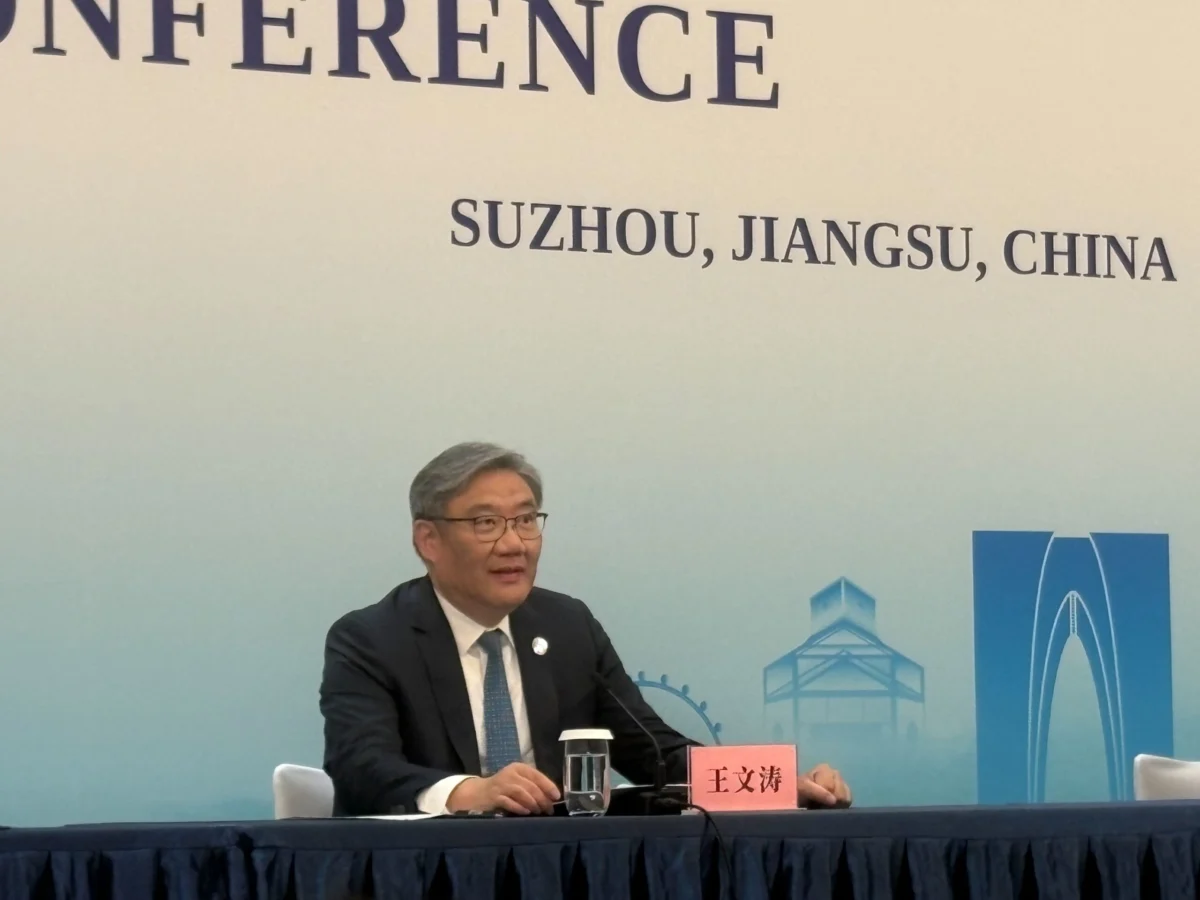
Just over a week after the U.S. and Chinese presidents met in Beijing, the world’s two largest economies are sending starkly different messages about their priorities for Asia, casting a shadow over regional economic integration efforts. These divergences were prominently highlighted at the Asia-Pacific Economic Cooperation (APEC) trade ministers’ meeting held in Suzhou, China, concluding on May 23, 2026, where China’s Commerce Minister Wang Wentao underscored Beijing’s commitment to free trade and digital cooperation, while U.S. representatives emphasized balanced trade and American technological leadership. The juxtaposition of these narratives underscores the persistent friction in the bilateral relationship, despite recent attempts at de-escalation.
A Crucial Juncture for Global Trade and Geopolitics
The APEC trade ministers’ meeting convenes amidst a complex global economic landscape, marked by supply chain disruptions, inflationary pressures, and escalating geopolitical tensions. For the Asia-Pacific region, home to some of the world’s most dynamic economies, the stance of its two largest members – the United States and China – holds immense sway over future trade architectures and investment flows. China, as the host nation for this year’s APEC meetings, culminating in a high-level leaders’ gathering in Shenzhen in November, has a vested interest in promoting a vision of open markets and regional integration, particularly through initiatives like the Free Trade Area of the Asia Pacific (FTAAP). Conversely, the U.S., under the Trump administration, has consistently prioritized domestic economic interests, advocating for "balanced trade" and scrutinizing multilateral agreements that it perceives as disadvantageous. This fundamental difference in approach was palpable throughout the Suzhou deliberations.
Divergent Paths on Tariffs and Trade Liberalization
One of the most immediate points of contention emerged around tariffs. China’s economy, a global manufacturing powerhouse, relies significantly on exports, which historically account for a substantial portion of its GDP. According to CNBC calculations based on World Bank data, China contributes approximately 28% of the goods manufactured globally. Beijing’s official readouts following the recent summit between Chinese President Xi Jinping and U.S. President Donald Trump, held in early May 2026, explicitly noted a commitment to maintaining "lower duties for longer." This statement aligns with China’s long-standing advocacy for free-flow trade, which it views as essential for its continued economic growth and global competitiveness.
In stark contrast, the U.S. White House statement regarding the same summit conspicuously omitted any mention of tariffs. This silence is indicative of the Trump administration’s continued adherence to a protectionist trade policy framework, which leverages tariffs as a tool to address perceived trade imbalances and protect domestic industries. The administration’s "America First" agenda, a cornerstone of its economic strategy, often frames trade relationships through the lens of national security and economic sovereignty, prioritizing the reduction of trade deficits over unfettered global commerce. This fundamental ideological schism on trade policy represents a significant hurdle to any comprehensive economic agreement between the two superpowers, and by extension, to broader regional trade liberalization.
The Vision of FTAAP: A Contested Regional Blueprint
On Saturday, May 24, 2026, China’s Commerce Minister Wang Wentao held a press conference at the close of the APEC trade ministers’ meeting, where he emphasized that affirming the "vision" of a Free Trade Area of the Asia Pacific (FTAAP) was a crucial outcome. "In the context of rising uncertain and destabilizing factors in global and regional economic development, members redirected their attention to the FTAAP with commitment to continuing advancing economic integration through the FTAAP agenda," Wang stated, according to an official English translation of his remarks delivered in Chinese. This declaration signaled China’s intent to propel a comprehensive regional trade agreement that would encompass all APEC members, potentially creating the world’s largest free trade zone.
The concept of FTAAP, initially proposed in 2004, aims to build upon existing regional agreements and foster deeper economic integration across the Asia-Pacific. China has consistently championed FTAAP as a mechanism to counter fragmentation and reinforce multilateral trade norms, particularly as an alternative to agreements that exclude it, such as the Comprehensive and Progressive Agreement for Trans-Pacific Partnership (CPTPP), which evolved from the Trans-Pacific Partnership (TPP) after the U.S. withdrew. For Beijing, FTAAP represents a strategic initiative to consolidate its economic influence in the region and shape the rules of global trade in a manner favorable to its interests.
However, the U.S. perspective on FTAAP appears markedly different. When CNBC questioned a member of the U.S. delegation a day prior to Wang’s remarks about FTAAP and free trade, the response pivoted to "balanced trade" – a central tenet of the Trump administration’s rationale for imposing tariffs and pursuing bilateral deals over expansive multilateral ones. Casey K. Mace, the U.S. Senior Official to the APEC Forum, described FTAAP as "more an agenda than it is a kind of destination." Mace acknowledged U.S. "activity" in elements of FTAAP, such as competitiveness, labor standards, and trade facilitation, but conspicuously avoided endorsing the overarching vision of a comprehensive free trade agreement. This U.S. position, emphasizing process and specific areas of cooperation rather than the ultimate goal of a broad free trade zone, highlights Washington’s reluctance to commit to a framework that might dilute its leverage or constrain its ability to pursue targeted bilateral trade objectives. The U.S. focus on labor standards, for instance, often serves as a means to critique the labor practices of countries like China, introducing conditions that can complicate trade negotiations. This divergence signifies a deeper philosophical divide on the future of regional economic governance, with China pushing for expansive multilateralism and the U.S. preferring a more calibrated, condition-based approach.

Navigating "Constructive Strategic Stability": An Elusive Goal
Beyond trade, the broader question of how the U.S. and China will manage their multifaceted relationship under the rubric of "constructive strategic stability" remains largely undefined. This phrase, seemingly a diplomatic effort to frame a path forward, offers little concrete detail on implementation beyond a few announced economic outcomes from the Trump-Xi summit. These outcomes notably included China’s commitment to purchasing 200 Boeing airplanes and $17 billion annually in U.S. agricultural products through 2028. While significant in their own right, these agreements represent specific transactions rather than a comprehensive framework for stability across critical domains like technology, security, or human rights.
A Chinese readout released early Saturday, May 24, 2026, detailed a meeting between Commerce Minister Wang Wentao and Rick Switzer, the U.S. Deputy Trade Representative and head of the U.S. delegation for the APEC trade ministers meeting, held on Thursday in Suzhou. The readout indicated that both sides expressed hope to reach an agreement "as soon as possible" on the specifics of the economic outcomes from the Trump-Xi meeting. This phrasing, however, serves as a subtle yet significant indication that substantive differences persist and that the implementation details are far from finalized. The lack of an immediate response from the U.S. embassy in Beijing or the U.S. State Department to requests for comment further underscores the cautious and often opaque nature of these high-level negotiations, suggesting that both sides are still navigating complex internal and external pressures. The very concept of "constructive strategic stability" implies a delicate balance, where both nations seek to manage competition without escalating into conflict, yet the specifics of how this stability will be maintained across contentious issues remain a critical unanswered question.
The Intensifying AI and Digital Trade Race
A third crucial area of divergence and intense competition emerged around technology, particularly the rapidly expanding fields of artificial intelligence (AI) and digital trade. Commerce Minister Wang Wentao announced that the APEC trade ministers’ meeting had reached a "new consensus" on digital trade cooperation. When pressed for details, Lin Feng, director-general of the Chinese Commerce Ministry’s department of international trade and economic relations, elaborated on plans to streamline operations for e-commerce companies in the region and a "commitment to strengthening trade exchanges related to AI." Lin also highlighted efforts to "narrow the digital divide," a recurring theme in China’s digital economy strategy, aimed at ensuring equitable access and development across APEC economies. However, notably absent from his remarks was any specific mention of Chinese AI companies, which operate within a global tech landscape increasingly segmented by geopolitical considerations.
This omission is significant in light of the ongoing U.S. restrictions on Chinese companies’ access to advanced semiconductors, critical components for training sophisticated AI models. These restrictions, imposed under the guise of national security, aim to curb China’s technological advancement in key strategic areas. Despite these constraints, Chinese businesses have demonstrated remarkable resilience, often releasing AI models that are cost-effective, if not free, to use, and whose capabilities are rapidly closing the gap with their U.S. rivals. This dynamic has fueled an intense technological arms race, where both nations are vying for global leadership in AI development and application.
On the U.S. side, Casey K. Mace reiterated Washington’s strategic objective "to continue to position the U.S. tech companies, digital companies, as the leaders in the region." Mace outlined plans for U.S. tech firms to conduct workshops at an APEC "digital week" scheduled for Chengdu in July. While China is the host of this event, Mace emphasized that it represents "an opportunity to engage with all 21 [APEC] economies," signaling a U.S. effort to proactively shape the digital agenda and promote American technological standards and platforms across the Asia-Pacific. This dual approach – restrictive measures on one hand and proactive engagement and promotion on the other – underscores the U.S.’s multi-pronged strategy to maintain its technological edge. The battle for dominance in AI and digital trade extends beyond economic competition; it encompasses the shaping of future global standards, ethical frameworks, and the very infrastructure of the digital economy, with profound implications for privacy, security, and international data governance.
APEC’s Enduring Role Amidst Geopolitical Crosscurrents
The Asia-Pacific Economic Cooperation forum, founded in 1989 in Australia as an informal forum for discussions on free trade and economic cooperation, now comprises 21 member economies, including mainland China, Hong Kong, and "Chinese Taipei," which joined in 1991. The U.S. is one of its 12 founding members. APEC’s historical mission has been to foster regional economic growth and prosperity through trade and investment liberalization. However, the current geopolitical climate, dominated by the U.S.-China rivalry, poses significant challenges to this mission. The diverging priorities articulated in Suzhou highlight the increasing difficulty of achieving consensus on fundamental economic principles within the forum.
As China prepares to host the culminating high-level APEC summit in Shenzhen in November, where Presidents Trump and Xi are again expected to meet, the forum finds itself at a critical juncture. Its ability to bridge these widening gaps between its two most influential members will determine its future relevance and effectiveness in promoting regional integration. The incident where Minister Wang Wentao did not comment on the "urgent official business" that prevented him from chairing the opening session on Friday, May 22, 2026, further adds to the narrative of underlying complexities and diplomatic maneuvering at play.
The implications of these persistent divergences are far-reaching. For regional economies, particularly those in Southeast Asia, the U.S.-China friction creates a challenging environment, forcing difficult choices and potentially hindering multilateral initiatives. The lack of a clear, unified vision for regional trade and digital cooperation could lead to greater economic fragmentation, increased supply chain risks, and a slowdown in investment, ultimately impacting growth across the Asia-Pacific. The Suzhou meeting thus serves as a powerful reminder that despite high-level dialogues, the fundamental competition between the U.S. and China continues to shape the global economic order, with APEC as a key arena where these profound differences are both debated and, at times, starkly revealed.
