

TEMPE – In 1981, President Ronald Reagan sought to curtail funding for children’s nutrition programs as part of a broader fiscal strategy aimed at balancing the federal budget while simultaneously reducing taxes, with a particular emphasis on the wealthy. This austerity measure placed school administrators in a precarious position, forcing them to seek cost-saving alternatives for federally subsidized school lunches. In response, the United States Department of Agriculture (USDA) put forth a proposal that would permit the classification of condiments such as ketchup and pickle relish as vegetables, a move widely criticized as a disingenuous attempt to circumvent nutritional standards.
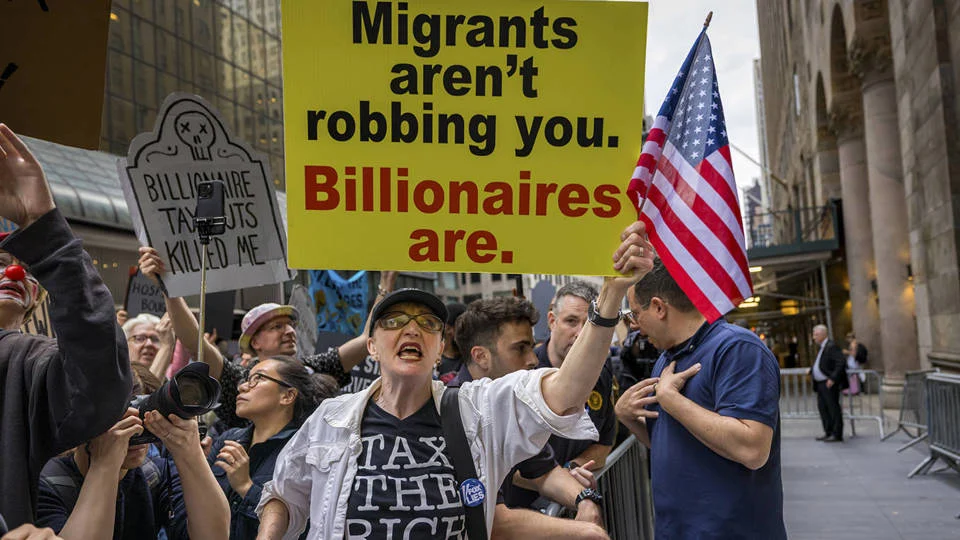
This episode, though seemingly minor in the grand scheme of economic policy, serves as a potent historical marker, illustrating a persistent ideological undercurrent in American fiscal policy: the prioritization of tax cuts for the affluent, often at the expense of essential social programs and the economic well-being of ordinary citizens. The current economic climate, where 55% of Americans report a deteriorating financial situation while the wealth of the top 1% continues to ascend to unprecedented heights, casts this historical parallel in stark relief. The assertion that taxing billionaires constitutes an "oppressive" burden is not only factually inaccurate but also a politically expedient narrative that distracts from the widening chasm of economic inequality.
The Widening Chasm: American Financial Realities in 2026
As of May 21, 2026, a significant majority of the American populace finds itself navigating an increasingly challenging economic landscape. Surveys consistently indicate a pervasive sense of financial insecurity, with reports from various economic think tanks and polling organizations highlighting a stark divergence between the lived experiences of the majority and the financial fortunes of the ultra-wealthy. Data from the Federal Reserve’s latest Survey of Consumer Finances reveals that the bottom 50% of American households hold less than 2% of the nation’s total wealth, a figure that has remained stubbornly low for decades. Conversely, the top 1% now controls an estimated 35% of national wealth, a record high since the Gilded Age.
This disparity is not merely a matter of abstract statistics; it translates into tangible consequences for everyday Americans. Rising costs of living, stagnant wage growth for many middle and lower-income earners, and the increasing burden of healthcare and education expenses contribute to the widespread sentiment of financial deterioration. The dream of upward mobility, a cornerstone of the American ethos, appears increasingly out of reach for a substantial segment of the population.
Historical Precedents: The Reagan Era and the Shifting Tax Landscape
The early 1980s marked a significant turning point in American fiscal policy, characterized by the "Reaganomics" doctrine, which championed supply-side economics. Central to this philosophy were substantial tax cuts, particularly for corporations and high-income individuals, with the theoretical promise of stimulating economic growth through investment and job creation. The proposed reclassification of condiments as vegetables in school lunch programs, while a specific and perhaps absurd example, symbolized a broader willingness to compromise on social welfare to achieve fiscal objectives that disproportionately benefited the wealthy.
The Economic Recovery Tax Act of 1981, a cornerstone of Reagan’s economic agenda, significantly reduced marginal income tax rates across the board, with the highest rate dropping from 70% to 50%. Subsequent tax cuts in 1986 further lowered top rates to 28%. While proponents argued these measures spurred economic expansion, critics pointed to a concurrent surge in income inequality and a growing national debt. Decades later, the trend of tax reductions for the wealthiest has continued, albeit with varying degrees of intensity and political rhetoric. The Tax Cuts and Jobs Act of 2017, for instance, implemented significant corporate tax reductions and adjustments to individual income tax rates, which analysis by the Congressional Budget Office indicated would primarily benefit higher earners and exacerbate the national debt.
The Economics of Wealth Accumulation and Taxation
The argument that taxing billionaires is "oppressive" often hinges on the idea that such individuals are job creators and that their wealth is best left in their hands for reinvestment. However, a closer examination of economic data reveals a more complex reality. While large corporations and wealthy individuals do invest, the rate and nature of this investment do not always directly translate into widespread economic benefit for the majority. Furthermore, the concept of "wealth" itself is often misunderstood. It is not simply income earned in a year, but the accumulated assets—stocks, bonds, real estate, and other investments—that generate further income and appreciation.
Economists like Thomas Piketty have extensively documented the historical trend of capital accumulation outpacing economic growth, leading to an ever-increasing concentration of wealth. This phenomenon, termed "r > g" (rate of return on capital is greater than the rate of economic growth), suggests that inherited wealth and investments tend to grow at a faster pace than wages earned through labor, thus perpetuating and amplifying inequality.
From a policy perspective, progressive taxation—where higher earners pay a larger percentage of their income in taxes—is a widely accepted mechanism for funding public services and mitigating extreme wealth disparities. The effective tax rates paid by billionaires, when considering all forms of income and capital gains, are often significantly lower than the statutory rates due to various loopholes, deductions, and the preferential treatment of capital gains. Proposals to increase taxes on the ultra-wealthy, such as wealth taxes or higher capital gains taxes, are designed to address this imbalance and generate revenue for public investments in infrastructure, education, healthcare, and social safety nets.
Voices from the Economic Frontlines
The economic anxieties expressed by 55% of Americans are not mere abstract concerns. They are rooted in the daily struggles of making ends meet, saving for retirement, and providing for families. Consider the perspective of a small business owner in a struggling urban area, who might see their local economy stagnating due to a lack of consumer spending power. They might observe that while national economic indicators might show growth, this growth is not trickling down to their community.
Conversely, the proponents of minimal taxation for the wealthy often cite the need to maintain a competitive global environment for capital. They argue that high taxes can drive investment and entrepreneurial talent away from a country. Think tanks funded by business interests frequently publish reports detailing the potential negative impacts of increased taxation on job creation and economic growth. For instance, a hypothetical analysis from a conservative economic institute might project a decrease in foreign direct investment if a wealth tax were implemented, leading to job losses in specific sectors.
However, the counterargument, often articulated by progressive economists and advocacy groups, emphasizes that the current system allows for extreme wealth accumulation that does not necessarily correlate with broader societal prosperity. They point to nations with robust social safety nets and higher levels of taxation on the wealthy that still maintain strong economies and high standards of living. The debate often centers on the definition of "fairness" in the tax system and the optimal balance between private wealth accumulation and public investment.
Policy Implications and Broader Societal Impact
The persistent debate over taxing the wealthy has profound implications for the future of American society. If current trends of wealth concentration continue unabated, the social and economic fabric of the nation could face significant strain. Increased inequality can lead to social unrest, political polarization, and a decline in overall public health and well-being.
The "politically convenient nonsense" of defending billionaires from "oppressive" taxation serves to deflect attention from substantive policy discussions about wealth distribution, tax fairness, and the role of government in ensuring a more equitable economy. The historical parallel of the Reagan era, where fiscal austerity measures impacted vulnerable populations while benefiting the affluent, serves as a cautionary tale.
Looking ahead, the economic trajectory of the United States will be shaped by the policy choices made regarding taxation, social spending, and wealth regulation. The sentiment of financial deterioration among a majority of Americans suggests a growing demand for policies that address inequality and promote broader economic security. The challenge for policymakers will be to navigate these competing interests and craft solutions that foster sustainable economic growth while ensuring a more just and equitable distribution of wealth and opportunity. The question of whether the nation will continue to prioritize the accumulation of wealth at the very top or invest in the well-being of its entire citizenry remains a central and pressing issue of our time.
