

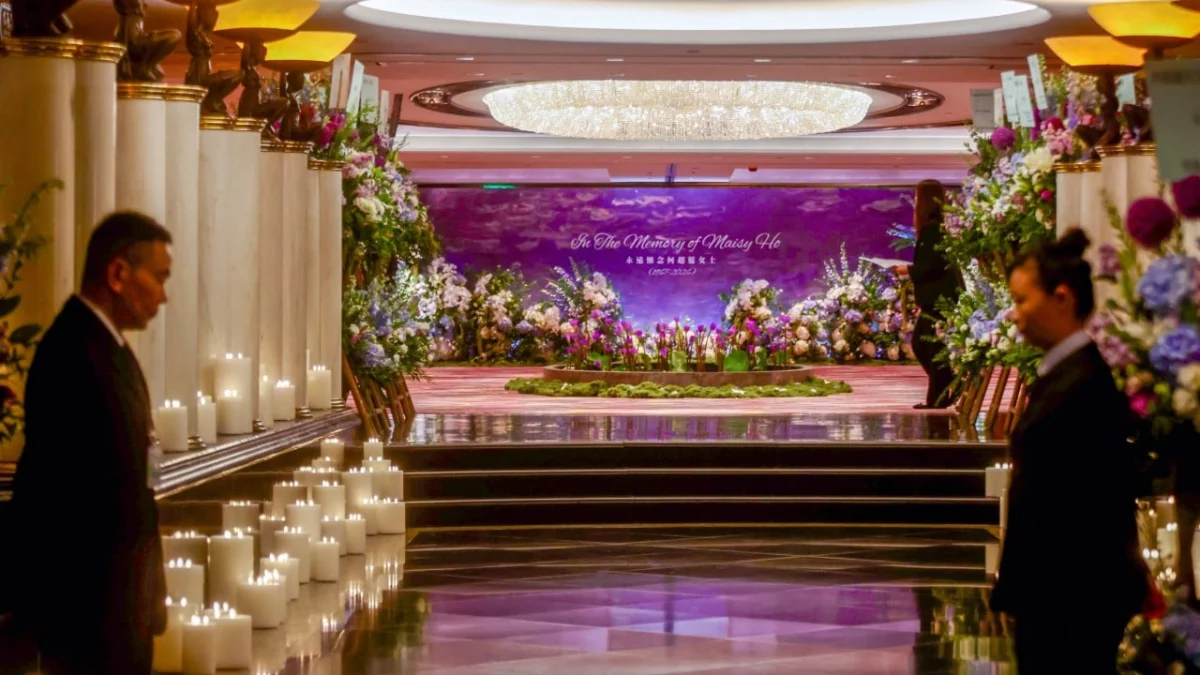
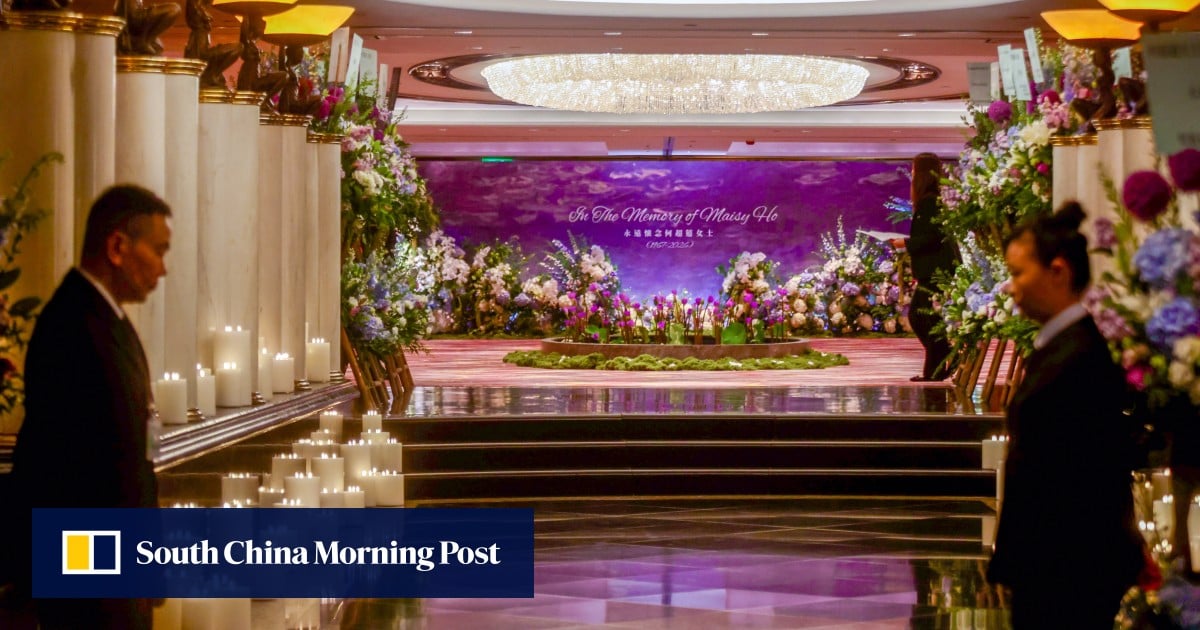
The grand ballroom of the Grand Hyatt in Wan Chai became a focal point of reflection and remembrance on Sunday as hundreds of Hong Kong’s most influential figures gathered to honor the life and legacy of Maisy Ho Chiu-ha. The memorial service for the executive director of Shun Tak Holdings and daughter of the late gaming magnate Stanley Ho Hung-sun drew a vast cross-section of society, from high-ranking government officials to titans of industry and stars of the entertainment world. Ho, who passed away on April 12 at the age of 58, was remembered not only as a pivotal figure in one of Asia’s most prominent business dynasties but also as a dedicated philanthropist who preferred to work away from the glare of the public eye.
The atmosphere inside the ballroom was one of somber elegance. Mourners, unified in black attire, moved through a space transformed by a monumental floral display. At the center of the room stood a large, vibrant portrait of Maisy Ho, capturing her in a characteristic moment of warmth; she was pictured smiling and wearing a red top, a choice that many attendees noted reflected her spirited nature and positive outlook. The portrait was framed by an expansive arrangement of white and pastel-colored hydrangeas, peonies, lilies, and orchids. Directly in front of the image were four heart-shaped wreaths, sent by her immediate siblings: her eldest sister Pansy Ho Chiu-king, second sister Daisy Ho Chiu-fung, younger sister Josie Ho Chiu-yi, and her brother Lawrence Ho Yau-lung. These tributes served as a poignant reminder of the close-knit bond within the "Second House" of the Ho family, a group that has remained central to the management of the late Stanley Ho’s multibillion-dollar empire.
A Gathering of Hong Kong’s Power Elite
The sheer scale of the attendance underscored Maisy Ho’s extensive influence and the respect she commanded across various sectors. Among the first to arrive was Financial Secretary Paul Chan Mo-po, whose presence highlighted the Ho family’s enduring significance to the economic fabric of Hong Kong and Macau. He was joined by a succession of prominent political figures, legislative councilors, and former government officials, many of whom had collaborated with Ho during her years of public service and charitable leadership.
The business community was equally well-represented. Executives from the city’s major conglomerates, banking institutions, and real estate firms lined the room, standing alongside figures from the arts and entertainment industry—a sector where her sister, Josie Ho, is a well-known figure. The walls of the ballroom were lined with hundreds of flower stands and scrolls of condolence, featuring names that read like a directory of the region’s elite. These tributes collectively spoke to a woman who, despite her high-profile lineage, was described by colleagues as "approachable," "meticulous," and "deeply committed to the welfare of the community."
The Professional Legacy at Shun Tak Holdings
While her father, Stanley Ho, was the visionary who built the foundation of modern Macau, Maisy Ho played a critical, albeit more understated, role in modernizing and sustaining the family’s corporate interests. As an executive director of Shun Tak Holdings, she was a key player in a conglomerate with diversified interests spanning property development, transportation, hospitality, and investments.
Shun Tak Holdings has long been a cornerstone of the Pearl River Delta’s infrastructure, most notably through its operation of the TurboJET ferry service, which for decades was the primary artery connecting Hong Kong and Macau. During her tenure, Maisy Ho was instrumental in overseeing various property and hospitality projects. Her professional approach was characterized by a focus on long-term stability and institutional growth. Analysts often noted that while her siblings Pansy and Daisy took more public-facing roles in the gaming and high-level corporate strategy sectors, Maisy’s work within the internal structures of Shun Tak provided the operational continuity essential for a legacy firm.
Her death at 58 came as a shock to many in the business world. Although her siblings announced her passing shortly after April 12, the family maintained a characteristic level of privacy regarding the specific cause of death. This privacy was respected by the attendees at Sunday’s service, who focused instead on celebrating her three decades of contribution to the Hong Kong corporate landscape.
A Life Defined by Philanthropy: The Tung Wah Group of Hospitals
Perhaps the most enduring aspect of Maisy Ho’s legacy, and a recurring theme in the eulogies and tributes shared at the service, was her devotion to charitable work. She was most closely associated with the Tung Wah Group of Hospitals (TWGHs), Hong Kong’s oldest and largest charitable organization.
Ho’s involvement with TWGHs was not merely titular. She climbed the ranks of the organization’s leadership, eventually serving as the Chairwoman of the Board of Directors for the 2015/2016 term. During her leadership, she oversaw a vast network of medical, educational, and community services. Her tenure was marked by a push for modernization in healthcare delivery and an expansion of youth development programs.
"She did not just sign checks; she showed up," noted one long-time volunteer at the service. "Maisy was known for visiting elderly centers and schools without any media presence. She wanted to understand the ground-level challenges of the people Tung Wah served." This commitment earned her the Bronze Bauhinia Star (BBS) from the Hong Kong government, an honor bestowed in recognition of her significant contribution to social services and her leadership in the charitable sector.
Chronology of a Dedicated Life
To understand the impact of Maisy Ho, one must look at the timeline of her development alongside the evolution of Hong Kong itself:
- 1967: Born in Hong Kong to Stanley Ho and his second wife, Lucina Laam King-ying.
- 1980s-1990s: Pursued higher education in North America, earning a Bachelor of Arts degree in Mass Communication and a Bachelor of Fine Arts degree from the University of Toronto. This international education informed her global perspective on business and governance.
- Late 1990s: Joined the family business, beginning her long-term tenure at Shun Tak Holdings.
- 2000s: Expanded her portfolio into public service, joining various government advisory boards and beginning her ascent within the Tung Wah Group of Hospitals.
- 2015: Appointed as the 146th Chairperson of the Tung Wah Group of Hospitals, becoming a leading voice in Hong Kong’s philanthropic community.
- 2020: The passing of her father, Stanley Ho, at the age of 98, marking a transition period for the family empire in which Maisy played a stabilizing role.
- April 12, 2026: Passed away at the age of 58, leaving behind a legacy of corporate and social service.
- May 17, 2026: A public memorial service held at the Grand Hyatt, attended by the city’s leadership.
Corporate and Social Implications of Her Passing
The passing of Maisy Ho carries implications for both the Ho family’s business empire and the charitable landscape of Hong Kong. Within Shun Tak Holdings, her departure marks the loss of a seasoned executive who understood the intricate balance between family traditions and modern corporate governance. While the company remains under the firm leadership of her sisters Pansy and Daisy, the loss of Maisy’s operational oversight will necessitate a redistribution of responsibilities among the remaining board members.
From a social perspective, her death leaves a void in the philanthropic community. Ho was a bridge between the traditional "old money" circles of Hong Kong and contemporary social enterprises. Her ability to leverage her family’s resources for systematic social improvement set a benchmark for other second- and third-generation members of Hong Kong’s wealthy elite.
The presence of figures like Paul Chan at her memorial indicates the government’s recognition of the "Ho siblings" as more than just business owners; they are viewed as stakeholders in the city’s stability and development. As the family navigates this period of mourning, the unity displayed by the siblings at the memorial suggests a continued commitment to the collective management of their father’s sprawling legacy.
Final Reflections on a Low-Profile Pillar
As the memorial service concluded on Sunday evening, the consensus among those departing the Grand Hyatt was clear: Maisy Ho Chiu-ha was a woman who defined herself not by her surname, but by her service. In a city where the lives of the "super-rich" are often chronicled in gossip columns, Ho remained a figure of dignity and discretion.
Her choice to be remembered through a portrait in a red top—symbolizing life, energy, and joy—offered a final message of resilience to her family and the city she served. While her siblings continue to lead the family’s commercial interests in the competitive gaming and real estate markets, Maisy Ho’s legacy will likely be most visible in the hospitals, schools, and community centers that she championed.
The sea of flowers that filled the Grand Hyatt ballroom will eventually be cleared, but the structural contributions Maisy Ho made to Hong Kong’s social welfare system and the operational integrity of Shun Tak Holdings remain. For a woman who spent much of her life avoiding the spotlight, the massive turnout at her memorial was a final, undeniable testament to the quiet power of her influence. In the history of the Ho family, she will be remembered as the pillar who supported the structure from within, ensuring that the family’s vast resources were used not just for growth, but for the betterment of the society that made their success possible.
