

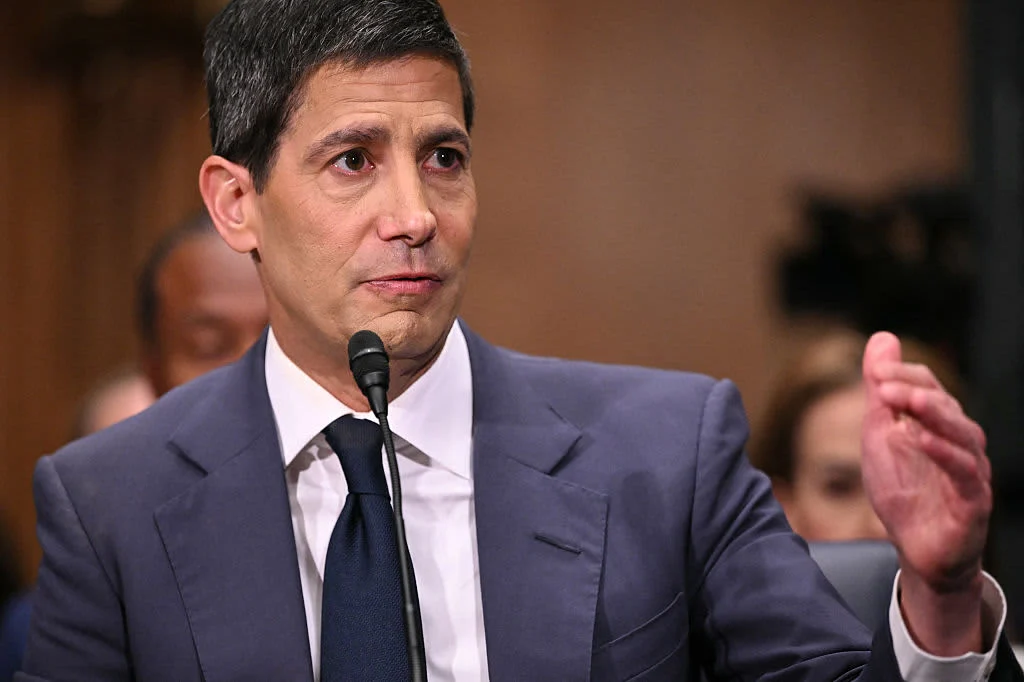
If newly confirmed Federal Reserve Chair Kevin Warsh is still itching for a "good family fight" over monetary policy, he is likely to find himself in the thick of one as he navigates a central bank increasingly at odds with his long-held convictions regarding interest rate cuts. Sworn in following a contentious Senate confirmation process, Warsh takes the helm of the world’s most influential central bank at a moment of profound economic uncertainty, marked by spiking inflation, surging Treasury yields, and a Federal Open Market Committee (FOMC) showing little appetite for easing monetary conditions.
A Challenging Economic Landscape
The economic backdrop against which Chair Warsh begins his tenure is anything but tranquil. Inflation, the primary and most pressing policy challenge, has soared to multi-year highs, with economic forecasters projecting a peak of 6% in the second quarter of 2026. This surge is attributed to a complex interplay of factors, including persistent supply chain disruptions exacerbated by ongoing geopolitical tensions—specifically, the fighting in Iran—which have driven up energy prices and commodity costs. Additionally, robust consumer demand, fueled by accommodative fiscal policies, has outstripped supply in several sectors, contributing to broad-based price pressures.
Correspondingly, Treasury yields have surged across the curve, reflecting heightened market expectations of sustained inflation and the anticipation of a more hawkish Fed stance. The yield on the benchmark 10-year Treasury note, for instance, has climbed above 4.5%, a level not seen in over a decade, signaling investor demand for higher compensation for holding government debt amidst inflationary erosion. This rise in borrowing costs presents a significant headwind for economic growth and complicates the Fed’s balancing act between price stability and maximum employment.
Chair Warsh, echoing much of the Trump administration’s position, has publicly articulated a belief that the current run of price surges is largely temporary, an transitory phenomenon that will fade once the conflict in Iran subsides and powerful disinflationary forces, such as increased productivity and technological advancements, reassert themselves. However, these arguments face a considerably tougher audience now, both within the FOMC and among external economic observers, given the breadth and persistence of the inflationary surge.

Warsh’s Background and the Road to the Chair
Kevin Warsh’s journey to the Federal Reserve Chairmanship has been marked by a distinctive career path and a consistent public voice on monetary policy. A former Fed governor from 2006 to 2011 during a period that encompassed the global financial crisis, Warsh gained firsthand experience in crisis management and unconventional monetary policy. However, he subsequently became a vocal critic of the Fed’s aggressive quantitative easing (QE) programs and its perceived expansion of its mandate beyond traditional price stability and full employment objectives. His public disagreements with the Fed’s post-crisis policies, often expressed through op-eds and media appearances, established him as a prominent figure advocating for a more streamlined and less interventionist central bank.
President Donald Trump nominated Warsh for the position in January 2026, succeeding Jerome Powell. The nomination came with clear expectations from the White House: a desire for lower interest rates to stimulate economic growth, a stance consistently championed by President Trump throughout his political career. Warsh’s Senate confirmation hearing on April 21, 2026, on Capitol Hill in Washington, D.C., was closely watched, not least for his "family fight" remarks, which, along with other critical comments about the Fed, central bank observers privately suggest could come back to haunt him as he seeks to build consensus.
The relationship between the White House and the Federal Reserve has been historically fraught, particularly during the Trump presidency. The previous Chair, Jerome Powell, endured frequent public criticism and personal attacks from President Trump over the Fed’s interest rate decisions, leading to an unprecedented level of discord between the administration and the central bank. This historical context casts a long shadow over Warsh’s arrival, raising questions about his ability to maintain the Fed’s crucial independence while navigating overt political pressure.
A Divided Federal Open Market Committee
Warsh’s challenge is compounded by the evident divisions within the FOMC. At the most recent policy meeting in late April 2026, three members of the central bank’s rate-setting arm cast dissenting votes against the official policy statement. The point of contention revolved around a single sentence in the communiqué that investors widely interpreted as hinting that the Fed’s next move would be an interest rate cut: "In considering the extent and timing of additional adjustments to the target range for the federal funds rate, the Committee will carefully assess incoming data, the evolving outlook, and the balance of risks."

This subtle linguistic cue sparked significant debate, underscoring a palpable split between those who believe the Fed should prepare for easing and a more numerous faction convinced that the current inflationary environment demands a continued hawkish posture, or at least the explicit optionality for further rate hikes. Indeed, several officials have recently stressed the imperative for the Fed to keep its options open for potential rate increases, signaling a reluctance to commit to a dovish path.
Outgoing Governor Stephen Miran, who departs the board with Warsh’s arrival, had been a prominent voice advocating for rate reductions. His role as a "lone wolf howling for reductions" highlights the isolation Warsh might face if he persists in pushing for cuts in the current climate. Miran, in a Bloomberg News interview, noted that while he voted against rate decisions at all six meetings he attended, other officials "started to respond" to his contrarian arguments, though "it takes time." This suggests a committee that, while potentially open to arguments, is not easily swayed without compelling data.
The Quest for Consensus and Communication Challenges
Loretta Mester, former Cleveland Fed President who served with Warsh during his prior stint as a governor, emphasized the importance of consensus within the FOMC. "I saw him in action. He does base his decisions on his view of the economy, and even his arguments for why he would favor rate decreases in general were based on his read of what’s happening structurally in the economy," Mester said. "I just don’t think right now he can make those arguments in a credible way, because we have an inflation problem."
Mester further elaborated on the operational realities of the FOMC, dispelling the perception that officials enter the meeting room to hash out positions from scratch. "Chair Powell and the chairs before him, Ben [Bernanke] and Janet [Yellen], they both made a point of calling each participant right before the meeting so they would know where people are," she explained. "The driving towards consensus is part and parcel of the setup of the FOMC." This underscores that a Fed chair’s role is less about dictating policy and more about skillfully guiding the committee toward a shared understanding and decision. Publicly dissenting from the committee’s decision, or attempting to push for a widely unpopular stance, would severely undermine the Chair’s credibility and authority.
Beyond the immediate interest rate debate, Warsh faces significant communications challenges, stemming from his past criticisms of modern Fed practices. He has previously spoken out against explicit "forward guidance," the Fed’s "dot plot" of individual officials’ rate expectations, and even expressed misgivings about hosting news conferences after each FOMC meeting – a practice initiated by former Chair Powell that deviated from the prior quarterly schedule. If Warsh were to attempt to roll back these communication tools, it could introduce further uncertainty into financial markets, which have grown accustomed to the Fed’s enhanced transparency.

Initial Moves and Broader Implications
Despite the formidable headwinds, some analysts believe Warsh could quickly put his imprint on the Fed. Lou Crandall, chief economist at Wrightson ICAP and a leading voice in internal Fed machinations, suggests Warsh could capitalize on the recent dissent to his advantage. "You get plenty of contrarian thinking in there. Kevin Warsh is a very fortunate man in his experience. Family fights generally lead to constructive outcomes," Crandall noted.
Warsh’s immediate tactical move might involve rallying the FOMC to remove the contentious sentence from the policy statement that hinted at future cuts. "On the one hand, he can present this as not a tightening signal, just a shift to more agnostic communications framework," Crandall added. "There is a PR element that would be helpful to him. He doesn’t have to say that the committee forced his hand in his first meeting to go to an effectively more restrictive stance." By doing so, Warsh could further his oft-stated disdain for prescriptive "forward guidance" while simultaneously uniting the panel around a common objective: preserving optionality for future monetary policy adjustments, be they cuts or hikes.
However, Warsh’s problems would be far from over. The fundamental tension between his personal inclination towards lower rates and the committee’s current hawkish tilt, driven by persistent inflation, remains. Should he fail to deliver the lower interest rates expected by President Trump, it could reignite the kind of perpetual clash that defined the Trump-Powell relationship, potentially involving renewed political attacks and further questions about the Fed’s independence.
Bill English, former head of monetary affairs at the Fed and now a professor at Yale, who served with Warsh, remains optimistic about Warsh’s collaborative capabilities. He deemed Warsh "good at working with people, and I think he’ll try to find a reasonable consensus" among the myriad issues ahead. "At least from what I saw years ago when he was a governor, he just doesn’t seem like the sort of guy who’s going to want to pick a fight with the committee," English said. "My guess is he’s going to want to continue to be a chair who’s going to try to find consensus and move the committee over time with arguments and with data."
The coming months will be a critical test for Chair Warsh. His leadership will determine not only the immediate trajectory of U.S. monetary policy but also the long-term credibility and independence of the Federal Reserve in an increasingly complex and politically charged global economic environment. His ability to bridge internal divisions, manage external pressures, and credibly address the nation’s inflation challenge will define his early tenure and shape the future of central banking.
