

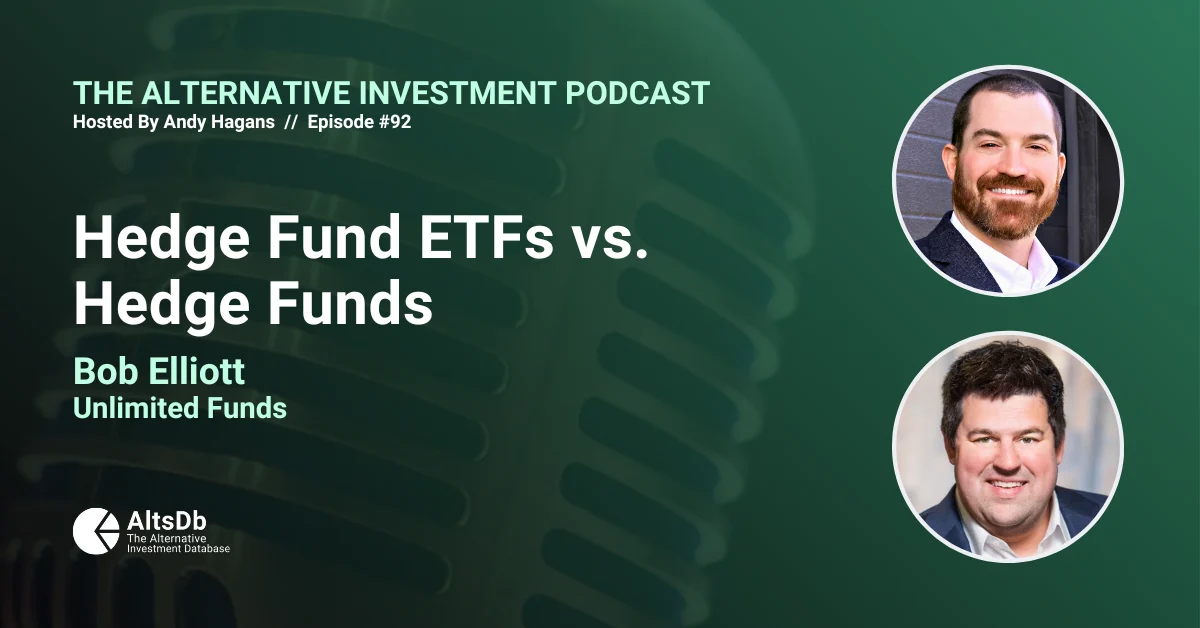
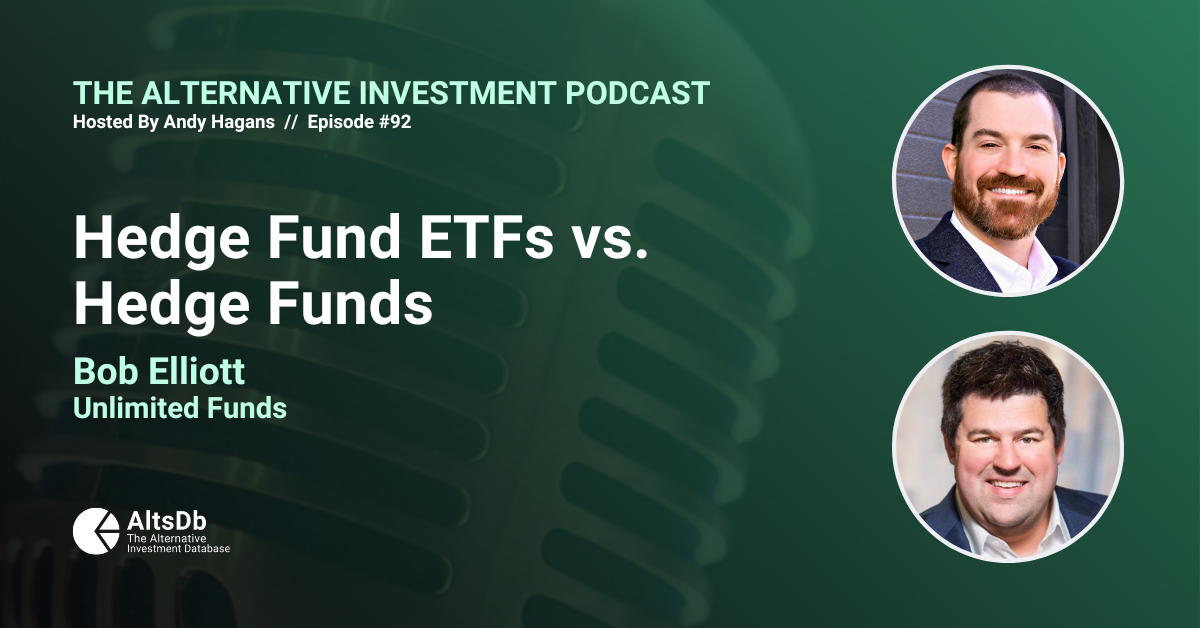
Leading hedge funds have long been recognized for their potential to generate substantial returns for investors, a feat achieved through active management. However, this sophisticated approach typically comes with a significant price tag in terms of fees and accessibility. Bob Elliott, CEO of Unlimited Funds, recently joined "The Alternative Investment Podcast" to discuss his firm’s innovative strategy, embodied in the HFND ETF, and to articulate why he believes alternative ETFs could potentially outperform traditional hedge funds, even after accounting for fees. This conversation offers a critical look at the evolving landscape of alternative investments, particularly for sophisticated investors seeking diversified, cost-effective exposure to hedge fund-like returns.
The Allure and Accessibility of Hedge Funds
The term "hedge fund" often evokes an image of an exclusive club, a realm of high finance accessible only to a select few. While this perception holds some truth, the industry has seen shifts in accessibility over the past two decades. Bob Elliott, with his extensive background, including a nearly 15-year tenure at Bridgewater Associates, brings a unique perspective to this complex world. He began his career at Bridgewater when it was a challenger in the asset management space, learning to apply systematic and rigorous approaches to macro investing, a field traditionally dominated by intuitive savants.
"Bridgewater’s real innovation in that space was bringing the sort of rigorous and systematic approaches that had existed for a long time in things like equity long-short, and areas like that, and bringing that understanding into the macro space," Elliott explained. He detailed how, from a few billion under management and a small team, Bridgewater grew into a global financial powerhouse, a journey that provided him with a deep understanding of various asset classes, systematic strategies, and the foundational principles of gaining an edge in investing.
Elliott’s own path to Bridgewater was unconventional, eschewing a traditional finance background for a degree in botany. This interdisciplinary approach, he suggests, fostered a unique way of understanding complex systems, a skill he found directly applicable to macroeconomics and investing. He viewed his early days at Bridgewater not just as a job, but as a "paid master’s degree" in understanding the intricate workings of the global economy and financial markets.
Decoding Macroeconomic Linkages and Systematic Investing
The conversation delved into the often-elusive nature of macroeconomic understanding. Elliott posited that real-world macroeconomics operates quite differently from academic textbook models. The key, he argued, lies in identifying intuitive cause-and-effect drivers within asset classes and then quantifying these linkages. For instance, a simple linkage exists between inflation exceeding expectations and rising bond yields. The real sophistication comes in quantifying the pressures on inflation relative to what is already priced into the bond market.
Systematization, in this context, is the process of quantifying these intuitions and applying them with unwavering discipline. For discretionary investors, incremental market information can lead to overreaction or underreaction, disrupting their strategies. Systematic investing, by contrast, offers discipline, helps synthesize vast amounts of information, and ensures execution according to a predefined plan.
Elliott drew an analogy to a blackjack player: even the best players are wrong about 45% of the time. However, if that slight edge (55% win rate) is applied consistently across hundreds of markets, it can lead to exceptional long-term performance. This probabilistic approach underscores the inherent uncertainty in investing and the importance of a disciplined framework.
The Nuances of Market Reactions and Predictive Modeling
The discussion touched upon the complexity of predicting market reactions, acknowledging that for every action, there are subsequent reactions. Elliott clarified that the goal of systematic macro investing isn’t perfect prediction, but rather to gain an edge in anticipating the actions of market participants. This involves understanding their motivations, access to resources, and decision-making frameworks.
He highlighted how the Federal Reserve’s actions, for example, are often driven by incoming data and a constrained set of decision rules. By analyzing basic inputs like growth and inflation, and understanding the central bank’s levers, one can predict their behavior more effectively than by solely relying on their forward-looking statements. This insight suggests that even complex policy decisions can be modeled and understood through systematic analysis.
Alternative Strategies: A Compelling Intellectual Pursuit
Elliott’s passion for "alternative strategies" stems from the intellectual challenge of understanding complex systems, much like dissecting a biological system in his scientific background. He views markets and economies as intricate systems in which individuals are both participants and observers. Investment strategies, in this light, are expressions of one’s understanding of how the market perceives the world, and where that perception might diverge from reality.
"What investment strategies are, are ways in which you can express your understanding relative to how the rest of the market understands the world because that’s essentially what’s priced in," Elliott explained. Success in this arena demonstrates superior understanding, while failure offers valuable learning opportunities. The probabilistic nature of macro investing, where even the best are wrong 45% of the time, ensures a continuous learning process, making it an intellectually enriching career. This continuous learning is why many prominent macro investors remain active well into their later years.
The Mechanics of Hedge Fund Investing
When discussing hedge funds, the concept of "bets" is central. Each trade is a calculated risk with an expected payoff if correct and a potential loss if incorrect. This emphasizes the inherent uncertainty and the need to consider not just the probability of an outcome, but also how that probability is priced into the market. Mispricing, whether driven by emotion (like a passionate sports fan betting on a team) or by a collective misunderstanding of odds, presents opportunities for alpha.
Hedge funds express these views through a wide array of financial instruments, including futures, swaps, options, and direct trading of cash securities. The flexibility to operate across various assets and take both long and short positions is a hallmark of hedge fund strategies.
The Bifurcation of the Hedge Fund Industry and Investor Access
Traditionally, hedge funds were primarily accessible to large institutional investors like pension funds and sovereign wealth funds. However, over the last two decades, platforms have emerged to make these investments more accessible to smaller-scale investors. Elliott cautioned that this increased accessibility doesn’t necessarily equate to access to the most sophisticated or successful funds.
He described a "bifurcation" in the industry: the top-tier, highly successful funds often exclusively accept institutional capital because they prefer managing fewer, larger relationships. This can lead to a negative selection problem for individual investors or smaller family offices, who may only gain access to less-proven strategies. Furthermore, the most sought-after funds may even be closed to new institutional investors due to capacity constraints.
Hedge Fund Performance in 2022: A Year of Defense
The performance of hedge funds in 2022, a year marked by significant drawdowns in traditional 60/40 portfolios, has been a subject of considerable discussion. While the broader alternative investment landscape, including managed futures which saw gains of around 20%, largely lived up to its promise, hedge funds as a whole also demonstrated resilience.
Elliott noted that the aggregate hedge fund industry, encompassing various strategies like managed futures, equity long-short, and global macro, performed well in a challenging market. Before fees, hedge funds were largely flat or down by only a few percentage points, a stark contrast to the 15-20% decline in the 60/40 portfolio. Even equity long-short strategies, which some media outlets have criticized, delivered significant alpha relative to passive equity benchmarks.
"Hedge funds in these sorts of difficult market environments, they’re very good at preserving capital in general," Elliott stated. They achieve this by reducing risk, lowering beta exposures, and identifying value opportunities. This defensive posture was a key theme in his analysis of 2022 performance, highlighting the strategies’ effectiveness in capital preservation. He emphasized the importance of analyzing gross returns to understand the underlying strategy’s strength before factoring in fees.
Introducing HFND: A New Paradigm in Alternative ETFs
Despite the strategic effectiveness of hedge funds, several pain points persist for many investors, particularly those outside the institutional sphere. High fees, typically ranging from 300 to 400 basis points annually, erode returns. Tax inefficiencies inherent in traditional Limited Partnership (LP) structures, where gains are often taxed at marginal income rates, further diminish net returns. Diversification can also be a challenge for smaller investors, who may not have the capital to invest in a sufficiently broad range of funds, leading to layered fees if investing through funds-of-funds. Finally, the administrative burden of paperwork, including K-1s, presents a significant hurdle.
To address these issues, Unlimited Funds launched the HFND ETF (Unlimited HFND Multi-Strategy Return Tracker ETF). This actively managed ETF aims to replicate the gross-of-fees return characteristics of the hedge fund industry while offering significantly lower expenses and improved tax efficiency.
"What we thought was, was there a way to bring the kind of low-cost diversified indexing approach, which has obviously totally changed stock and bond investing, right? Was there a way to sort of take that concept and apply it to the world of two and 20?" Elliott asked, referring to the typical hedge fund fee structure.
The HFND ETF leverages proprietary hedge fund strategies developed by Elliott and his partner, Bruce, combined with modern machine learning techniques. This technology allows the fund to monitor hedge fund managers’ positions in near real-time, translating that understanding into long and short positions in various index products. The goal is to create a portfolio that mirrors the risk-return profile of the hedge fund industry’s gross returns, packaged in an accessible ETF wrapper.
The Technological Edge: Machine Learning and Cost Efficiency
By employing technology and a systematic replication approach, HFND aims to offer its strategy at a fraction of the management fee charged by traditional hedge funds—approximately a quarter of the cost. Furthermore, its ETF structure provides superior tax efficiency compared to traditional LP structures.
"If we can do a pretty good job of replicating that and then offer it at, you know, a lower management fee and a more tax-efficient structure, the end result that the investor sees… the end investor sees a much more consistent return stream and a higher return net of fees and taxes," Elliott explained. The fund also offers liquidity and eliminates minimum investment requirements, allowing investors to buy as little as one share.
This approach positions HFND as a potential "hedge fund for the little guy," democratizing access to sophisticated investment strategies. The use of machine learning signifies a potential revolution in how hedge fund strategies are implemented, driving down costs and increasing efficiency.
The Evolving Landscape of Alternative ETFs
The rise of actively managed ETFs, particularly in the alternative strategies space, marks a significant evolution in the investment landscape. While early iterations of actively managed ETFs faced skepticism, the current wave, including products like HFND, is gaining traction. Regulatory changes, such as those implemented around 2020-2021, have enabled managers to run more sophisticated strategies within the ETF wrapper, provided they implement robust risk controls.
Elliott believes the ETF structure itself is inherently investor-friendly due to its liquidity, transparency, tax efficiency, and ease of execution. As investors and financial advisors increasingly demand investor-centric products, sophisticated strategies are migrating into this format. This shift benefits investors by providing access to diversified, consistent, and lower-cost investment options.
The Future of Hedge Fund ETFs vs. Traditional Hedge Funds
Looking ahead, Elliott anticipates a rationalization of fees across the investment management industry. In an era of potentially lower overall market returns, the skill of an investor relative to their fees will come under intense scrutiny. He foresees a bifurcation in the hedge fund industry: a small segment of highly sophisticated managers who genuinely generate unique alpha and warrant their fees, and the larger portion of the industry that may not.
For investors who are not among the world’s largest institutions, accessing the top-tier hedge funds remains challenging. Consequently, capital is likely to flow towards innovative products like HFND that replicate hedge fund strategies at a significantly lower cost and with greater tax efficiency. This trend promises to benefit investors by providing access to sophisticated strategies in a more diversified, consistent, and cost-effective manner than has been previously possible.
"Increasingly we’re gonna see a bifurcation between, you know, money’s gonna go as much as can to the best most sophisticated managers. And then I suspect we’re gonna see a lot of capital flow into these increasingly sophisticated replication strategies put in structures like ETFs," Elliott concluded. This evolution represents a significant step forward in democratizing access to advanced investment strategies and ensuring that investors receive greater value.
For those seeking to learn more about Unlimited Funds and the HFND ETF, the company website, unlimitedfunds.com, offers detailed information and commentary. Bob Elliott also actively shares his insights on macroeconomics and market trends via his Twitter handle, @BobEUnlimited.
