

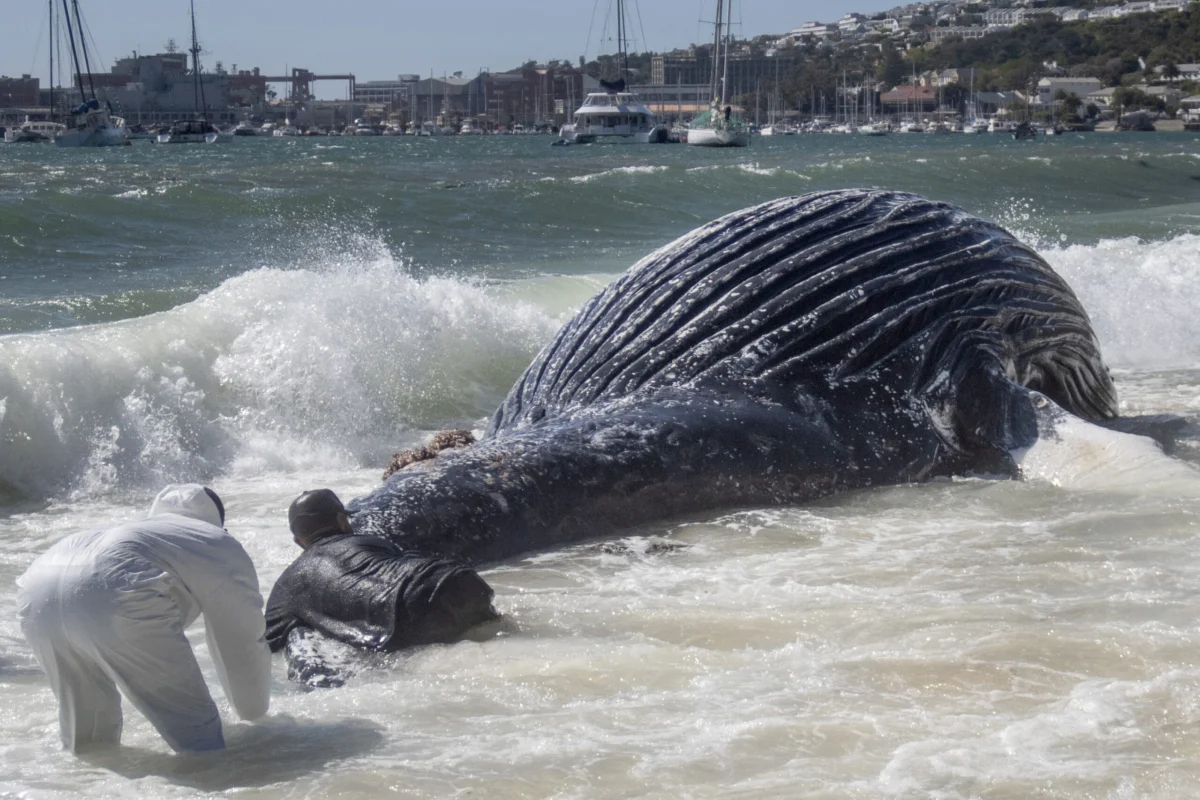
The escalating military tensions in the Middle East, characterized by the multifaceted conflict involving the United States, Israel, and Iran, have transcended regional boundaries to create a profound ecological crisis thousands of miles away along the coastline of South Africa. While the immediate focus of the conflict remains on the disruption of global supply chains—impacting the flow of energy, fertilizers, medicines, and rare gases like helium—a secondary and increasingly dire consequence is emerging in the Southern Hemisphere. Marine researchers and environmental scientists are warning that the mass diversion of commercial shipping traffic away from the Red Sea and the Strait of Hormuz is placing South Africa’s diverse whale populations at a substantially increased risk of lethal ship strikes.
The shift in maritime logistics is a direct response to the volatile security situation in the Middle East. Since late 2023, Houthi rebels in Yemen have targeted commercial vessels in the Red Sea, citing solidarity with Palestinians during the conflict in Gaza. This threat was recently compounded by restrictions and blockades in the Strait of Hormuz, a critical maritime artery controlled by Iran. Consequently, shipping companies have been forced to abandon the shorter Suez Canal route in favor of the arduous journey around the Cape of Good Hope. This detour, while necessary for vessel safety, has effectively doubled the volume of heavy maritime traffic in waters that serve as a primary migratory corridor and feeding ground for some of the world’s most vulnerable marine mammals.
The Geopolitical Catalyst and Maritime Shift
The current maritime crisis finds its roots in the geopolitical instability that intensified in November 2023. As the conflict between Israel and Hamas expanded into a broader regional confrontation involving Iranian-backed militias, the Red Sea became a high-risk zone. The Houthis’ use of anti-ship ballistic missiles and suicide drones forced the world’s largest shipping conglomerates—including Maersk, MSC, and Hapag-Lloyd—to reroute their fleets.
By early 2024, the situation worsened as the United States and its allies launched "Operation Prosperity Guardian" to secure the Red Sea, leading to further skirmishes. More recently, the focus has shifted toward the Strait of Hormuz, where Iranian naval forces have imposed restrictions on transit. The cumulative effect has been a radical restructuring of global trade routes. According to data provided by the International Monetary Fund’s (IMF) PortWatch Monitor, the volume of traffic around Southern Africa has seen a staggering increase. Between March 1 and April 24, 2024, at least 89 large commercial vessels were recorded navigating the Cape of Good Hope, compared to just 44 during the same period in the previous year. This 100% increase in traffic represents thousands of additional tons of steel moving through ecologically sensitive zones at high speeds.
Ecological Impact on South African Waters
South Africa’s coastal waters are recognized globally as a biodiversity hotspot, home to more than 40 species of whales and dolphins. The southwestern coast, particularly the area surrounding the Cape of Good Hope, serves as a vital junction for migratory species. Among the most prominent residents are the Southern Right whales, Humpback whales, and Bryde’s whales. The region also hosts significant populations of Orcas (killer whales), sperm whales, and Minke whales.
The influx of shipping traffic is particularly dangerous for Humpback whales. South Africa is famous for its "super-pods" of Humpbacks—massive congregations of up to 200 individuals that gather to feed on krill and small fish. These are the largest known groupings of Humpback whales on the planet, with total regional populations estimated between 11,000 and 13,000. These whales are currently in the midst of their annual migration toward Antarctica, a journey that now requires them to navigate a "minefield" of container ships and oil tankers.
The Science of Ship Strikes: A Growing Threat
A study presented this month at the International Whaling Commission (IWC) meeting highlights the mechanical and behavioral reasons why increased traffic leads to higher mortality. Researchers led by Dr. Els Vermeulen of the University of Pretoria have expressed grave concern over the "substantial increase" in strike risks.
The primary issue is that whales, despite their intelligence, have not evolved to perceive fast-moving, massive ships as predators. Dr. Vermeulen noted that humpback whales are often "distracted" by feeding activities or social interactions, rendering them oblivious to an approaching vessel until it is too late. "There have been videos of people on cargo vessels that were going through high densities of humpback whales," Vermeulen told the AFP. "Their social media posts were all about ‘Wow, look how many nice whales we see,’ but as a researcher, your heart stops because you know they are likely striking whales in the process."

The danger is compounded by the speed of the vessels. High-speed traffic, which poses the greatest risk of causing fatal internal trauma or deep lacerations from propellers, has reportedly quadrupled in the region. Chris Johnson, the global lead for the World Wildlife Fund’s (WWF) Protecting Whales and Dolphins Initiative, explains that different species react differently to underwater noise. While some might dive, others—like the Blue whale—tend to simply sink just below the surface when they hear an approaching ship, placing them directly in the path of the hull or the propeller.
Historical Data and the "Silent Mortality" Problem
The risk is not merely theoretical. Previous research conducted by Dr. Vermeulen’s team on Southern Right whales (SRW) along the Western Cape Coast between 1999 and 2019 found that ship strikes were a significant, though often hidden, cause of death. Out of 97 recorded deaths in that period, 11 were confirmed fatal ship strikes. However, researchers emphasize that these numbers are likely a significant undercount.
Whales struck in the open ocean often do not wash ashore; their carcasses typically sink to the sea floor, meaning the true death toll from maritime traffic is rarely fully realized. Furthermore, the behavioral patterns of these animals are changing. Due to climate change and shifting ocean temperatures, Humpback whales began feeding off the West Coast of South Africa more frequently starting in 2011—an area that is now seeing some of the heaviest traffic increases due to the Red Sea bypass.
Economic and Supply Chain Implications
The environmental crisis is inextricably linked to the economic fallout of the United States-Israel-Iran conflict. The rerouting around Africa adds approximately 3,000 to 3,500 nautical miles to a typical journey between Asia and Europe, extending travel time by 10 to 14 days. This delay has disrupted the "just-in-time" delivery models for essential goods.
Global supplies of fertilizers, crucial for food security in developing nations, have seen price spikes due to increased freight costs. Similarly, the medical sector is facing delays in the shipment of specialized equipment and pharmaceuticals. Even the supply of helium—essential for MRI machines and semiconductor manufacturing—has been affected, as Qatar is a major producer and its exports must now navigate these contested waters. The environmental "tax" of this conflict is thus being paid not only in carbon emissions from longer voyages but also in the loss of marine biodiversity.
Official Responses and Potential Mitigations
In response to the findings presented at the IWC, the South African government has indicated that it is monitoring the situation closely. The Department of Forestry, Fisheries, and the Environment (DFFE) stated that "all available solutions and mitigation measures will be examined" to protect the whales in the Cape of Good Hope.
Proposed solutions include:
- Traffic Lane Shifts: Shifting shipping lanes even a few nautical miles further away from the coast could reduce the risk of strikes by 20 to 50 percent for certain species.
- Speed Reduction Zones: Implementing mandatory "slow-down" zones in known whale hotspots. Reducing ship speed to 10 knots or less has been proven in other parts of the world, such as the North Atlantic, to significantly reduce the lethality of collisions.
- Technological Alerts: Developing radio messaging systems or specialized apps to alert ship captains when they are approaching "super-pods."
- Corporate Responsibility: Following the lead of companies like MSC, which has voluntarily rerouted ships in the Hellenic Trench and off Sri Lanka to protect sperm and blue whales, respectively.
Conclusion: The Cost of Geopolitical Instability
The crisis off the coast of South Africa serves as a stark reminder that modern conflicts have ecological footprints that extend far beyond the battlefield. The war involving the United States, Israel, and Iran has created a butterfly effect: a drone strike in the Bab al-Mandab Strait leads to a container ship strike on a humpback whale in the Atlantic.
As maritime authorities and the South African Environment Ministry chart a way forward, the situation remains a race against time. With the Middle Eastern conflict showing no signs of immediate resolution, the "Cape Route" will likely remain the primary corridor for global trade for the foreseeable future. The survival of South Africa’s whale populations may depend on whether the international community can implement maritime safety measures as quickly as they have adapted their trade routes. For now, the "Whale Highway" remains a dangerous thoroughfare where the giants of the sea are forced to compete with the giants of global commerce.
