

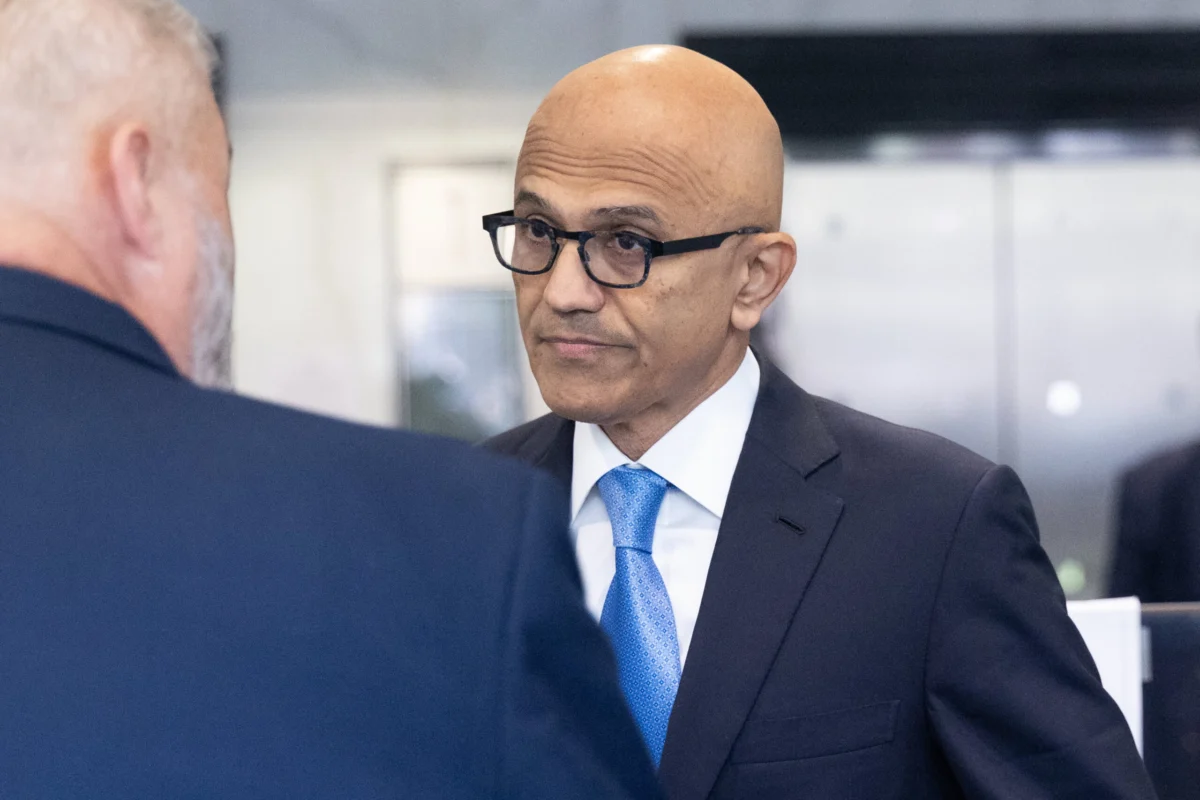
Microsoft CEO Satya Nadella took the witness stand in a federal courtroom in Oakland, California, on Monday, providing pivotal testimony in the ongoing legal battle between Elon Musk and OpenAI. During several hours of questioning, Nadella addressed the core allegations of the Musk v. Altman trial, asserting that Elon Musk had never personally reached out to him to express concerns that Microsoft’s multibillion-dollar investments in OpenAI violated any foundational agreements or charitable commitments. Nadella’s appearance marks a critical juncture in a case that examines the intersection of high-stakes technology investment, corporate governance, and the ethical obligations of artificial intelligence pioneers.
Dressed in a navy suit and blue tie, Nadella concluded his testimony after navigating a range of inquiries regarding the early strategic partnership between Microsoft and OpenAI, his personal involvement during the brief ousting of Sam Altman in late 2023, and the commercial motivations behind Microsoft’s $13 billion commitment to the AI lab. The trial, which has drawn international attention, centers on Musk’s claim that OpenAI, Altman, and Greg Brockman abandoned the company’s original nonprofit mission in favor of a profit-driven model bolstered by Microsoft’s influence.
The Core of the Testimony: Commercial Interests vs. Charitable Vows
A central theme of Nadella’s testimony was the nature of the financial relationship between Microsoft and OpenAI. While Elon Musk has characterized the partnership as a "betrayal" of a charitable trust, Nadella argued that the arrangement was transparently commercial from its inception. He testified that he did not view Microsoft’s capital injections as donations, but rather as a strategic business move designed to benefit both entities.
Nadella highlighted that during the partnership’s formative years, Microsoft provided OpenAI with significant discounts on computing resources—specifically through its Azure cloud platform. In exchange, Microsoft expected to reap marketing benefits and technological advantages. This commercial reality was underscored by a video deposition from Michael Wetter, a Microsoft corporate development executive, which was played earlier in the day. Wetter revealed that as of March 2025, Microsoft had recognized approximately $9.5 billion in revenue directly linked to its partnership with OpenAI.
Nadella expressed pride in Microsoft’s early support of OpenAI, noting that the tech giant took a substantial risk at a time when "no one else was willing" to bet on the fledgling research lab. This defense stands in direct opposition to Musk’s testimony from late last month, in which the Tesla CEO identified Microsoft’s $10 billion investment in 2023 as the "key tipping point" that signaled OpenAI’s shift away from its nonprofit roots. Musk told the court he feared the defendants were "really trying to steal the charity."
The Historical Context: Avoiding the IBM Trajectory
One of the more revealing moments of the testimony occurred when Musk’s lawyer, Steven Molo, presented an internal email sent by Nadella in 2022. In the message to Microsoft executives, Nadella wrote, "I don’t want to be IBM and OpenAI to be Microsoft."
This reference points to a famous era in computing history. In 1980, IBM entered a non-exclusive agreement with Microsoft to use its DOS operating system for IBM’s personal computers. While the deal helped IBM dominate the hardware market initially, it allowed Microsoft to license the software to other manufacturers, eventually leading to Microsoft eclipsing IBM in market value and influence.

When asked by Molo if Microsoft had eventually grown to be a more prominent and important company than IBM, Nadella replied, "That’s right." As of the close of markets on Monday, Microsoft’s market capitalization reached $3 trillion, a figure that dwarfs IBM’s $210 billion valuation. The email suggests that while Microsoft is a primary benefactor of OpenAI, Nadella has remained acutely aware of the risk of becoming a mere "distributor" for a more dominant software entity, driving his strategy to deeply integrate OpenAI’s technology into Microsoft’s own product ecosystem.
Elon Musk’s Allegations and the Tipping Point
The legal friction began in 2024 when Musk sued OpenAI, Altman, and Brockman. Musk, who co-founded OpenAI in 2015 alongside the defendants, alleges that the group breached a "founding agreement" to keep the technology open-source and for the benefit of humanity rather than for private profit. Microsoft is named as a defendant, accused by Musk of "aiding and abetting" this breach of trust.
Musk’s departure from the OpenAI board in 2018 followed internal disagreements, including a failed proposal to merge OpenAI with Tesla. Following his exit, OpenAI established a for-profit subsidiary, which Musk claims has become "the tail wagging the dog." He argued from the stand that while he is not fundamentally opposed to for-profit units, the current structure allows Altman and Brockman to enrich themselves while maintaining the "halo effect" of a nonprofit mission. "All due respect to Microsoft," Musk said during his testimony, "do you really want Microsoft controlling digital superintelligence?"
A Chronology of the Microsoft-OpenAI Alliance
To understand the scale of the dispute, the court examined the timeline of Microsoft’s investments, which have totaled more than $13 billion over six years:
- 2019: Microsoft invests $1 billion, providing the initial capital for OpenAI to scale its large-scale AI models.
- 2021: A secondary investment of $2 billion is finalized as OpenAI’s research begins to show commercial promise.
- 2022: The launch of ChatGPT in late 2022 sends OpenAI’s valuation soaring and cements the partnership’s importance to Microsoft’s search and productivity tools.
- 2023: Microsoft commits an additional $10 billion. Later that year, the partnership is tested by the temporary removal of Sam Altman.
- 2024: OpenAI undergoes a recapitalization, cementing its structure as a nonprofit with an equity stake in its for-profit business. Microsoft discloses a 27% stake in the for-profit unit, valued at approximately $135 billion.
- 2026: The companies announce a "revamped" partnership agreement, allowing OpenAI more flexibility in serving customers across different cloud providers, amid signs of strategic strain.
The November 2023 Crisis: "Amateur City" and Board Dynamics
Nadella also provided a candid look into the chaotic five-day period in November 2023 when the OpenAI board fired Sam Altman. Nadella testified that he was "pretty surprised" by the move and immediately sought to ensure continuity for Microsoft’s customers.
He described the board’s vague explanation—that Altman was "not consistently candid"—as insufficient. "It just didn’t sort of suffice," Nadella said, noting that as a major partner and investor, he expected a detailed account of the incidents that led to the firing. When no such details were forthcoming, Nadella concluded the situation was handled poorly. "It was sort of amateur city, as far as I’m concerned," he testified.
While former board member Tasha McCauley suggested in a deposition that Nadella had demanded Altman’s reinstatement, Nadella denied this on the stand, stating he never made such a demand, though his priority was restoring stability.
Ilya Sutskever and the Founding Tension
Following Nadella, former OpenAI co-founder and chief scientist Ilya Sutskever took the stand. Sutskever, a legendary figure in AI research, discussed his motivations for joining the startup in 2015. He revealed that Google had offered him a salary of $6 million a year to stay, but he chose OpenAI because he believed in its mission.

Sutskever’s testimony touched on the internal friction that led to the 2023 leadership crisis. He admitted to being one of the employees who expressed concerns about Altman’s behavior to the board. "I simply cared for it, and I didn’t want it to be destroyed," Sutskever said, describing a sense of "ownership" over the lab’s ethical direction. His testimony highlighted the deep-seated tension between the research-focused founders and the commercial expansion led by Altman.
Competitive Pressures and the Google Factor
The trial also touched on the broader competitive landscape of Silicon Valley. Evidence presented by Musk’s legal team included text messages between Nadella and Microsoft’s CTO, Kevin Scott, regarding potential candidates for the OpenAI board.
Nadella admitted to opposing the appointment of Diane Greene, the former head of Google Cloud, to the OpenAI board. "I thought there were going to be conflicts because of our major competition with Google," Nadella explained. He noted that since he became CEO in 2014, Google has remained Microsoft’s primary rival in the AI space, particularly following Google’s acquisition of the UK-based lab DeepMind.
Broader Impact and Implications
The outcome of Musk v. Altman could have profound implications for the future of AI governance. If the court finds that OpenAI breached a charitable trust, it could force a restructuring of how the company shares its technology or manages its profits. Conversely, a victory for OpenAI and Microsoft would validate the "capped-profit" model that many believe is necessary to fund the massive computational costs of developing Artificial General Intelligence (AGI).
As the trial continues, the industry is watching closely. The partnership between Microsoft and OpenAI, once seen as an unbreakable alliance, is being scrutinized for cracks. Recent adjustments to their agreement, allowing OpenAI to work with other cloud providers, suggest that the "special relationship" is evolving into a more traditional, perhaps more distant, corporate partnership.
Sam Altman is expected to take the stand on Tuesday, where he will likely face intense questioning regarding his communications with the board and his vision for the company’s $850 billion future. Bret Taylor, the current chairman of OpenAI, is also set to resume his testimony, providing further insight into how the company plans to balance its nonprofit origins with its status as a global tech powerhouse.
