

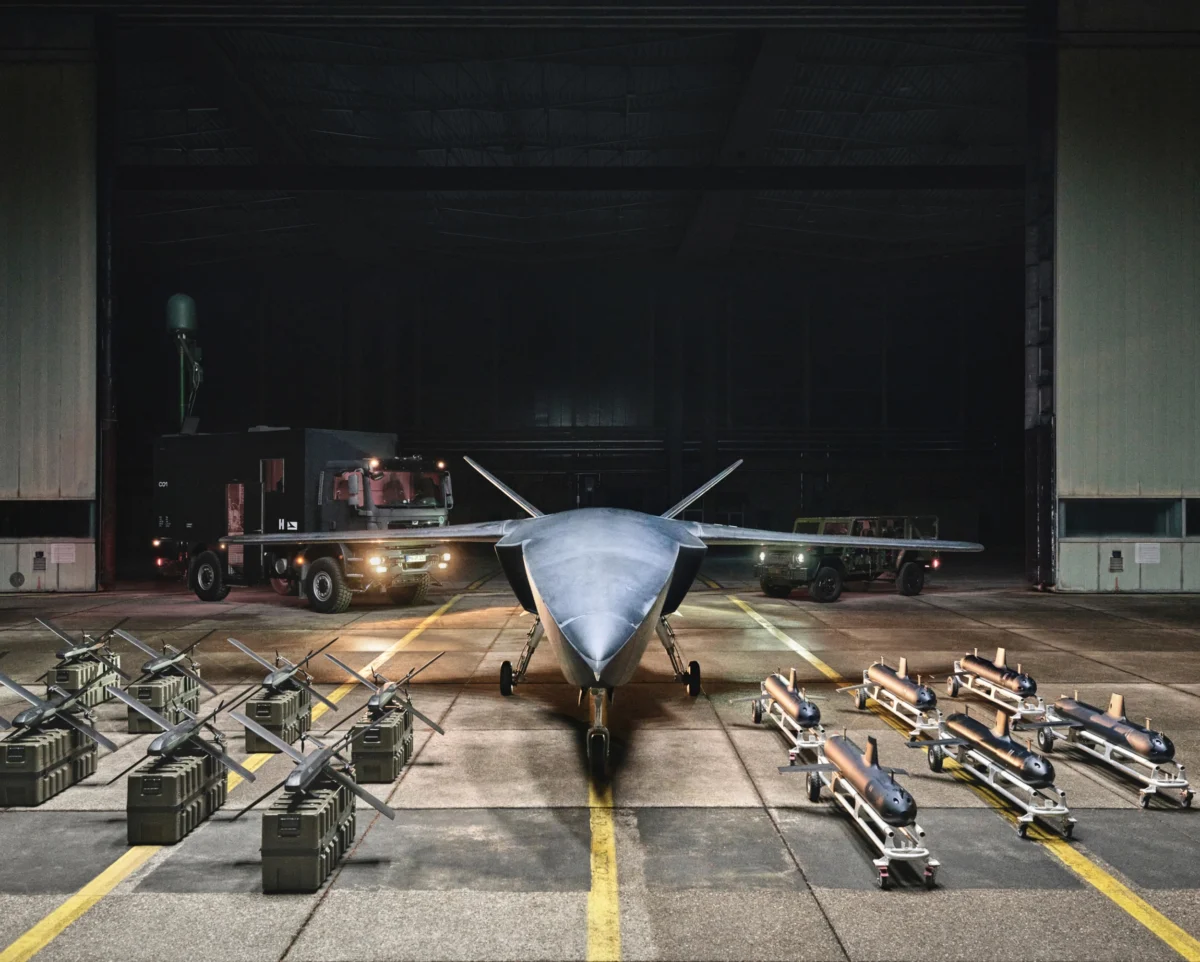
The European defense technology sector is witnessing a landmark shift in capital allocation as Helsing, the Berlin-based artificial intelligence startup, nears the completion of a massive $1.2 billion funding round. According to reports from the Financial Times and industry insiders, the investment is expected to be led by the San Francisco-based firm Dragoneer Investment Group, with significant participation from existing investor Lightspeed Venture Partners. This latest injection of capital reportedly values the five-year-old company at approximately $18 billion, marking a significant step-up from its $14 billion valuation achieved less than a year ago. The deal underscores a broader trend in the venture capital landscape, where "software-defined defense" has moved from a niche interest to a central pillar of geopolitical and economic strategy.
Founded in 2021 by Niklas Köhler, Torsten Reil, and Gundbert Scherf, Helsing has rapidly ascended to become the most valuable private defense technology company in Europe. The company specializes in developing AI-based software that integrates with existing military hardware, such as fighter jets, tanks, and drones, to provide real-time battlefield intelligence and autonomous capabilities. Unlike traditional defense contractors that focus primarily on heavy machinery and long-term hardware cycles, Helsing operates on a software-first model, prioritizing rapid iteration, sensor fusion, and edge computing to give modern armed forces a technological advantage in contested environments.
The Evolution of Helsing and Its Funding Trajectory
The current $1.2 billion round follows a highly publicized €600 million Series C investment in June 2025, which was led by Daniel Ek, the billionaire founder of Spotify, through his investment vehicle Prima Materia. At that time, the company was valued at roughly €12 billion ($14 billion USD). The rapid escalation to an $18 billion valuation in less than twelve months reflects the urgent demand for AI-driven defense solutions amidst a deteriorating global security environment.
Helsing’s growth trajectory has been characterized by its ability to secure major government contracts early in its lifecycle. The company has already established deep ties with the German, French, and British governments. Notable projects include providing the AI infrastructure for the Future Combat Air System (FCAS)—a multi-national European project to develop a next-generation fighter jet—and upgrading the electronic warfare capabilities of the Eurofighter Typhoon. By focusing on the "brain" of military platforms rather than the "body," Helsing has positioned itself as an essential partner for both legacy defense firms and national ministries of defense.
The Geopolitical Catalyst: The War in Ukraine and the Need for Autonomy
The ongoing conflict in Ukraine has served as a grim but effective proving ground for the technologies Helsing develops. Modern warfare has transitioned into a high-tech struggle where electronic warfare, GPS jamming, and drone swarms play a decisive role. Traditional military systems, often reliant on stable satellite links and human-in-the-loop controls, have frequently struggled against sophisticated jamming techniques.
Helsing’s software is designed to address these specific vulnerabilities. By enabling "autonomous at the edge" processing, the company’s AI allows drones and sensors to operate independently of a constant data link to a central command. This means that even in environments where signals are blocked or spoofed, Helsing-equipped systems can identify targets and make tactical decisions based on pre-set parameters. This capability has become a top priority for NATO allies who are watching the lessons of the Ukrainian battlefield closely.
The infusion of $1.2 billion is expected to be used to scale the production of these autonomous systems and to expand Helsing’s presence along NATO’s eastern flank. Investors are betting that the shift toward autonomous, AI-driven defense is not a temporary surge but a permanent realignment of military procurement.
A Comparative Analysis of the European Defense Tech Ecosystem
While Helsing stands as the clear leader in terms of valuation, it is part of a growing ecosystem of European "sovereign tech" companies. The success of Helsing has paved the way for other startups to secure significant funding, breaking a long-standing taboo in European venture capital regarding investments in lethal technology.
In November 2025, the German drone manufacturer Quantum Systems raised €180 million, tripling its valuation to over €3 billion. Quantum Systems specializes in tactical reconnaissance drones that have seen extensive use in surveillance missions. Similarly, the Lisbon-headquartered firm Tekever raised £400 million a year ago, achieving unicorn status with a valuation exceeding £1 billion. Tekever focuses on maritime surveillance and long-endurance unmanned aerial vehicles (UAVs).
However, Helsing’s $18 billion valuation places it in a different league, comparable to major US players like Anduril Industries, which was co-founded by Palmer Luckey. The massive valuation gap between Helsing and its European peers highlights the market’s belief in the scalability of software over hardware. While Quantum Systems and Tekever produce the physical drones, Helsing provides the underlying intelligence that could theoretically be deployed across thousands of different platforms from various manufacturers.

Investor Sentiment and the Shift in ESG Standards
The involvement of Dragoneer and Lightspeed in this round signals a maturing of the defense tech sector. Historically, many European and American venture capital firms avoided the defense sector due to Environmental, Social, and Governance (ESG) constraints and the reputational risks associated with "weapons of war." However, the Russian invasion of Ukraine in 2022 catalyzed a re-evaluation of these standards.
Many institutional investors now view "defense tech" as a necessary component of "S" (Social) in ESG, arguing that the protection of democratic values and national sovereignty is a social good. This shift has unlocked billions of dollars in capital that was previously unavailable to startups in this space. Lightspeed’s continued support, having co-led previous rounds, demonstrates a long-term conviction in Helsing’s mission to provide "AI for the protection of democracies."
Although Helsing, Dragoneer, and Lightspeed have not officially commented on the specifics of the $1.2 billion round, the reported terms suggest a "clean" deal with high confidence in the company’s revenue projections. Helsing’s revenue model, which blends long-term government contracts with software-as-a-service (SaaS) style recurring fees for AI updates, is particularly attractive to VCs accustomed to high-margin software businesses.
Strategic Implications for European Sovereignty
Beyond the financial metrics, Helsing’s rise is a matter of strategic importance for the European Union. For decades, Europe has been criticized for its reliance on American defense technology and its fragmented defense industry. The "Strategic Autonomy" initiative championed by leaders like French President Emmanuel Macron aims to reduce this dependency by fostering homegrown technological leaders.
Helsing is frequently cited as the poster child for this initiative. By developing world-class AI within Europe, the company ensures that European nations maintain control over the algorithms and data that drive their national security. This avoids the "black box" problem associated with importing foreign military AI, where the end-user may not fully understand or have the right to modify the underlying code.
Furthermore, Helsing’s cross-border operations—with major offices in Munich, London, and Paris—align with the EU’s goals of industrial cooperation. The company’s ability to navigate the complex regulatory and procurement landscapes of multiple nations is a competitive advantage that few other startups possess.
Future Outlook and Challenges
With $1.2 billion in new capital, Helsing faces the challenge of moving from a high-growth startup to a foundational defense prime. This transition involves not only technological innovation but also the navigation of intense political scrutiny and the ethical debates surrounding autonomous weapons systems.
The company has consistently advocated for "human-defined" AI, emphasizing that their systems are designed to support human decision-makers rather than replace them. However, as the speed of the battlefield increases, the line between "human-in-the-loop" and "human-on-the-loop" becomes increasingly thin. Helsing will likely need to continue its transparent engagement with policymakers and ethics boards to maintain its social license to operate.
Looking ahead, the industry expects Helsing to explore further integrations into naval and space-based assets. The ability to coordinate "multi-domain" operations—linking sensors and shooters across land, sea, air, and space—is the next frontier for AI in defense. With an $18 billion valuation and the backing of some of the world’s most influential investors, Helsing is now uniquely positioned to lead that charge, cementing its role as the digital backbone of modern European defense.
As the deal nears its final closing, the broader tech industry will be watching closely. A successful $1.2 billion round for a defense startup during a period of fluctuating interest rates and economic uncertainty would be a definitive signal that the "defense-industrial complex" is being permanently disrupted by the "defense-tech complex." For Helsing, the mission remains the same: ensuring that the world’s democracies have the technological tools necessary to deter aggression in an increasingly volatile century.
