

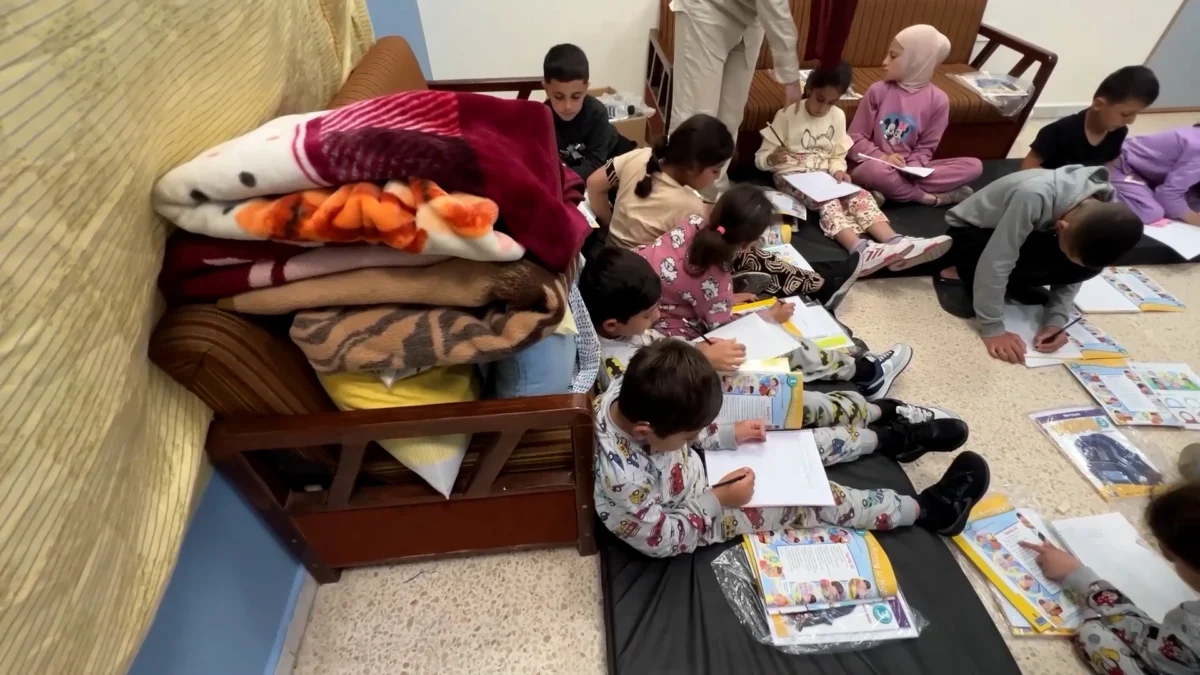
In the coastal city of Sidon, a local public school has become a microcosm of Lebanon’s enduring humanitarian crisis, serving simultaneously as a sanctuary for those fleeing conflict and a functioning educational institution for the next generation. As of May 9, 2026, the hallways of this facility are crowded with the laundry and makeshift partitions of displaced families from southern Lebanon, while just feet away, classrooms remain in session. This uneasy coexistence highlights a broader national tragedy: despite a standing ceasefire, more than 1.5 million Lebanese citizens remain displaced from their homes, caught between the hope of a peaceful resolution and the harsh realities of a destroyed infrastructure and ongoing military restrictions.
The situation in Sidon reflects the complex challenges facing the Lebanese government and international aid agencies. While the guns have largely fallen silent across the Blue Line, the transition from active conflict to a sustainable peace remains fraught with obstacles. The United Nations and various humanitarian partners have identified a dual-threat barrier to the return of civilians: the profound lack of basic services in southern villages and the explicit orders from the Israeli military preventing residents from entering dozens of border communities.
The Dual Role of Educational Infrastructure
For the families living in the Sidon school, the facility represents the only stability they have known for months. Most arrived with little more than the clothes on their backs, fleeing the intensive bombardments that characterized the peak of the hostilities. Now, they live in communal spaces, sharing bathrooms and kitchens with hundreds of others. For the students, however, the school remains a place of learning, though the environment is far from ideal. Teachers report that the presence of displaced families—many of whom are relatives of the students—creates a somber atmosphere that serves as a constant reminder of the instability outside the school gates.
The Lebanese Ministry of Education has struggled to balance the need for emergency housing with the constitutional right to education. In many parts of the country, schools were the only public buildings capable of housing large numbers of people. As the displacement persists into its second year for many, the "temporary" nature of these shelters is being called into question. Officials note that while classes are running, the quality of education is hampered by overcrowding and the psychological trauma shared by both the resident families and the student body.
Barriers to Repatriation: Insecurity and Infrastructure
The United Nations has been vocal regarding the impediments to a safe and dignified return for the 1.5 million displaced. According to recent reports from the UN Office for the Coordination of Humanitarian Affairs (OCHA), the primary barrier is the total collapse of essential services in southern Lebanon. In towns such as Bint Jbeil, Khiam, and Aita al-Shaab, the infrastructure for water, electricity, and telecommunications has been systematically dismantled by months of shelling and airstrikes.
"Returning to a home that has no roof is one challenge; returning to a village that has no water or medical facilities is an impossibility for families with children and the elderly," a UN spokesperson stated during a briefing in Beirut. The UN has also highlighted the presence of unexploded ordnance (UXO) and landmines, which litter the agricultural fields and residential streets of the south, making the simple act of walking to a neighbor’s house a potentially lethal endeavor.
Furthermore, the Israeli military has maintained a strict "no-go" policy for approximately 80 towns and villages located in the immediate vicinity of the border. Despite the ceasefire, Israel cites security concerns and the potential for a resurgence of hostilities as the rationale for keeping these areas off-limits to civilians. For the residents of these 80 towns, the ceasefire exists in name only, as they remain barred from even surveying the damage to their properties.
A Chronology of the Crisis
To understand the current stalemate, it is necessary to examine the timeline of the conflict that led to this unprecedented level of displacement:
- Late 2023 – Mid 2024: Initial cross-border skirmishes escalate into a sustained conflict. Displacement begins in small numbers from the immediate border zone.
- Early 2025: A significant escalation in hostilities leads to a mass exodus from southern Lebanon and the Bekaa Valley. The number of internally displaced persons (IDPs) surpasses the one-million mark.
- Late 2025: Intense diplomatic efforts by the international community, led by the United States and France, result in a tentative ceasefire agreement. The agreement calls for the cessation of hostilities but leaves the specifics of civilian return to be negotiated in subsequent phases.
- January – March 2026: Small-scale attempts at return are met with logistical failures. Families find their homes leveled and the soil contaminated. The Israeli Defense Forces (IDF) formalize the list of "restricted zones," effectively preventing the return of nearly 400,000 people to the border strip.
- May 2026: The current status quo. The ceasefire holds precariously, but 1.5 million people remain in shelters, rented apartments, or with host families, with no clear timeline for a permanent homecoming.
Supporting Data and Economic Impact
The humanitarian data paints a grim picture of the current landscape. Of the 1.5 million displaced, approximately 35% are children under the age of 18. The economic toll of this displacement is staggering. Southern Lebanon is the country’s agricultural heartland; the inability of farmers to access their olive groves and tobacco fields has resulted in a loss of an estimated $2.4 billion in agricultural revenue over the last two harvest cycles.
Moreover, the strain on host communities like Sidon, Tripoli, and Beirut is reaching a breaking point. Public utilities in these cities, already weakened by Lebanon’s long-standing economic crisis, are now supporting a population significantly larger than they were designed for. In Sidon, water shortages and electricity blackouts have become more frequent, leading to occasional tensions between local residents and the displaced populations they are hosting.
The Lebanese government, currently operating under a caretaker capacity with limited financial resources, has estimated that the reconstruction of the south will require upwards of $15 billion. This figure includes the rebuilding of over 60,000 housing units that were either completely destroyed or rendered uninhabitable.
Official Responses and Geopolitical Analysis
The Lebanese government has repeatedly called on the international community to pressure Israel to lift the restrictions on the 80 southern towns. The Lebanese Ministry of Foreign Affairs issued a statement last week asserting that the "continued forced displacement of our citizens constitutes a violation of international humanitarian law and the terms of the cessation of hostilities."
Conversely, Israeli officials maintain that the restrictions are a necessary security measure. An IDF spokesperson stated that the "buffer zone" is essential to prevent the re-establishment of military infrastructure near the border. "Our priority is the safety of our northern communities. Until we can guarantee that the border area is neutralized of threats, we cannot allow a vacuum that could be exploited," the spokesperson added.
International analysts suggest that the situation has evolved into a "frozen conflict" where the displacement is being used as a geopolitical lever. By preventing the return of civilians, a de facto buffer zone is created, but at the cost of a permanent refugee crisis within Lebanon’s borders.
The United Nations High Commissioner for Refugees (UNHCR) has warned that the longer the displacement lasts, the more difficult it will be to eventually reintegrate these populations. "We are seeing the ‘normalization’ of displacement," said a UNHCR field officer in Sidon. "When children start spending their entire developmental years in a school hallway, the social fabric of their home villages begins to unravel. The right to return is not just about a physical location; it is about the restoration of a community."
Broader Implications for the Region
The prolonged displacement has significant implications for Lebanon’s fragile sectarian balance and its future stability. Many of the displaced come from specific demographic backgrounds, and their long-term presence in other parts of the country is beginning to shift local dynamics. In some areas, this has led to increased competition for low-wage jobs and a rise in rental prices, further alienating the Lebanese middle class.
Furthermore, the education sector is facing a generational threat. While schools like the one in Sidon are attempting to maintain a semblance of normalcy, the psychological stress on students is profound. Educators report high rates of absenteeism, difficulty concentrating, and symptoms of post-traumatic stress disorder (PTSD) among the youth. If a significant portion of the population remains displaced and out of a stable learning environment, the long-term impact on Lebanon’s human capital could be devastating.
As May 2026 progresses, the international community remains focused on maintaining the ceasefire, but critics argue that "negative peace"—the absence of active shelling—is not enough. Without a comprehensive plan for reconstruction, demining, and the lifting of military exclusion zones, the 1.5 million displaced Lebanese remain in a state of perpetual limbo.
The school in Sidon stands as a testament to the resilience of the Lebanese people, but also as a stark reminder of the work that remains. Until the families in its hallways can safely return to the hills of the south, the conflict cannot truly be considered over. For now, the bell rings for class, the laundry dries on the balcony, and a million and a half people wait for a future that remains obscured by the politics of security and the debris of war.
