

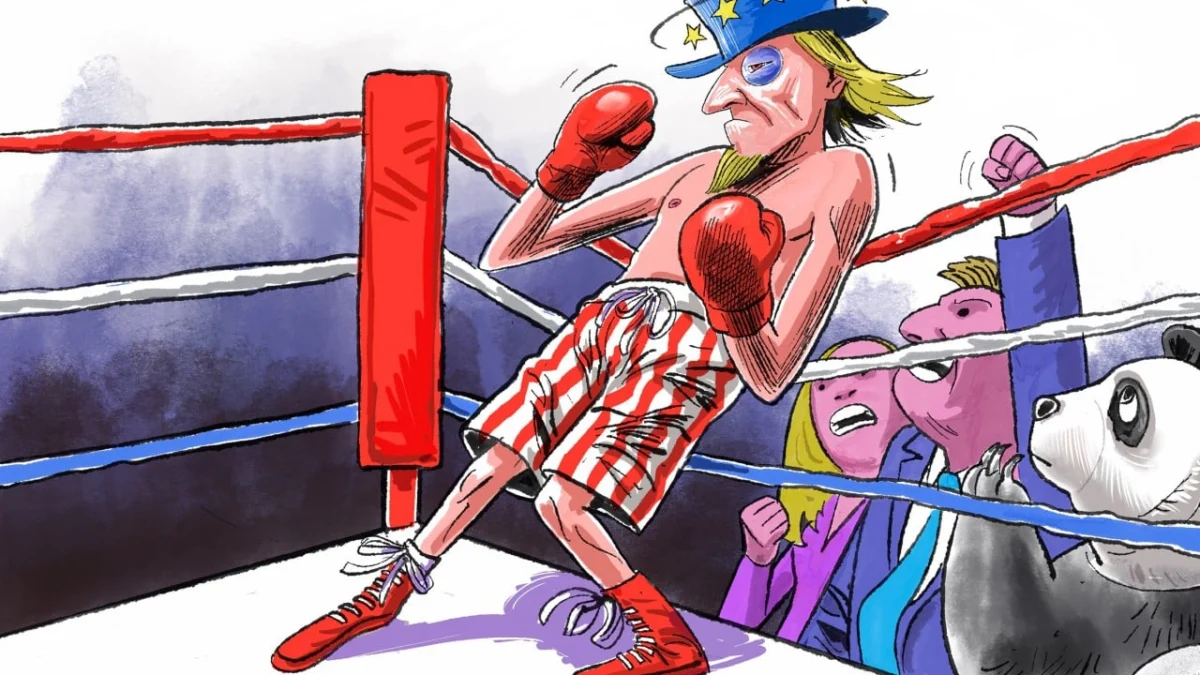
When US President Donald Trump announced that 5,000 US troops would leave Germany, the immediate reading in Western capitals was political: another round in Trump’s running quarrel with European allies, triggered by German Chancellor Friedrich Merz’s criticism of Washington’s handling of the war with Iran. However, beneath the surface of diplomatic friction lies a more profound structural shift in American grand strategy. The drawdown marks a pivotal moment in the post-Cold War era, signaling a departure from the traditional security architecture that has defined the North Atlantic Treaty Organization (NATO) for over seven decades. For Beijing, this maneuver is not merely a symptom of a temperamental presidency but a clear indication of a US military that is overextended, resource-constrained, and decisively pivoting toward the Indo-Pacific.
The Catalyst: Diplomatic Rupture and the Iran Conflict
The decision to withdraw troops from German soil did not occur in a vacuum. It was the culmination of months of escalating tension between Washington and Berlin. German Chancellor Friedrich Merz, who assumed leadership during a period of renewed European assertiveness, has been vocal in his opposition to the US-led military campaign against Iran. Merz’s administration, mirroring a broader European sentiment, argued that the conflict destabilized global energy markets and created a refugee crisis that disproportionately affected the European Union.
Trump’s response—a direct order to reduce the US footprint in Germany—was framed by the White House as a cost-saving measure and a penalty for Germany’s perceived lack of "burden sharing." However, the timing suggests a tactical use of military posture to demand political loyalty. This friction has provided an analytical opening for global observers, particularly in China, who view the fraying of the Transatlantic alliance as a historic opportunity to reshape the international order.
Beijing’s Strategic Calculus: "Partners Not Rivals"
While Washington and Berlin exchange barbs, Beijing has been playing a longer, more subtle game. Throughout 2026, Chinese Foreign Minister Wang Yi has focused his diplomatic efforts on a "partners not rivals" framework with European counterparts. This narrative is designed to exploit the growing perception in Europe that the United States is an unreliable security guarantor.
For the Chinese leadership, the US withdrawal from Germany is a structural validation of their worldview. Beijing interprets the drawdown as evidence that the US can no longer sustain a dual-theater dominance strategy. By cultivating deeper economic and diplomatic ties with a disillusioned Europe, China aims to ensure that European capitals remain neutral, or at least less aligned with Washington, in the event of a US-China confrontation in the South China Sea or the Taiwan Strait. The strategic window for China is narrow, but the current volatility in US-European relations provides a rare chance to decouple European security interests from American geopolitical goals.
The 2026 National Defence Strategy: A Shift in Priority
The structural underpinnings of the troop withdrawal are codified in the 2026 US National Defence Strategy (NDS). Shaped largely by Elbridge Colby, the US undersecretary of defence for policy, the document represents a radical departure from previous iterations. The 2026 NDS explicitly downgrades Europe to a theater of "more limited" conventional support.
Colby’s influence is visible in the strategy’s laser-like focus on "peer warfare"—specifically the threat posed by the People’s Liberation Army (PLA). The NDS posits that the US can no longer afford to maintain a massive, permanent presence in Europe if it hopes to deter a sophisticated adversary in the Pacific. This "Strategy of Denial" necessitates a lean, agile force in the West, forcing European nations to take the lead in their own territorial defense.
Trump’s recent characterization of NATO as a "paper tiger" and his threats to pull troops from Spain and Italy are not merely rhetorical flourishes; they reflect the core logic of the 2026 NDS. The message to Europe is clear: the era of the American "security umbrella" is coming to a close, replaced by a "pay-to-play" model where US involvement is contingent on immediate American interests and host-country contributions.
Resource Depletion and the Crisis of Logistics
Perhaps the most alarming aspect of the current US military posture is the physical exhaustion of its arsenals. A recent analysis by the Centre for Strategic and International Studies (CSIS) highlights the staggering cost of the US-Israeli campaign against Iran. The report estimates that US forces have expended roughly half of their Patriot interceptors and between 53 and 80 percent of the total THAAD (Terminal High Altitude Area Defense) inventory. Furthermore, approximately 45 percent of the US military’s Precision Strike Missiles have been utilized in the conflict.
The implications for global readiness are severe:
- Replenishment Timelines: CSIS estimates that it will take between one and four years to replenish these stockpiles to pre-2026 levels.
- Industrial Bottlenecks: US defense production rates remain optimized for low-intensity conflict, falling well below the demand required for a sustained peer-competitor fight.
- Strategic Vulnerability: With a significant portion of its advanced interceptors and missiles spent in the Middle East, the US finds itself in a "missile gap" that China or Russia could potentially exploit.
This resource constraint is a primary driver behind the troop withdrawal. The US Army is currently in the midst of its "Army Transformation Initiative," a sweeping effort to restructure the force away from the counter-insurgency tactics of the post-9/11 era. The goal is to prepare for "Multi-Domain Operations" against high-tech adversaries, but this transformation is being hampered by the immediate need to backfill depleted stocks and manage the fallout of the Iran campaign.
The European Response: A "European NATO" and Increased Spending
The realization that the US commitment to Europe is no longer absolute has sent shockwaves through the continent. Long-standing taboos are being broken as European leaders grapple with a future where they must provide for their own security.
The Rise of the Backup Framework
Reports of a "European NATO" backup framework—a security arrangement that could function independently of US command—have gained significant momentum. Berlin, which for decades opposed any initiative that might undermine the Transatlantic link, has reportedly abandoned its objections. This shift is driven by the pragmatic necessity of ensuring collective defense in an era of American retrenchment.
Massive Defense Budget Increases
The financial commitment to this new reality is unprecedented. European defense spending is projected to nearly double by 2030, reaching an estimated US$750 billion. This surge in spending is aimed at:
- Autonomous Intelligence and Surveillance: Reducing reliance on US satellite and reconnaissance data.
- Independent Logistics: Developing the heavy-lift capabilities and supply chains necessary to move troops across the continent without US assistance.
- Advanced Missile Defense: Building a homegrown alternative to the Patriot and THAAD systems.
Political Fragmentation
Polish Prime Minister Donald Tusk has emerged as a leading voice of caution, warning that the greatest threat to NATO is not an external attack but "internal disintegration." Tusk’s sentiment captures the mood of European elites who fear that Trump’s transactional approach to alliances will embolden Russian aggression and lead to a "Finlandization" of the continent.
Chronology of the Realignment (2024–2026)
- Late 2024: Trump wins the US Presidency on a platform of "Restoring the Arsenal," emphasizing the need to exit "endless wars" in favor of peer competition.
- Early 2025: Conflict erupts between Israel and Iran; the US provides extensive military and logistical support, rapidly consuming advanced munitions.
- January 2026: The US Department of Defense releases the 2026 National Defence Strategy, officially prioritizing the Indo-Pacific over the European theater.
- March 2026: German Chancellor Friedrich Merz delivers a landmark speech in the Bundestag, criticizing US Middle East policy and calling for "European Strategic Autonomy."
- June 2026: Trump announces the withdrawal of 5,000 troops from Germany, citing Merz’s lack of support and the need to relocate resources to the Pacific.
- August 2026: CSIS releases its report on missile depletion, revealing the critical state of US interceptor stockpiles.
- October 2026: European Union leaders meet in Brussels to finalize the roadmap for the "European NATO" framework and the $750 billion spending target.
Broader Impact and Strategic Implications
The withdrawal of 5,000 troops from Germany is more than a localized military move; it is a symptom of a global rebalancing. For the United States, the move represents a painful but necessary "triage" of its global commitments. By reducing its footprint in Europe, Washington hopes to shore up its defenses in the Pacific and address the alarming depletion of its industrial base.
However, the risks are manifold. A weakened NATO presence in Germany could embolden Russia to test the resolve of the alliance’s Eastern Flank, particularly in the Baltic states. Furthermore, if the "European NATO" framework fails to materialize or becomes bogged down in bureaucratic infighting, the continent could find itself in a security vacuum.
For China, the "strategic window" is wide open. By positioning itself as a stable, predictable partner for a nervous Europe, Beijing seeks to prevent the formation of a unified Western front. The durability of the US-European alliance is being tested as never before, and the outcome will likely depend on whether Europe can transform its sudden alarm into a sustainable, independent military capability.
In the final analysis, the 2026 troop withdrawal may be remembered as the moment the "American Century" in Europe officially ended, giving way to a more fractured, multipolar world where security is no longer a guaranteed export from Washington, but a costly and precarious domestic responsibility for those who wish to remain sovereign.
