

The consumer sector is grappling with unprecedented levels of chief executive officer turnover, reaching a historic high in the past year. This phenomenon, driven by a confluence of rapid and compounding market changes, is reshaping the demands on leadership and presenting significant challenges for corporate boards. The role of a CEO in the consumer industry has become increasingly arduous, marked by shortening tenures, a volatile and unpredictable operating environment, and a dwindling pipeline of qualified and willing successors. In response, boards are increasingly looking for candidates with prior CEO experience, but experts caution that this is only a partial solution. Proactive and continuous engagement with succession planning is emerging as the critical differentiator for organizations aiming to navigate future disruptions effectively, rather than merely reacting to them.
This analysis is based on a recent memorandum from Russell Reynolds Associates, a global leadership advisory firm, with contributions from Consultant Dick Patton and Director Alex Madronal. Their findings underscore a concerning trend that requires immediate attention from corporate governance bodies.
Prolonged Uncertainty Fuels Unprecedented CEO Exits in the Consumer Sector
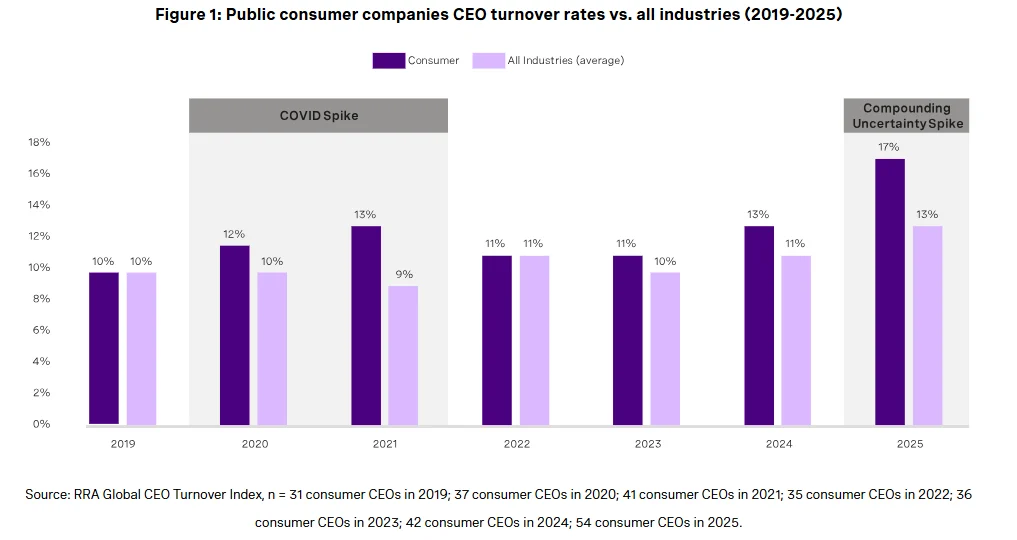
In 2025, a staggering 54 CEOs of publicly listed consumer companies worldwide departed their positions, marking the highest number since Russell Reynolds Associates began tracking CEO turnover in 2018. This surge translated into the highest turnover rate across all tracked sectors within major global indices, reaching an alarming 17%. Compounding this trend, these outgoing CEOs served, on average, just 6.3 years in their roles, falling below the global average of 7.1 years and continuing a significant shortening of tenure.
This pattern is not an isolated incident but rather a recurring theme for the consumer industry. CEO turnover within this sector has historically spiked during periods of significant disruption, as observed during the COVID-19 pandemic in 2020 and 2021, and again in the most recent reporting year. The direct correlation between consumer company performance and frontline consumer behavior means that shifts in consumer spending and confidence are swiftly reflected in financial results. Consequently, boards tend to react decisively when faced with these performance pressures.
What makes the 2025 data particularly striking is the apparent lack of preparedness among many consumer company boards. A parallel study, the 2025 Board Culture and Director Behaviors Study by Russell Reynolds Associates, revealed that nearly half of consumer board members either lacked a formal CEO succession plan or were unsure of its existence. Among those with a plan, almost half indicated that it extended only three years into the future. Across the entire sample of directors surveyed, approximately half expressed a lack of confidence in identifying an internal successor should their CEO depart unexpectedly. In an era characterized by persistently elevated turnover, the financial and strategic costs associated with such unpreparedness are escalating.
Compounding Uncertainty: A New Era of Disruption for Consumer Brands
The COVID-19 pandemic acted as a permanent catalyst, fundamentally altering consumer behavior. The widespread adoption of digital habits, the proliferation of omnichannel expectations, and the restructuring of operational models became the new standard. Boards initially rewarded agility and rapid transformation, promoting leaders who could make swift decisions under immense pressure. However, before many organizations could fully integrate these pandemic-induced changes, a new wave of disruption emerged, equally intense and significantly more complex to interpret.

Unlike the COVID-19 crisis, which, while challenging, provided a relatively clear, albeit arduous, trajectory for businesses to follow, the forces shaping the consumer landscape in 2025 and beyond are multi-directional and lack a definitive playbook. Persistent inflation and a prolonged period of high interest rates continue to strain household budgets, pushing consumers toward greater value-consciousness and selectivity. This intensified competition for consumer spending across various categories and geographies. As leaders navigate shifting trade policies, AI-driven technological transformations, and the deceleration of consumer spending, decision-making has become increasingly complex. A single issue, such as supply chain logistics, can rapidly cascade into pricing strategies, brand positioning, and marketing efforts, requiring leaders to manage multiple critical areas simultaneously. The pressure to deliver both short-term financial results and long-term resilience has demonstrably shortened boards’ patience for visible progress, leading to the increased CEO turnover observed across the industry.
The Evolving Profile of the Incoming Consumer CEO
While consumer boards have historically shown a willingness to appoint first-time CEOs, their stance on prior public company experience is becoming less flexible. Although first-time CEO appointments still constitute the majority at 78% of incoming leaders, there is a discernible shift towards seeking executives who have previously held the top job. Notably, appointments of CEOs with prior public company CEO experience nearly doubled year-over-year, and those with any prior CEO experience, whether public or private, nearly tripled.
This pronounced shift is a direct reflection of the current challenging operating environment. Boards are actively searching for leaders who possess a proven track record of navigating uncertainty and successfully executing transformations, particularly within larger organizations where the stakes are high and the margin for error is minimal. While first-time CEOs continue to be appointed, often due to their deep understanding of company-specific knowledge and existing credibility, the appeal of candidates with prior CEO experience has significantly strengthened. In an era where artificial intelligence is accelerating the pace of change at a rate that outstrips most organizations’ ability to adapt, boards are prioritizing leaders who can immediately match this tempo from day one.
The Succession Imperative in the Consumer Industry
CEO succession stands as one of the most critical responsibilities of any board of directors. In the consumer sector, the urgency surrounding this function has never been more pronounced. Consumer behavior serves as the primary driver for all subsequent business outcomes. Performance directly influences investor scrutiny and board expectations, which, in turn, shape the tenure of chief executives. When consumer behavior undergoes rapid shifts, boards must respond with commensurate speed.
The challenge extends beyond merely identifying the right candidate for the present moment. The pipelines upon which boards traditionally rely for future leadership are showing signs of erosion. According to Russell Reynolds Associates’ Global Leadership Monitor, a substantial 65% of C-suite and next-generation consumer leaders express a lack of explicit interest in pursuing CEO roles. This suggests that the pool of actively motivated and prepared executives may be smaller than boards anticipate. Furthermore, those consumer leaders who might otherwise develop such ambition may not remain with their current organizations. A concerning 73% of next-generation consumer leaders have indicated an interest in leaving their employers, and a significant 70% are open to exploring opportunities outside the consumer sector altogether.
Despite these warning signs, the prevailing approach among most boards remains reactive, focusing on transitions as they occur rather than proactive preparation. Prior research by Russell Reynolds Associates found that fewer than half of consumer board directors are confident in the success of their CEO succession plans. In a sector where the pace of change rarely abates, this widening gap between preparedness and need is becoming increasingly difficult to bridge.
Strengthening succession pipelines necessitates more than merely updating existing plans. Many boards are failing to adopt a sufficiently long-term perspective. A common deficiency is a lack of comprehensive understanding of their internal talent pool, leaving the internal pipeline largely invisible until a transition necessitates immediate action. Boards that proactively address this challenge invest in transparent succession processes, tailored leadership development programs, and cultivate a leadership culture where senior teams serve as role models for the behaviors required by next-generation leaders. In an industry already contending with record levels of turnover, these strategic investments are not merely best practices; they are becoming essential for ensuring a viable leadership pipeline and avoiding critical talent shortages.

Key Recommendations for Consumer Board Directors
In light of the escalating challenges, Russell Reynolds Associates offers three pivotal recommendations for consumer board directors to enhance their succession planning strategies:
1. Initiate Succession Planning Earlier and Emphasize Optionality Over Mere Replacement
Many consumer boards still commence succession planning a mere 12 to 18 months before an anticipated transition. In the current dynamic environment, this timeframe is demonstrably insufficient. Boards that begin this process three to five years in advance, or ideally, as soon as a new CEO assumes their role, gain a significant advantage. This extended timeline allows for the development of multiple credible candidates, facilitates the closing of critical experience gaps, enables robust scenario planning for potential activist investor pressures, ensures the maintenance of momentum on transformation mandates, and provides the agility to strategize effectively in anticipation of unforeseen external shocks.
2. Redefine Readiness for a Compressed CEO Lifecycle
Consumer CEOs currently experience the shortest tenures across all industry sectors. Given that first-time CEOs constitute the majority of new appointments, boards must fundamentally redefine what constitutes "readiness" for the role. This redefinition should move beyond prior experience and focus on attributes such as curiosity, adaptability, learning agility, demonstrated decision-making under pressure, proven ability to lead complex transformations, and the capacity to rapidly build and mobilize a high-performing senior team. Directors who establish clear expectations regarding the CEO’s mandate, desired outcomes, and inherent trade-offs from the outset are better positioned to prevent shortened tenures from becoming self-fulfilling prophecies, where judgments are made before performance can reasonably materialize.
3. Treat CEO Development as a Governance Responsibility, Not a Remedial Measure
Boards that approach first-time CEO appointments as a strategic choice understand that the decision to appoint is merely the beginning of the process, especially when the appointment is internal. Leadership development must be intrinsically integrated into the succession plan itself, rather than being viewed as an option that a CEO chooses to pursue or a measure only implemented when performance falters. Boards that invest early and visibly through structured onboarding, targeted coaching, and robust chair-CEO partnerships equip their CEOs with the optimal conditions to achieve peak effectiveness more rapidly than on-the-job learning alone would permit. The proactive development of a CEO serves as both a protective measure and a catalyst for accelerated performance.
The current landscape of elevated consumer CEO turnover demands a fundamental reassessment of traditional succession planning approaches. By embracing earlier planning, redefining leadership readiness, and prioritizing continuous development, boards can better position their organizations to navigate the complexities of the modern consumer market and ensure a stable and effective leadership future.
