

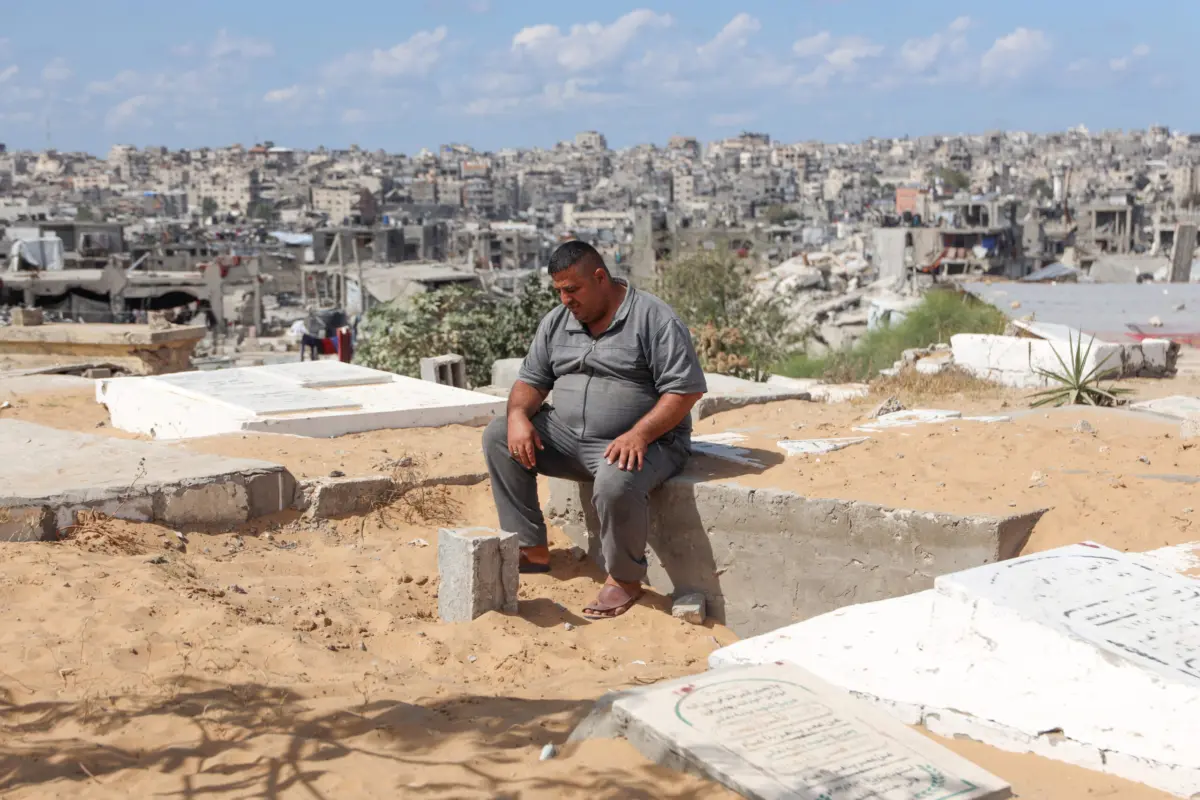
Every morning, under the pale Gaza sky, Mahmoud Khalla undertakes a solemn pilgrimage to a nearby cemetery, a ritual that has anchored his existence in the desolate months following an Israeli strike that annihilated his entire family. The graveyard has become his sanctuary, a physical space where he can commune with the ghosts of his past, imagining that his wife, three children, parents, two brothers and their families, his sister and her children, and other relatives are still around him, their laughter echoing in the quiet air. For Mahmoud, a 40-year-old resident of Gaza City, this daily routine is not merely a visit to graves; it is a desperate attempt to keep alive the memory of 39 souls, all lost in a single devastating moment on December 21, 2023.
The Catastrophic Strike in Jabalia
The tragic event unfolded in Jabalia, northern Gaza, a region that has borne the brunt of intense military operations. On that fateful day, Mahmoud’s extensive family had gathered in their five-storey home, seeking refuge and companionship amidst the escalating conflict. The Israeli military had by then significantly intensified its ground and aerial operations across northern Gaza, including Jabalia, following the October 7, 2023, attacks by Hamas. The area was under severe siege, with Israeli tanks surrounding key locations, restricting movement and access to essential supplies. Food, water, and medicine were already critically scarce, turning daily survival into a relentless struggle.
Mahmoud vividly recalls the suffocating atmosphere of that day, a memory etched into his heart with an unbearable ache. In the evening, driven by the desperate need to find provisions for his large family, he ventured out into the perilous streets. "I told them I would go and see what was available," he recounted to Al Jazeera, his voice heavy with the weight of that final conversation. "As soon as I had been out for about 15 minutes, I heard a huge explosion." The earth-shattering blast reverberated through the besieged neighborhood, a sound that would forever haunt him.
He ran back, propelled by a primal fear, only to be confronted by a scene of unimaginable horror. Their five-storey family home, once a vibrant hub of life and love, had been reduced to a pile of twisted metal and pulverized concrete. "I was in complete shock," he said, describing the instant his world collapsed. Despite the overwhelming despair, he pulled himself together, driven by a desperate hope. With the help of a few courageous neighbors who had not yet fled the area, he began to sift through the smoldering ruins, frantically searching for any sign of life.
An Obstacle Course of Danger and Despair

The immediate aftermath of the strike was a chaotic and perilous environment. Israeli air attacks, drone surveillance, and quadcopters continued to operate intensely over the area, making any sustained rescue attempt exceedingly dangerous. "A surveillance aircraft dropped a bomb on us, so we immediately ran away," Mahmoud recalled, highlighting the constant threat that prevented even the most basic humanitarian actions. The continuous military activity rendered the site inaccessible for formal emergency services; ambulances and civil defense teams, already overwhelmed and under-equipped, were unable to reach the devastated home that night.
Trapped between the searing pain of loss and the relentless danger, Mahmoud spent the night in a torment of helplessness. He clung to the faint hope that some of his family members might still be alive beneath the colossal pile of rubble, desperately waiting for rescue. He described feeling as though he had died a thousand times over in those agonizing hours. The following morning, as the first rays of dawn pierced through the smoke and dust, he returned to the shattered remnants of his home. He called out, his voice hoarse with grief and exhaustion, to his loved ones, hoping against hope for a response. The silence that met his calls was deafening, a definitive confirmation of the irreversible loss. "There were five floors of rubble. It was impossible for us to pull anyone out," he stated, the stark reality settling in that nearly every person he loved had been taken from him.
The Broader Context of Gaza’s Humanitarian Catastrophe
Mahmoud’s story is one among tens of thousands that illustrate the profound human cost of the ongoing conflict in the Gaza Strip. The Israeli military operation, launched in response to the October 7 attacks, has transformed Gaza into what international organizations describe as a humanitarian catastrophe of unprecedented scale. According to the United Nations Office for the Coordination of Humanitarian Affairs (OCHA), by mid-2024, more than 37,000 Palestinians, predominantly women and children, have been killed. Over 85,000 have been injured, and an estimated 1.7 million people – over 75% of Gaza’s population – have been internally displaced, many multiple times.
Northern Gaza, including Jabalia, was among the first and most heavily impacted areas. Reports from various humanitarian bodies, including the World Health Organization (WHO) and Médecins Sans Frontières (MSF), detail the systematic destruction of civilian infrastructure, including homes, hospitals, schools, and water facilities. The Israeli siege, which intensified after October 7, has severely restricted the entry of humanitarian aid, leading to widespread famine-like conditions, particularly in the northern governorates. International human rights groups have repeatedly called for investigations into alleged violations of international humanitarian law, including concerns about indiscriminate targeting and disproportionate use of force. The International Court of Justice (ICJ) has also heard cases alleging acts of genocide, a term used by some states and organizations to characterize the unfolding events, a classification that Israel vehemently denies, asserting its operations are self-defense against Hamas.
Alone and Adrift: Mahmoud’s Post-Strike Ordeal
The December 21 attack marked not only the end of Mahmoud’s family but also the beginning of an extended period of profound emptiness and precarity for him. With his home obliterated and almost all his relatives either killed or displaced to the south, he found himself utterly alone and without shelter. The scale of his loss extended beyond his immediate household; his uncles and their families had also been victims of the relentless violence. "Even my uncles had been killed," he explained. "Their house, opposite ours, was targeted nine days before our family home. Eighteen people were killed in that attack. The rest of the family had gone south." This secondary loss underscored the pervasive nature of the conflict, where entire family lines were being erased within days or weeks.

For months, Mahmoud was a displaced person in his own land, navigating the bombed-out streets in a desperate search for somewhere safe to sleep. The overwhelming number of displaced families meant that finding shelter was nearly impossible, especially for someone with no remaining family ties in the immediate vicinity. "I was sleeping in the streets, or in cars or vehicles whenever I found one that was open," he recounted, painting a stark picture of his homelessness. "I was totally lonely and homeless."
His existence was a daily struggle for survival, constantly exposed to the ongoing dangers of the conflict. The constant threat of Israeli attacks, whether from bullets, rockets, or drones, loomed large. Basic necessities, once taken for granted, became monumental challenges. "You don’t know whether a bullet will hit you, whether a rocket will come, whether you will find food or where you will sleep," he articulated, capturing the relentless anxiety that defined his days and nights.
The Agonizing Task of Recovery
As the intensity of major military operations somewhat subsided in early 2024, a grim and heartbreaking task began for many Gazans: the search for missing loved ones beneath the colossal piles of rubble. While no formal, sustained ceasefire was in place, periods of reduced bombing and increased accessibility in certain areas allowed for preliminary recovery efforts. Nearly a year after the initial escalation of the conflict, an estimated 8,000 people remained missing, their bodies believed to be entombed beneath the ruins of their homes or in other unidentified locations. This figure represents an unparalleled challenge for humanitarian and civil defense teams.
For Mahmoud, the unbearable thought that his family remained unburied, trapped within the debris of their home for months, was a constant torment. "The feeling that my family was still under the rubble, without being buried, was very difficult," he confessed. "It never left me." He desperately sought assistance from official channels, approaching civil defense units, the Red Cross, and other authorities. However, the scale of destruction was so immense, and the resources so depleted, that their capacity to help was severely limited. A critical shortage of heavy equipment, combined with an overwhelming number of requests from thousands of other grieving families, meant that Mahmoud’s pleas could not be met effectively.
Driven by an unwavering resolve and a profound sense of duty, Mahmoud decided to undertake the harrowing task himself. With the invaluable help of a few steadfast friends and neighbors who volunteered their time and strength, he began the painstaking process of recovering his loved ones by hand. This began around May 2024, a grueling endeavor that consumed three months of his life. "Sometimes, we managed to recover one person in a day. Sometimes, it took two days," he detailed, highlighting the meticulous and physically demanding nature of the work. The rubble, once the foundation of his family’s life, now held their final resting places, each brick and beam a testament to their tragic end.
The first remains he found belonged to two relatives who had been sheltering with the family. The search continued, day after day, through the dust and debris, until he finally uncovered his sister and her children, found together, in a poignant final embrace. Each discovery was a fresh wave of grief, yet also brought a step closer to closure. He meticulously gathered what remained of his family and buried them in a cemetery near Jabalia an-Nazla, in northern Gaza. "I felt a great sense of relief when I finally buried them," he shared, the exhaustion and emotional toll evident in his voice. "It took me three months to recover all of their remains, working day by day."

Broader Impact and Lingering Scars
Mahmoud Khalla’s story is a poignant microcosm of the wider devastation and trauma inflicted upon the people of Gaza. The systematic destruction of homes and the loss of entire families have profound long-term implications, extending far beyond the immediate casualties. The psychological scars on survivors like Mahmoud are deep and enduring. Mental health professionals and aid workers in Gaza report an unprecedented surge in post-traumatic stress disorder (PTSD), depression, and anxiety among the population, particularly children who have witnessed unimaginable horrors. The constant threat of violence, coupled with extreme displacement and deprivation, has created a pervasive sense of hopelessness and despair.
The sheer scale of destruction also presents an enormous challenge for any future reconstruction efforts. Thousands of buildings have been completely destroyed, and tens of thousands more severely damaged. Rebuilding homes, infrastructure, and communities will require monumental international support and resources, a process that could take decades. Furthermore, the recovery of missing persons remains an ongoing and agonizing process for countless families. The presence of unexploded ordnance (UXO) and the instability of damaged structures continue to pose significant risks to those attempting to retrieve remains.
Mahmoud’s daily visits to the cemetery are not merely a personal act of mourning; they are a stark reminder of the countless untold stories of loss and resilience across Gaza. His solitary journey reflects the collective grief of a population grappling with an unimaginable catastrophe, a testament to the enduring human spirit amidst profound desolation. As the world continues to grapple with the complexities of the conflict, stories like Mahmoud’s underscore the urgent need for a lasting peace and comprehensive humanitarian response that addresses not only the immediate needs but also the deep-seated trauma and long-term recovery required for a shattered society.
