

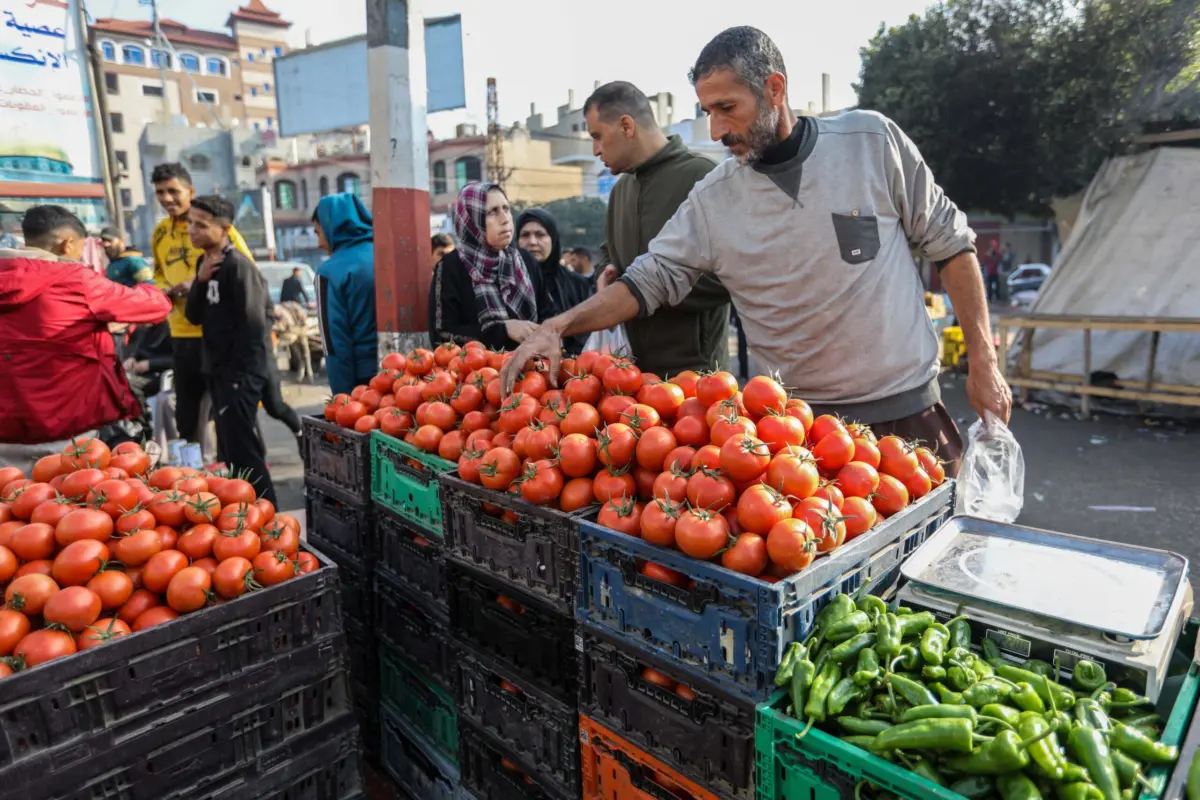
The Gaza Strip, home to 2.1 million Palestinians, faces an escalating humanitarian crisis following a two-day halt of commercial shipments by Israeli authorities. The cessation, which includes essential goods like fruit and winter clothing, cuts off a vital supply artery for a population already teetering on the brink of famine and heavily reliant on external aid and imports. The Israeli military body overseeing humanitarian affairs in Gaza, COGAT (Coordinator of Government Activities in the Territories), announced the halt on Wednesday, attributing the decision to an alleged tax dispute between local merchants and the governing Hamas administration.
According to COGAT’s statement, the suspension was a direct consequence of local merchants’ decision to stop imports, purportedly in response to new financial demands imposed by Hamas. COGAT claimed these demands included a 10,000 shekel ($3,220) fee on each truck entering Gaza, alongside a contentious requirement for 30 percent of all sales within the Strip to be conducted in cash. This Israeli narrative immediately sparked a vehement rebuttal from Gaza’s government media office, which on Thursday condemned the claims as "blatant disinformation" and a "false statement" designed to shift blame. The Hamas-affiliated office asserted that the fee in question was a voluntary contribution to a charitable fund aimed at supporting vulnerable populations, such as widows and orphans, and that cash payments were merely encouraged to address an acute shortage of physical currency in the war-torn territory, not a mandatory requirement.
The Economic Lifeline Under Threat
Gaza’s economy is fundamentally constrained by a protracted blockade imposed by Israel and Egypt, severely restricting the movement of goods and people since 2007. This blockade has decimated local industries, leading to soaring unemployment rates, particularly among youth, and an overwhelming dependency on humanitarian aid and commercial imports facilitated through Israeli-controlled crossings. The Kerem Shalom crossing, the primary gateway for commercial goods into Gaza, has been instrumental in supplying everything from construction materials to fresh produce, medical supplies, and basic consumer items. The flow of these goods is meticulously controlled by Israeli authorities, who cite security concerns for the stringent regulations.
The current halt, regardless of the disputed reasons, immediately impacts the availability and affordability of crucial supplies. While international aid organizations primarily deliver staples like flour, sugar, and cooking oil, commercial merchants are responsible for importing perishable foods such as fresh fruits, vegetables, and meat, as well as non-food items like winter clothing, hygiene products, and spare parts for essential infrastructure. Data released earlier this year by COGAT itself underscores this division of labor, highlighting the indispensable role of the commercial sector in diversifying the food supply and meeting the broader needs of the population.
A Deepening Humanitarian Crisis
The implications of this commercial shutdown are particularly dire given the pre-existing humanitarian catastrophe in Gaza. The United Nations and various international aid agencies have consistently warned of critical shortages across multiple sectors. A global hunger monitor, for instance, issued a stark warning in July, projecting that more than two-thirds of Gaza’s population could face acute hunger by the year-end. This is exacerbated by years of conflict, displacement, and economic hardship that have left a significant portion of the population food insecure and reliant on external assistance for survival.

The suspension of commercial shipments directly threatens to push more families into severe food insecurity. With winter fast approaching, the inability to import winter clothing and heating fuel could have devastating consequences, particularly for vulnerable groups such as children, the elderly, and internally displaced persons living in makeshift shelters. The lack of a robust commercial market also disrupts the delicate balance required to maintain stable prices. As Shaina Low, a spokesperson for the Norwegian Refugee Council, articulated, "The humanitarian sector on its own cannot meet the needs of all the people. The markets need to be functioning." When commercial supply chains are severed, prices of available goods often skyrocket due to scarcity, rendering even basic necessities unaffordable for the majority of Gaza’s impoverished residents.
Chronology of a Disputed Halt
The sequence of events unfolded rapidly, highlighting the volatile nature of supply lines into the enclave:
- Wednesday: COGAT officially announces the halt of commercial goods entering Gaza, citing a tax dispute between local merchants and Hamas as the primary reason. This immediately triggers concern among humanitarian organizations and local businesses.
- Thursday: Gaza’s government media office issues a strong denial of COGAT’s claims, refuting the allegations of mandatory fees and cash payment demands. They instead present the fees as voluntary contributions to a welfare fund and cash payments as encouraged due to a currency shortage.
- Ongoing: The halt continues for an unspecified duration, with Israeli authorities maintaining their stance and Gaza officials pushing back, leaving the fate of commercial goods in limbo. The impact of this stoppage begins to ripple through local markets, raising fears of shortages and price increases.
This recent incident mirrors a pattern of intermittent closures and restrictions that have historically characterized access to Gaza, often linked to security concerns, political disputes, or military escalations. Each disruption exacerbates the already fragile living conditions and further erodes the resilience of the civilian population.
Conflicting Narratives and Local Voices
The competing claims from Israeli and Gazan authorities underscore the deep distrust and political deadlock that govern the Strip. Nahed Sheheiber, the head of Gaza’s private truckers union, vehemently denied the Israeli narrative, stating, "The Israeli coordinator is claiming that Gaza’s merchants are responsible, but the truth is that the Israelis are the ones who imposed the restrictions." Sheheiber’s statement directly contradicts COGAT’s assertion, suggesting that Israel is using the alleged internal dispute as a pretext to restrict commercial access.
Following COGAT’s announcement, Sheheiber’s union met with Gaza’s Ministry of Economy to express their concerns. They reportedly conveyed that Israel was leveraging fees levied by the ministry—which Gaza officials claim are standard administrative charges or voluntary contributions—as a justification to cut off commercial goods, rather than the fees themselves being the cause of merchants’ refusal to import. This highlights the complex interplay of internal governance, Israeli control, and the severe economic consequences for the Palestinian population caught in the middle.
International Obligations and Insufficient Aid

Under a US-mediated agreement, Israel is obligated to allow a minimum of 600 trucks carrying humanitarian aid and commercial goods to enter Gaza each day. This figure is considered essential to meet the basic needs of the population. However, diplomats and humanitarian workers consistently report that the actual number of trucks entering Gaza falls significantly short of this benchmark. Sheheiber confirmed this disparity, estimating that the daily average is closer to 300 trucks, with approximately two-thirds of these carrying commercial goods. This means that even under normal circumstances, Gaza receives only half of its stipulated supply, rendering any further reduction catastrophic.
The international community, including the United Nations and various human rights organizations, has frequently called on Israel to ease its blockade on Gaza, citing its obligations under international humanitarian law to ensure the welfare of the civilian population in territories it occupies or exercises effective control over. The Fourth Geneva Convention, for example, places responsibility on an occupying power to provide for the needs of the civilian population. Critics argue that Israel’s tight control over Gaza’s borders, airspace, and territorial waters makes it an occupying power, with corresponding duties.
Broader Implications: Economic Collapse and Social Distress
The cessation of commercial shipments is not merely a logistical problem; it is a catalyst for deeper economic collapse and social distress within Gaza. The local market, already struggling with high unemployment rates—exceeding 50 percent for the general population and significantly higher for youth—and widespread poverty, will face immense pressure. Businesses reliant on imported raw materials or finished goods will be unable to operate, leading to further job losses. The informal economy, often a survival mechanism in Gaza, will also suffer as goods become scarce and expensive.
Beyond immediate economic ramifications, the long-term impact on public health and welfare is substantial. Shortages of specific food items can lead to dietary deficiencies, particularly among children, exacerbating existing health crises. The inability to import spare parts for essential infrastructure, such as water purification systems or electricity generators, could further degrade public services, which are already critically strained. The psychological toll on a population living under constant siege and facing chronic shortages is also immense, contributing to widespread mental health issues and a pervasive sense of hopelessness.
Looking Ahead: The Urgent Need for Resolution
The ongoing halt to commercial shipments into Gaza demands immediate attention and a swift resolution. While the precise nature of the dispute between local merchants and Hamas, and its alleged role in the Israeli decision, remains contested, the undisputed consequence is the increased suffering of 2.1 million people. The international community, particularly mediators like the United States and the United Nations, must exert pressure on all parties to ensure the unimpeded flow of essential goods into the Strip.
Resolving this specific dispute requires transparency from all sides and a commitment to prioritizing humanitarian needs over political or administrative disagreements. Beyond the immediate crisis, a more sustainable solution for Gaza’s economic future necessitates a fundamental reevaluation of the blockade policies, allowing for greater freedom of movement for goods and people, and fostering an environment where local industries can thrive. Without such comprehensive changes, Gaza will remain perpetually vulnerable to such disruptions, with its population bearing the brunt of ongoing political stalemates and humanitarian neglect. The current situation serves as a stark reminder of the urgent need for a durable political solution that addresses the root causes of the conflict and ensures the basic human rights and dignity of all Palestinians in the Strip.
