

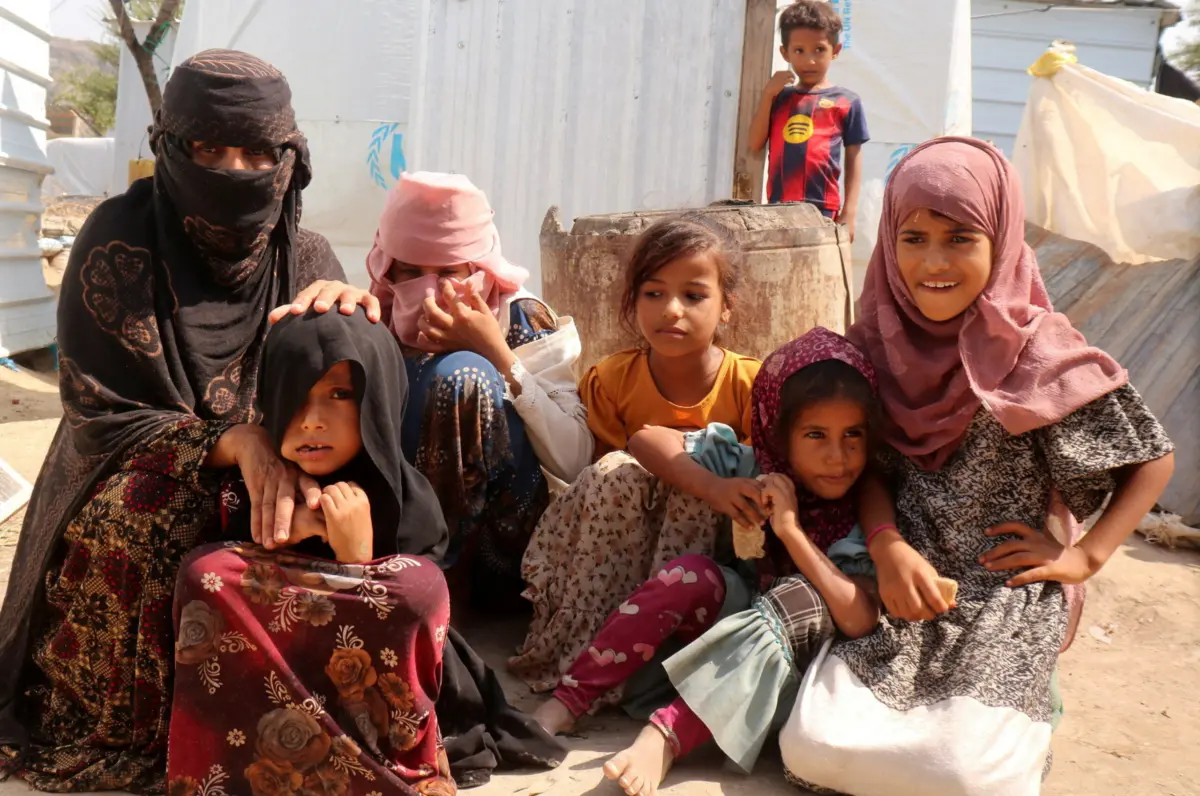
At sunrise, 12-year-old Ahmed stirs under the flimsy canvas roof of a tent, a temporary shelter in a displacement camp nestled within the Wadi Bani Khawlan area of Taiz governorate’s Jabal Habashi district. His days, for the past two weeks, have unfolded with a monotonous rhythm: playing with other children, or retreating into the confines of the tent, a stark contrast to the vibrant life he knew. This has been his routine since he was forced to flee his home in the village of al-Ashroh, west of the embattled city of Taiz, leaving behind everything familiar.
"Life in the camp is boring," Ahmed confides, his voice carrying the weight of a childhood prematurely interrupted. He yearns for the simple joys of his former existence – the comfort of his home, the bustling streets of his village, and most poignantly, the familiar weight of his school bag and the morning walk to his classroom. "I left my school bag in the house as we fled the clashes, and I do not know if I will carry it again and go back to my classroom and meet my teachers and classmates," Ahmed shared with Al Jazeera, his words echoing the uncertainty gripping countless Yemeni children.
The Echo of Renewed Conflict: A System Under Siege
Ahmed’s predicament is not an isolated incident but a poignant reflection of a deepening humanitarian and educational catastrophe unfolding across Yemen. After a fragile period of relative calm, spanning nearly four years, armed clashes between pro-government forces and the Houthi movement intensified sharply through August and September. This renewed wave of violence has dealt a devastating blow to Yemeni schools and students, further entrenching an already dire education crisis that has plagued the nation since the war began with the Houthi takeover of Sanaa in 2014.
According to the United Nations Children’s Fund (UNICEF), the recent escalation has led to the suspension of classes in hundreds of schools across conflict-affected parts of Yemen, disrupting the education of more than 137,000 students. The humanitarian body further reported that over 57,000 children were displaced in just the first two weeks of September alone, a number that has undoubtedly surged as hostilities persist. The broader scale of displacement is staggering; the UN stated on October 2 that more than 150,000 people have been newly uprooted by the recent fighting, adding to the staggering five million Yemenis who had already been internally displaced since the conflict’s inception.
From Classrooms to Camps: A Shift in Priorities
For families like Ahmed’s, arriving at a displacement camp means an immediate and stark reprioritization of needs. Education, once a cornerstone of daily life, takes a back seat to the fundamental struggle for survival. "Before the war reached my house and school, my family would care if I completed my school homework," Ahmed recalled. "Today, no one cares about education in the camp. Families’ focus shifted to tents, food and water." This grim reality highlights the severe pressures faced by displaced communities, where the pursuit of knowledge is overshadowed by the desperate search for shelter, sustenance, and safety.
The task of meeting these urgent needs falls heavily on humanitarian organizations, already grappling with stretched resources and monumental challenges. Mohammed Radman, a displacement coordinator with the Executive Unit for IDP Camp Management in Jabal Habashi district, painted a harrowing picture. He told Al Jazeera that thousands of students are now displaced, many compelled to abandon their education amidst what he described as "horrific circumstances."
Radman elaborated on the systemic collapse of the education infrastructure in conflict zones. "These students do not have options," he asserted. "All schools near the front lines are closed. And even if these students wanted to travel several kilometres every day to reach functioning schools, those schools are already crowded. So, the displaced students cannot be accommodated." He categorized schools in affected areas into three critical states: those repurposed as shelters for the displaced, those struggling with severe overcrowding, and those situated on or perilously close to front lines, rendering them inaccessible or dangerous. "This creates a real challenge for society, the Yemeni government and international organisations," Radman underscored, emphasizing the multifaceted nature of the crisis.
A Decade of Crisis: The Chronology of Yemen’s Educational Erosion
The current predicament is not sudden but the culmination of a decade-long conflict that has systematically dismantled Yemen’s social and infrastructural fabric.
- 2014: The Houthi movement seizes Sanaa, marking the start of a protracted civil war.
- 2015: A Saudi-led coalition intervenes, escalating the conflict and initiating widespread aerial campaigns. This period sees the initial wave of school closures and damage.
- 2016-2021: Sustained conflict leads to widespread destruction of schools, displacement of populations, and a significant exodus of teachers due to unpaid salaries. UNICEF reports indicate hundreds of schools are either destroyed, damaged, or repurposed for military use. The curriculum becomes politicized, further fragmenting the education system.
- 2022-Early 2026: A period of relative calm emerges, partly facilitated by a UN-brokered truce in April 2022 and subsequent de-escalation efforts. While some recovery attempts are made, the underlying vulnerabilities in the education system persist. Many schools remain damaged, and teacher salaries are still inconsistent.
- August-September 2026: Renewed and intensified clashes erupt, particularly in key battleground areas like Taiz. This new wave of violence triggers mass displacement and immediate school closures, reversing hard-won, albeit limited, gains.
- October 2026: The UN reports over 150,000 new displacements, bringing the total displaced population to over 5.15 million. The education crisis deepens, with thousands more children like Ahmed finding their futures on hold.
Even before this latest escalation, UNICEF estimated that a staggering 3.2 million children were already out of school in Yemen. This figure represents roughly one in four school-aged children, highlighting the long-term systemic failures exacerbated by the conflict. The recent wave of displacement is poised to worsen this ordeal dramatically.
Beyond the Classroom: The Perils of a Lost Generation
The implications of prolonged educational disruption extend far beyond lost lessons. Tawfiq al-Humaidi, the president of SAM Organization for Rights and Liberties, warned of the severe risks facing Yemeni children. "This war leaves them vulnerable to homelessness, begging, and potentially forced recruitment," al-Humaidi stated, emphasizing that "alternatives available to children outside the classroom are not safe."
The hope among families that their stay in displacement camps will be temporary often clashes with the harsh reality that educational disruption can be long-lasting. Al-Humaidi pointed out that extended periods in camps can pull children into alternative daily routines, making their eventual return to formal schooling increasingly difficult. "The repercussions extend beyond deprivation and the loss of educational lessons to the loss of the social and psychological protection provided by schools," he explained. "When schools close, children become more vulnerable to violence, exploitation, recruitment and child labour."
Indeed, the absence of a structured educational environment removes a critical protective layer for children. Girls become more susceptible to early marriage as families seek to reduce the financial burden or ensure perceived security. Boys, particularly, face the terrifying prospect of forced recruitment by armed factions, a tragic outcome that perpetuates the cycle of violence. The psychological toll is also immense; children exposed to conflict and displacement often suffer from trauma, anxiety, and depression, conditions that schools, with their routines and supportive environments, can often help mitigate.
The Challenge of Teaching in a War Zone
For educators, the task of providing continuity in learning is almost insurmountable. Abdulkarim, a teacher in Taiz who requested anonymity due to security concerns, articulated the profound difficulties of teaching in a "war zone." "When students hear explosions, fear bullets and stay in shaky tents, education cannot happen. I saw how little children cry when they hear the sounds of heavy gunfire," he recounted. His observations underscore the primary obstacle: the pervasive lack of security and stability.
Abdulkarim stressed that providing students with a safe environment must be the absolute priority. "Once that is achieved, we can try to accommodate students in functioning schools or create alternative centres so that students can continue to receive education," he added. This highlights the multi-layered approach required, where immediate safety must precede any meaningful educational intervention.
The sheer scale of the educational damage is immense. Pre-war, Yemen already struggled with high illiteracy rates, particularly among women. The conflict has only exacerbated this, leading to significant learning loss and the potential for a "lost generation." Infrastructure damage alone is staggering: UNICEF estimated that by 2020, over 2,500 schools were either damaged, destroyed, or used for non-educational purposes (such as sheltering IDPs or military use). With the recent escalation, these figures are certainly higher. Moreover, the economic collapse has meant that tens of thousands of teachers have gone unpaid for years, forcing many to seek alternative livelihoods or abandon the profession altogether, further crippling the system.
A New Illiterate Generation: Long-Term Implications and Solutions
Afrah al-Humaiqani, a sociologist based in Aden, echoed the dire warnings, stating that the recent hostilities risk denying thousands of students access to education, which could tragically contribute to creating a "new illiterate generation" in Yemen. The long-term implications of this are catastrophic, not only for individuals but for the entire nation’s future development, stability, and potential for peace. An uneducated populace is less equipped to rebuild a war-torn country, participate in a functioning economy, or contribute to democratic governance. It perpetuates cycles of poverty, vulnerability, and dependence.
However, al-Humaiqani maintains that reducing the impact of this crisis is still possible, provided there is concerted cooperation and coordination between the Yemeni government and international organizations. "There is a need for safe camps where students can feel secure," she told Al Jazeera. "This can be followed by the provision of teachers and textbooks, programmes to address learning loss, and provide psychosocial support for children."
These proposed solutions are comprehensive, addressing both the immediate humanitarian needs and the long-term educational recovery. Safe learning spaces, whether dedicated classrooms or temporary centers within camps, are crucial. Recruiting and paying teachers, perhaps through international funding mechanisms, is essential to rebuild the teaching workforce. Crucially, addressing "learning loss" – the academic regression experienced by children out of school – will require specialized curricula and accelerated learning programs to help students catch up. Finally, psychosocial support is paramount for children who have endured trauma, helping them to cope, heal, and reintegrate into learning environments.
The international community, including major donors and UN agencies, must renew their commitment to Yemen’s education sector. This includes advocating for an immediate and lasting ceasefire, ensuring humanitarian access, and prioritizing funding for educational initiatives. Without a concerted and sustained effort to protect and restore education, the cries of children like Ahmed will fade into the collective silence of a generation denied its fundamental right to learn, leaving an indelible scar on Yemen’s future. The potential for a "new illiterate generation" looms large, a stark reminder of the enduring human cost of protracted conflict.
