

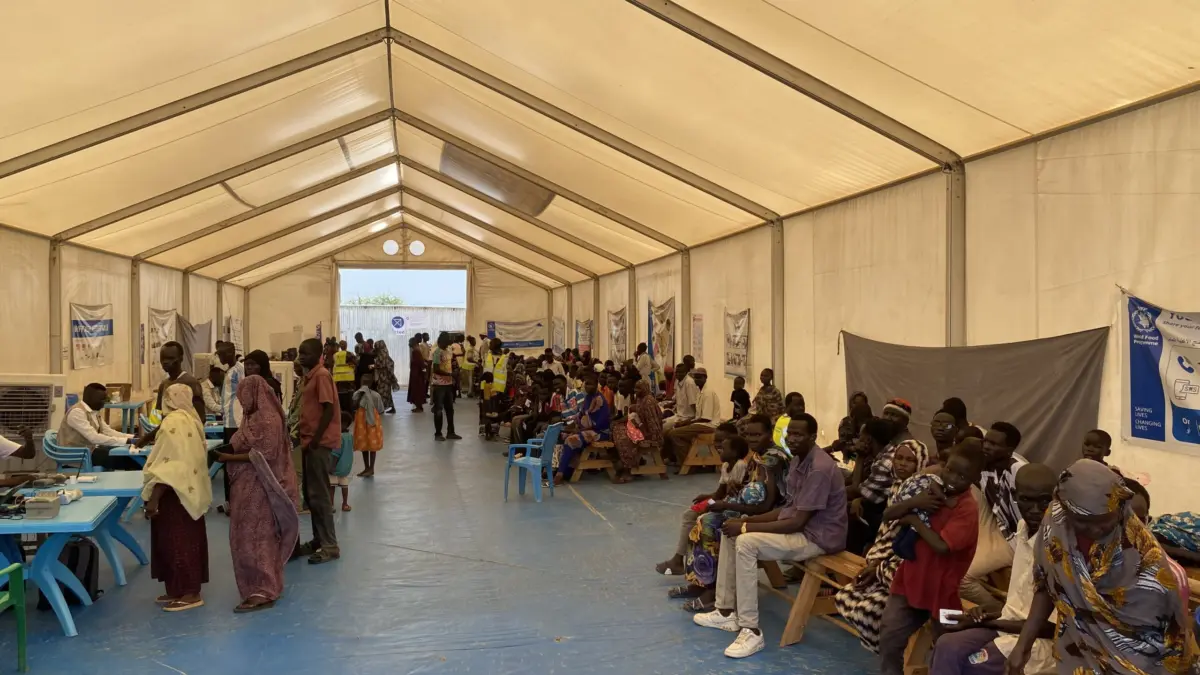
Renk, South Sudan – As the pre-dawn light barely pierces the horizon, a relentless tide of humanity continues to flow across the border into South Sudan. Women, often carrying infants and their meagre possessions in plastic bags, and men, frequently arriving with little more than the clothes on their backs, represent the weekly average of approximately 3,000 refugees and returnees escaping the devastating conflict in neighbouring Sudan. These arrivals, hungry, exhausted, and largely destitute, are stepping into a nation already reeling from its own protracted crises, only to find that the very food assistance they desperately depend on is on the verge of collapse.
The World Food Programme (WFP) issues a stark warning: over one million highly vulnerable individuals in South Sudan face the imminent loss of life-saving food and nutrition assistance by October unless substantial additional resources are secured. This humanitarian catastrophe unfolds against a backdrop of shrinking global aid budgets and burgeoning needs exacerbated by regional instability and climate change.
The scale of the crisis is graphically illustrated in Malakal, a pivotal logistics hub for humanitarian operations in Upper Nile state. Food stocks, which stood at a robust 10,000 metric tonnes at this time last year, have plummeted to a perilous less than 300 tonnes. This dramatic reduction comes as humanitarian agencies contend with an alarming paradox: global demand for aid is skyrocketing, while the financial means to provide it are dwindling rapidly.
Matthew Hollingworth, WFP Assistant Executive Director, recently undertook a harrowing visit to Renk and Malakal in Upper Nile, and Pigi county in Jonglei state. His firsthand observations painted a grim picture of communities trapped in a vicious cycle of conflict, displacement, chronic hunger, and recurrent climate shocks. Speaking to Al Jazeera, Hollingworth underscored the profound ripple effects of the Sudanese conflict on South Sudan, noting a sharp escalation in prices and immense pressure on a nation already stretched to its limits in accommodating those fleeing violence. "The war in Sudan has been catastrophic for the north of this country. Prices have gone so much higher due to the complexity of importing goods from Sudan," he explained. "Moreover, the influx of refugees [comes] to a country that is really stretched when it comes to helping them."
During his visit to Renk, Hollingworth witnessed the stark environmental contradictions plaguing the region, with areas ravaged by prolonged drought existing alongside others still struggling with the aftermath of severe flooding. This climatic volatility further complicates agricultural efforts and exacerbates food insecurity. He lamented the global context, stating, "It all comes at the time when the international community has a lot less to give, and we don’t have the same resources we used to have." Compounding these external pressures, Hollingworth also pointed to internal challenges, urging the South Sudanese government to address "the issue of illegal checkpoints that prevent us from being able to get everywhere. We need to reach vulnerable people across the country." These roadblocks not only delay critical aid but also inflate operational costs, making an already difficult task even more challenging.

A Nation on the Brink: South Sudan’s Pre-existing Vulnerabilities
South Sudan, the world’s youngest nation, has endured a tumultuous history since its independence in 2011. Years of civil war (2013-2018), inter-communal violence, and political instability have decimated its infrastructure, displaced millions, and left its population highly vulnerable. Even before the current Sudanese crisis, South Sudan was facing one of the world’s most severe humanitarian emergencies. According to UN OCHA, over two-thirds of its population required humanitarian assistance in 2022. Chronic food insecurity, exacerbated by recurrent floods, droughts, and pest infestations, was already a critical concern. The country consistently ranks among the lowest in human development indices, with limited access to basic services like healthcare, education, and clean water.
The influx of over 1.4 million refugees and returnees since the Sudanese conflict erupted in April 2023 has pushed these pre-existing vulnerabilities to breaking point. Many of the returnees are South Sudanese who had sought refuge in Sudan during their own country’s civil war, now forced to flee once again. Their return, while understandable, places an additional, immense burden on communities and services that were already struggling to cope.
Voices from the Frontlines of Despair
The human cost of this multi-layered crisis is palpable in the testimonies of those directly affected. Peter Maker, an internally displaced person (IDP) in Pigi county, articulated the profound challenges faced by his community. "We face major challenges due to national insecurity and an influx of people from other areas. Our main issues are insecurity and lack of access to farmland," he told Al Jazeera. Despite being "able-bodied and qualified to work," Maker’s opportunities are severely curtailed by the pervasive insecurity, which prevents him from travelling safely for work or farming. This leaves him and countless others "heavily reliant on the UN and aid." Maker underscored the urgent need for "longer-term solutions" and warned that further cuts or blockages to assistance would be "devastating." He candidly attributed much of the local suffering to political leadership failures and persistent divisions between communities, while acknowledging that people currently survive through a combination of sharing resources, relying on faith, and receiving occasional aid.
Renk, strategically located in Upper Nile state near the border with Sudan, has become an unintentional gateway for this mass movement of people. The journey to Renk is often fraught with peril, marked by numerous checkpoints, extortion, and violence. Many arrive traumatized, with little clarity about their immediate future or where they will find safety and sustenance.

Zainab Musa, a mother of six seeking refuge at a transit centre in Renk, recently arrived from Sudan and described the dire conditions. "The humanitarian situation is hard and there is nothing to eat, just hunger," she recounted to Al Jazeera. "I thought of moving from the border at Jodha to the transit centre to look for help." Musa expressed her intention to travel to her grandfather in Bunj, Maban county, also in Upper Nile, highlighting the fragmented and often desperate attempts by families to reunite or find safer havens.
These transit centres in Renk, originally designed for temporary processing, are now overwhelmed by the sheer scale and protracted nature of arrivals. Families, sometimes numbering in the hundreds, linger for months awaiting onward transport to Malakal or other parts of South Sudan, stretching resources and facilities far beyond their intended capacity. The WFP has already been forced to implement drastic measures, reducing rations and cutting essential support as funding streams have dried up.
The alarming projections extend beyond general food aid. In August, the WFP and the United Nations High Commissioner for Refugees (UNHCR) jointly warned that over 650,000 refugees and asylum seekers were at immediate risk of losing food assistance. More specifically, they projected that food and nutrition assistance for the most vulnerable 240,000 refugees would cease entirely by September without a critical injection of additional funding. Nura Mohammed Ahmed, a Sudanese refugee, bore witness to the grim reality, stating that hunger and inadequate nutrition were already exacting a heavy toll at the transit centre, with visible signs of suffering among the displaced.
Malakal’s Fragile Refuge: A City Under Siege
Malakal, a city with a long history of hosting populations displaced by conflict and disaster, represents another critical node in this unfolding crisis. The former Protection of Civilians (PoC) site, recently redesignated as an internally displaced people’s (IDP) settlement, is currently home to nearly 40,000 displaced individuals across more than 6,000 households. Many of these residents have been displaced for years, their lives punctuated by successive waves of conflict and environmental calamities.
The influx of new arrivals further strains Malakal’s already fragile basic services. The International Organization for Migration (IOM) has issued a dire warning regarding the precarious state of water, sanitation, and hygiene (WASH) services in both Bentiu and Malakal, attributing the risk to severe funding shortfalls. Without crucial drainage pumping and dyke maintenance, Malakal faces a heightened and potentially catastrophic risk of widespread flooding during the impending rainy season, which could displace thousands more and trigger public health emergencies.

Najah al-Tayieb al-Fadhul, a Sudanese refugee and mother of four, arrived at a transit centre in December 2023 after experiencing unimaginable trauma. "My husband was killed by the Sudan armed forces in front of me, and I could not stay with my kids there because the situation was traumatizing," she recounted to Al Jazeera. Desperate to provide for her children, she has "tried her best to hustle and earn some small job with the humanitarian organisations based in Renk." Despite her efforts, al-Fadhul confirmed that hunger, sickness, and malnutrition are an inescapable part of daily life. "There are massive cases of hunger, sickness and malnutrition among the children," she stated, adding poignantly, "Even my child has a heart disease, and I cannot afford to treat him." Despite holding a college degree, al-Fadhul struggles to find stable employment, often earning a meagre $2.50 a day from casual market work. "The humanitarian situation is worsening despite securing a job with one of the organisations," she observed. "WFP only helped us here with the small ration for the children in particular. Elders and most individuals lack energy to work due to hunger."
The Funding Gap: A Chasm of Unmet Needs
The financial lifeline sustaining humanitarian operations in South Sudan is dangerously thin. The WFP reports an immediate funding gap of $86 million, with a projected shortfall of $416 million over the next six months. This staggering deficit directly threatens the agency’s capacity to deliver essential aid to refugees, internally displaced people, and vulnerable host communities. The implications extend far beyond the immediate beneficiaries of WFP assistance. For the wider South Sudanese population, the hunger crisis is already severe and widespread. The WFP estimates that a staggering 7.8 million people – more than half of South Sudan’s entire population – are grappling with high levels of acute food insecurity. Furthermore, an alarming 2.2 million children are acutely malnourished, a condition that can lead to irreversible developmental damage and increased mortality rates.
The WFP’s current emergency response plan for South Sudan highlights a total funding shortfall of $258 million for the remainder of 2026, underscoring the systemic and persistent nature of the financial challenges. This recurring crisis means that aid agencies are constantly operating in a reactive mode, unable to plan effectively for long-term solutions or build resilience within communities.
For those arriving from Sudan, the journey across the border offers no respite; the crisis merely transforms. Nura Mohammed Ahmed articulated the horrific choice confronting many refugees in stark terms: "Many people died here because of hunger and lack of nutrition. There’s nothing, or food that can give us strength. The only solution is to return to war-torn Sudan despite the risks, or die here from hunger." This sentiment reflects the profound desperation and lack of viable alternatives faced by hundreds of thousands.
Broader Impact and Implications

The humanitarian crisis in South Sudan, intensified by the spillover from Sudan, carries profound implications not just for the affected individuals but for regional stability and global humanitarian efforts. A collapse in aid could trigger further displacement within South Sudan, intensifying pressure on already scarce resources and potentially fueling inter-communal conflicts over land and water. The breakdown of health and sanitation services could lead to outbreaks of preventable diseases, further straining a nascent healthcare system.
Economically, the influx of people and the disruption of trade routes with Sudan have driven up inflation, making basic goods unaffordable for many. South Sudan’s nascent economy, heavily reliant on oil, struggles to diversify and provide sustainable livelihoods for its population. The protracted humanitarian crisis also diverts resources and attention away from long-term development goals, trapping the country in a cycle of emergency response.
Internationally, the situation in South Sudan serves as a stark reminder of the interconnectedness of regional conflicts and the escalating demands on a global humanitarian system already stretched thin by multiple crises worldwide. The reluctance of international donors to fully fund critical operations in South Sudan reflects a broader fatigue, yet the consequences of inaction are dire. Without sustained and increased funding, the gains made in stabilizing communities and preventing famine could be rapidly reversed, leading to a much larger and more costly emergency in the near future.
The urgent call from humanitarian agencies is not just for immediate financial assistance but also for renewed political will, both within South Sudan and internationally, to address the root causes of conflict, ensure unimpeded access for aid, and invest in long-term solutions that build resilience and pave the way for sustainable peace and development. The fate of over a million vulnerable people hangs precariously in the balance, a testament to the devastating human cost of unresolved conflicts and underfunded humanitarian responses.
