

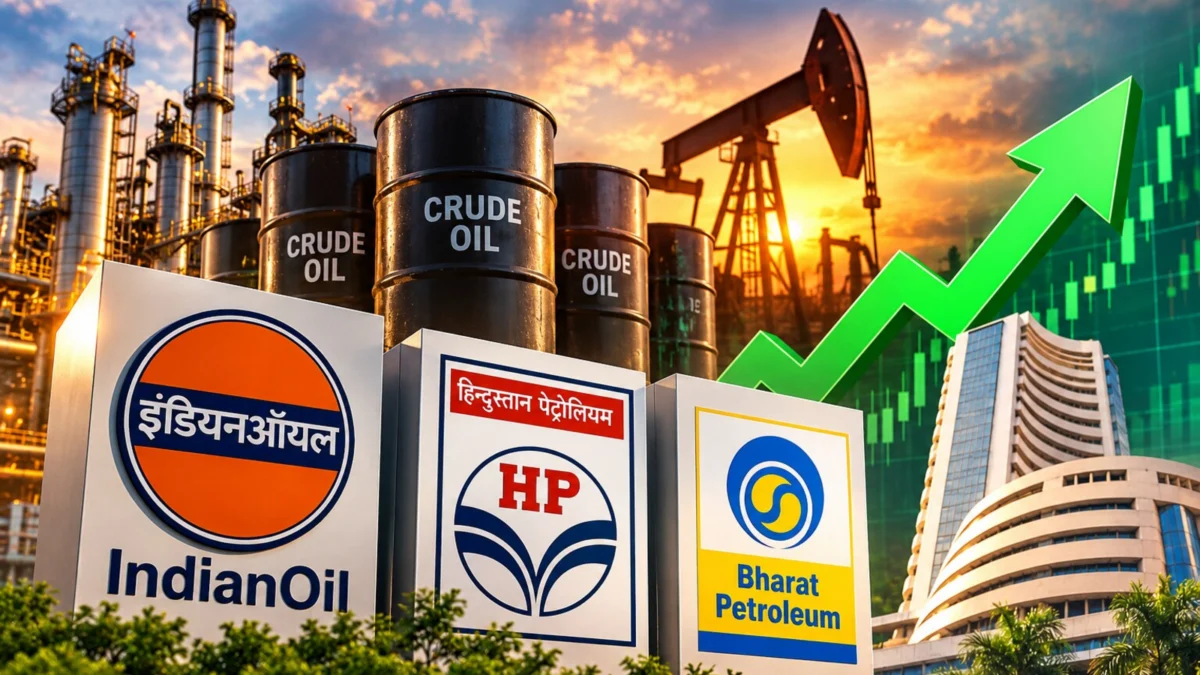
The Indian equities market witnessed a significant surge in energy and utility stocks during the midweek session on Wednesday, September 30, as a sharp decline in international crude oil prices triggered a wave of buying interest across the oil and gas sector. Shares of major state-run Oil Marketing Companies (OMCs), including Indian Oil Corporation (IOC), Hindustan Petroleum Corporation (HPCL), and Bharat Petroleum Corporation (BPCL), led the rally, climbing as much as 3% in intraday trade on the Bombay Stock Exchange (BSE). The upward momentum was not confined to the "Big Three" OMCs; gas transmission giant GAIL (India) Ltd, liquefied natural gas importer Petronet LNG, city gas distributor Indraprastha Gas Limited (IGL), and the country’s most valuable company, Reliance Industries (RIL), also posted notable gains, reflecting a broader sector-wide recovery.
The rally comes at a time when the global energy landscape is navigating a period of heightened volatility, primarily driven by shifting demand-supply dynamics and macroeconomic headwinds in major consuming nations. For Indian oil companies, the relationship between international crude prices and domestic stock performance is often inverse: as the cost of Brent crude falls, the financial outlook for downstream companies improves, leading to the type of investor enthusiasm seen in today’s trading session.
The Catalyst: Why Crude Oil Prices Are Sliding
The primary driver behind the sudden appreciation in oil-linked stocks is the softening of global crude benchmarks. Brent crude, the international benchmark for oil prices, has faced downward pressure due to a combination of factors. First, concerns over a slowdown in global manufacturing activity, particularly in China and the Eurozone, have dampened the demand outlook. As the world’s largest importer of crude, any sign of economic cooling in China sends ripples through the energy markets.
Furthermore, reports of increased supply from non-OPEC+ producers, coupled with speculation regarding the easing of production cuts by the OPEC+ alliance, have added to the bearish sentiment for oil prices. In recent sessions, Brent has struggled to maintain its footing above key psychological levels, retreating toward the lower end of its recent trading range. For a country like India, which imports more than 85% of its crude oil requirements, this downward trend in international prices serves as a significant tailwind for the domestic economy and the corporate entities tasked with refining and distributing fuel.
Understanding the Impact on OMCs: IOC, BPCL, and HPCL
The state-owned OMCs—IOC, BPCL, and HPCL—occupy a unique position in the Indian economy. They are the primary entities responsible for the procurement, refining, and retail distribution of petroleum products across the country. The profitability of these firms is largely determined by two key metrics: Gross Refining Margins (GRMs) and Marketing Margins.
- Marketing Margins: This refers to the profit OMCs earn on every liter of fuel sold at the retail pump. When international crude prices fall, the cost of raw material (crude) decreases. If the retail prices of petrol and diesel remain steady at the pump, the OMCs’ marketing margins expand significantly. This "spread" is a direct contributor to their bottom line. Investors often pile into these stocks when crude prices drop, anticipating a bumper quarter for marketing profits.
- Gross Refining Margins (GRMs): This is the difference between the price of crude oil and the total value of the petroleum products produced from it. While lower crude prices are generally positive, the market also looks at "crack spreads"—the difference between the price of crude and specific products like diesel, jet fuel, and gasoline.
On Wednesday, the market’s reaction suggested a high degree of confidence that the current drop in crude would provide a much-needed cushion to the OMCs’ margins, which have been under pressure in previous quarters due to volatile global prices and the government’s efforts to keep domestic fuel prices stable to curb inflation.
Beyond the OMCs: GAIL, Petronet LNG, and IGL
The rally extended beyond the liquid fuel segment into the natural gas sector. GAIL (India) Ltd, the nation’s largest natural gas company, saw its share price rise as lower energy prices generally reduce the cost of gas sourcing and transmission fuel. For city gas distribution companies like Indraprastha Gas Limited (IGL), lower international energy prices can lead to a reduction in the cost of imported Liquefied Natural Gas (LNG), which is often used to supplement domestic gas supplies.
Petronet LNG, which operates major regasification terminals, also benefited from the sentiment. Lower spot LNG prices—often correlated with crude oil movements—encourage higher consumption volumes among industrial users, thereby increasing the throughput and revenue for terminal operators. The synchronization of gains across the oil and gas value chain indicates that investors are betting on a holistic improvement in the sector’s operating environment.
Reliance Industries: The Complex Refiner’s Perspective
Reliance Industries (RIL), which operates the world’s largest single-location refining complex in Jamnagar, also saw its shares gain ground. Unlike the state-run OMCs, RIL’s refining business is highly sophisticated, capable of processing "heavy" and "sour" crudes that are cheaper than the Brent benchmark.

For RIL, a drop in crude prices is a double-edged sword. While it reduces the cost of feedstock, it can also signal weak global demand for refined products. However, the market today focused on the positive aspect: lower input costs and the potential for improved domestic demand as the festive season approaches in India. RIL’s diversified portfolio, which includes telecommunications and retail, often provides a hedge, but its O2C (Oil-to-Chemicals) segment remains a massive driver of its stock price, making it highly sensitive to global energy trends.
Chronology of the Oil Market Volatility (2025-2026)
To understand the context of the September 30 rally, one must look at the timeline of events that have shaped the energy sector over the past year:
- Late 2025: Crude prices remained elevated above $85 per barrel due to geopolitical tensions in the Middle East and restricted supply from the OPEC+ bloc. This put significant pressure on Indian OMCs, leading to "under-recoveries" on certain products.
- January – March 2026: A brief period of stability was observed as global supply chains normalized, but prices remained sensitive to any news regarding the US Federal Reserve’s interest rate path.
- June 2026: OPEC+ announced a plan to gradually phase out some of its voluntary production cuts, leading to initial market jitters about an oversupplied market.
- August 2026: Weak economic data from the United States and China began to weigh heavily on the demand outlook. Brent crude began a steady descent from the $80 level.
- September 2026: The decline accelerated as Libyan oil production returned to the market following a period of domestic political instability, and Saudi Arabia reportedly signaled a shift toward regaining market share rather than maintaining a price floor.
- September 30, 2026: The intraday rally in Indian oil and gas stocks occurs as Brent crude hits a multi-month low, providing a clear signal to domestic investors to increase exposure to downstream energy plays.
Supporting Data and Market Reactions
Market analysts have noted that for every $1 per barrel drop in crude prices, Indian OMCs can potentially see an improvement of 30 to 40 paise per liter in their marketing margins, provided retail prices are not adjusted downward. With Brent crude falling by several dollars in recent weeks, the mathematical upside for companies like BPCL and HPCL is substantial.
In the derivatives market, there was a noticeable increase in "long" positions for oil and gas futures. Trading volumes on the BSE for IOC and BPCL were significantly higher than their 30-day averages, indicating strong institutional participation. Domestic brokerage firms have maintained a "Buy" or "Accumulate" rating on most OMCs, citing attractive valuations and a favorable risk-reward ratio given the current crude trajectory.
While official statements from the Ministry of Petroleum and Natural Gas or the heads of the OMCs are rare during intraday market movements, sources within the industry suggest that the companies are utilizing this period of lower prices to optimize their inventory costs. "The current price environment allows for a stabilization of the balance sheet," noted an industry consultant. "After a period of high volatility, this breather in crude prices helps in planning capital expenditure for green energy transitions, which all major OMCs are currently undertaking."
Broader Economic Implications
The rally in oil-linked stocks is not just a corporate success story; it has broader implications for the Indian economy. High oil prices are a major contributor to "imported inflation." When crude prices fall, the pressure on the Reserve Bank of India (RBI) to maintain a hawkish monetary policy eases, as the risk of fuel-driven inflation diminishes.
Furthermore, a lower oil import bill helps in narrowing the Current Account Deficit (CAD) and strengthens the Indian Rupee against the US Dollar. For the government, lower crude prices reduce the subsidy burden on domestic cooking gas (LPG) and provide more fiscal room to meet deficit targets without cutting back on infrastructure spending.
Future Outlook: Risks to Watch
Despite the current euphoria, market experts warn of several "known unknowns" that could reverse the rally. The primary risk remains geopolitical; any escalation of conflict in oil-producing regions could lead to a sudden "risk premium" being added back to crude prices. Additionally, if the global economy enters a deeper-than-expected recession, the benefits of lower input costs for oil companies might be offset by a sharp decline in the volume of fuel consumed.
Investors will also be closely watching the upcoming OPEC+ ministerial meetings. If the cartel decides to implement deeper production cuts to support prices, the recent gains in OMC stocks could be erased. Furthermore, the Indian government’s policy on retail fuel pricing remains a wildcard. If the government directs OMCs to pass on the benefits of lower crude to consumers through a price cut at the pump, the anticipated expansion in marketing margins would be curtailed.
Conclusion
The 3% climb in shares of IOC, HPCL, BPCL, and their peers on September 30 serves as a clear indicator of how closely the Indian markets are tethered to global energy benchmarks. As crude prices retreated amid global demand concerns and supply increases, the domestic oil and gas sector found a reason to cheer. For now, the combination of stable retail prices and falling raw material costs has created a "Goldilocks" scenario for downstream companies. However, in the fast-moving world of global commodities, both investors and policy-makers remain watchful, knowing that the tide in the oil markets can turn as quickly as it arrived. For the moment, the bulls are in control of the energy counters on Dalal Street, fueled by the hope of improved margins and a healthier fiscal outlook for India’s energy giants.
