

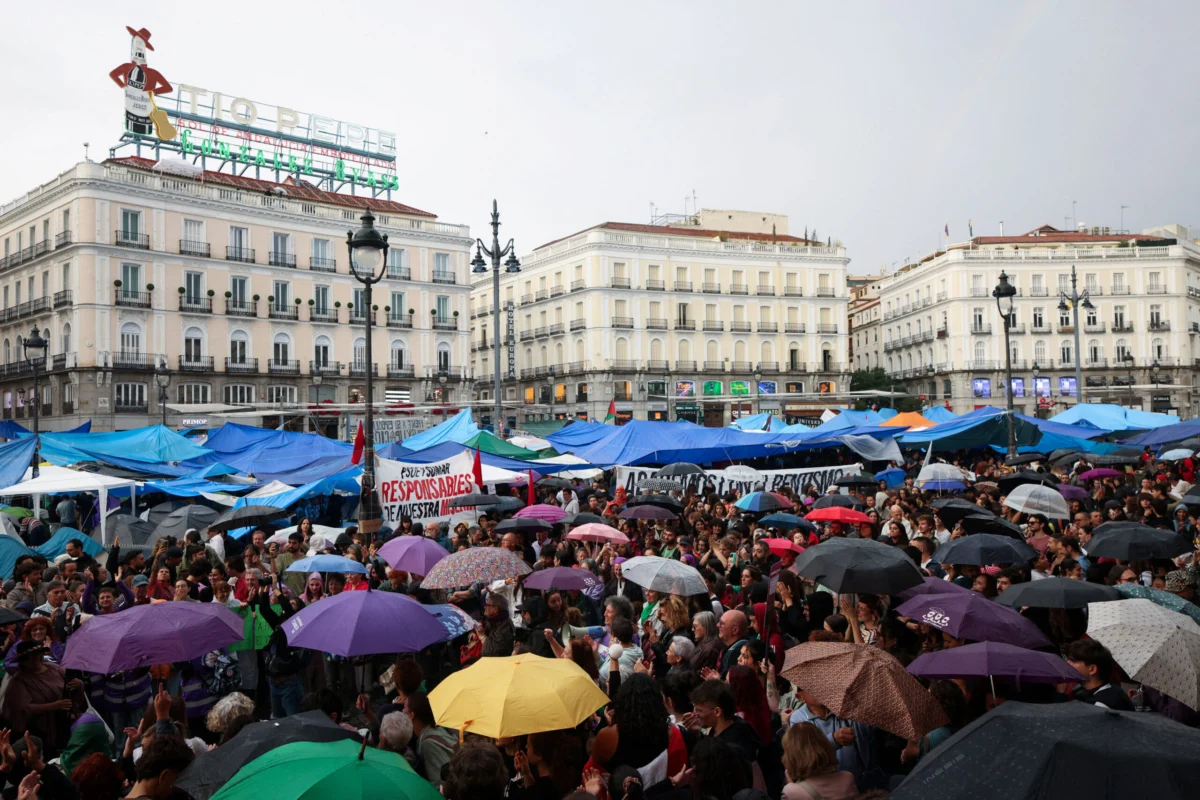
The demonstrations come at a time when Spain’s housing market is under unprecedented pressure. According to data released by the Bank of Spain, the country currently faces a structural deficit of approximately 750,000 housing units. If current trends in construction and demographic shifts continue, this shortfall is projected to exceed one million homes by 2028. For the protesters occupying the streets, these are not merely statistics; they represent a systemic failure that has pushed the dream of stable housing out of reach for a significant portion of the population.
The Escalation of the Encampment Movement
The current wave of protests was sparked by a series of high-profile evictions in the Madrid suburbs, which served as a catalyst for a broader mobilization of tenant unions and social activists. On Monday, what began as a march through the city center culminated in the pitching of tents in the Paseo del Prado and near the Puerta del Sol. The organizers, operating under the banner of the "Right to Housing Platform," have stated that they do not intend to leave until the government provides a concrete roadmap for lowering rent prices.
In Barcelona, a similar scene has unfolded. Thousands gathered in the Plaza de Cataluña, echoing the demands heard in Madrid. The dual-city mobilization highlights a national crisis that transcends regional politics. While Madrid and Barcelona have different local governance structures, both cities have seen rent prices soar by more than 15% in the last year alone, far outpacing wage growth. The encampments are reminiscent of the 15-M movement of 2011, which saw "the Indignados" occupy Spanish squares for weeks, signaling a return to grassroots activism in the face of economic hardship.
A Timeline of the Spanish Housing Crisis
To understand the gravity of the current situation, one must look back at the trajectory of the Spanish real estate market over the last two decades. The roots of the current crisis are deeply embedded in the aftermath of the 2008 financial crash and the subsequent policy responses.
- 2008–2014: The Great Recession and the Bubble Burst. Spain experienced a massive real estate bubble that burst in 2008, leading to a wave of foreclosures and a total halt in new construction. During this period, thousands of families lost their homes, while a surplus of "ghost estates" sat empty in rural areas where there was no demand.
- 2015–2021: The Rise of Tourism and Short-Term Rentals. As the economy began to recover, investment shifted toward urban centers. The explosion of platforms like Airbnb transformed residential buildings into tourist accommodations, particularly in Madrid and Barcelona. This led to "touristification," where locals were priced out of their own neighborhoods.
- 2023: The Housing Law (Ley de Vivienda). The Spanish government passed a landmark housing law intended to cap rent increases in "stressed zones" and provide more protections for vulnerable tenants. However, the law faced significant pushback from regional governments, particularly in Madrid, where local authorities refused to implement the price controls, leading to a fragmented regulatory environment.
- 2024–2025: Supply Stagnation. High interest rates and rising costs for construction materials led to a slowdown in new developments. Despite the high demand, the rate of new housing completions failed to keep pace with the formation of new households.
- September 2026: The Current Unrest. The failure of the 2023 law to produce tangible results for the average renter, combined with the Bank of Spain’s dire 2028 projections, has led to the current encampments and mass protests.
Supporting Data: The Magnitude of the Shortfall
The figures provided by the Bank of Spain paint a grim picture of the years ahead. The deficit of 750,000 homes is not evenly distributed; it is concentrated in the economic engines of the country where job growth is highest. In Madrid, the demand for housing is estimated to be three times higher than the current rate of supply.
The central bank’s warning that the shortage could exceed one million by 2028 is based on several factors. First, the Spanish population has grown due to net migration, which is concentrated in urban areas. Second, the size of the average household is shrinking, meaning more individual housing units are required for the same number of people. Third, public investment in social housing in Spain remains among the lowest in the European Union. Social housing accounts for less than 3% of the total housing stock in Spain, compared to over 30% in the Netherlands or 17% in France.
Furthermore, the "effort ratio"—the percentage of income that a household must spend on housing—has reached alarming levels. In Madrid and Barcelona, it is now common for young workers to spend over 50% of their net salary on rent, leaving little for other essentials and making it nearly impossible to save for a down payment on a mortgage.
Stakeholder Reactions and Official Responses
The response from political leaders has been divided along ideological lines. The central government, led by a left-leaning coalition, has expressed "understanding" for the protesters’ frustrations while defending its legislative efforts. The Minister of Housing stated in a press conference on Tuesday that the government is working on a plan to mobilize land for 184,000 affordable housing units, though she acknowledged that "construction takes time that many families do not have."
Conversely, the regional government of Madrid has criticized the encampments, labeling them as "illegal occupations of public space." Regional officials argue that the solution lies not in rent caps, which they claim discourage investment and reduce supply, but in the deregulation of land use to allow for more private development. "The only way to lower prices is to build more," a spokesperson for the Madrid regional presidency said, "and the current central government’s policies are doing the exact opposite."
Tenant unions and the organizers of the encampments have dismissed the government’s promises as "too little, too late." A spokesperson for the Madrid Tenant Union (Sindicato de Inquilinas) stated: "We are tired of promises of houses that will be built in five years. People are being evicted today. People are choosing between rent and food today. We need an immediate decree to stop all evictions and a mandatory reduction in rents across the board."
Socio-Economic Implications and the Path Forward
The housing crisis in Spain is not merely an economic issue; it is a demographic and social one. The inability of young Spaniards to access affordable housing has led to one of the highest "emancipation ages" in Europe, with many adults living with their parents well into their 30s. This, in turn, has contributed to a plummeting birth rate, as couples delay starting families due to financial instability.
Moreover, the crisis is creating a "brain drain" within the country. Skilled workers are increasingly fleeing high-rent cities for smaller towns or moving abroad, which could hamper Spain’s long-term economic competitiveness. The concentration of housing wealth in the hands of older generations and institutional investors is also widening the wealth gap, leading to increased social polarization.
If the Bank of Spain’s projection of a one-million-home deficit by 2028 comes to pass, the social fabric of the country could be further strained. The encampments in Madrid and Barcelona may be the precursor to a more sustained period of civil unrest if structural reforms are not implemented.
In the immediate term, the government faces a difficult choice: forcibly clear the encampments and risk further radicalizing the movement, or enter into negotiations with the protesters to find a middle ground on rent regulation and social housing acceleration. As winter approaches, the pressure on all sides is expected to intensify. For the hundreds of people currently sleeping in tents in the middle of Madrid, the fight for a home is no longer a policy debate—it is a struggle for survival in an increasingly unaffordable nation.
