

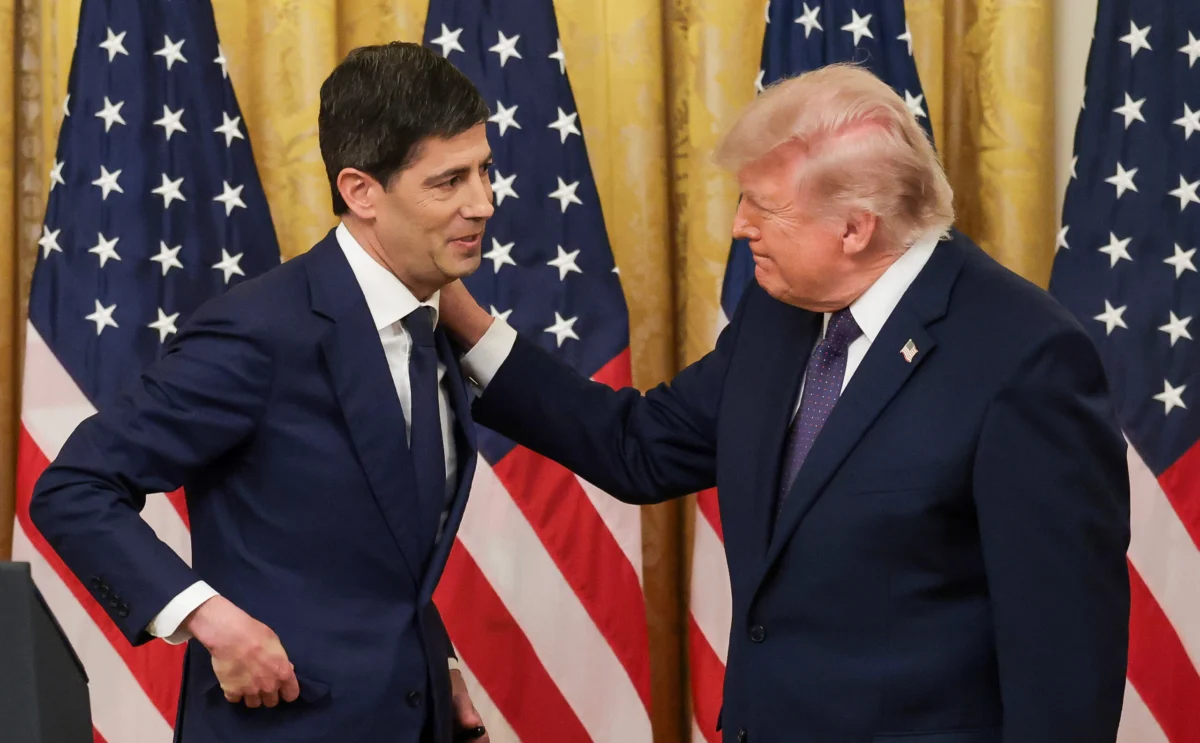
Ten days before a pivotal Federal Reserve meeting where a potential interest rate hike is widely anticipated, the Trump administration has launched an unusually broad and aggressive public campaign to dissuade the central bank from tightening monetary policy. This concerted effort, involving the President, Vice President, Treasury Secretary, and a senior economic advisor, marks a significant escalation in the administration’s ongoing critique of the Federal Reserve’s actions.
President Donald Trump, who has historically been critical of the Federal Reserve and its leadership, appears to be employing a new tactic by directly linking trade policy to interest rate decisions. In a significant departure from previous pronouncements, Trump publicly threatened to halt trade with nations that maintain trade surpluses with the United States, explicitly conditioning this action on the Fed’s willingness to cut interest rates. This direct linkage between trade sanctions and monetary policy represents a novel and potentially destabilizing approach to influencing the independent central bank.
The President’s public statement on Friday was swiftly followed by an interview given by Peter Navarro, a senior economic counselor, to former Trump advisor Steve Bannon. During this interview, Navarro characterized a potential rate hike as "careless" and predicted it would disproportionately harm sectors crucial for American economic prosperity. He went as far as to label members of the Federal Open Market Committee (FOMC), the Fed’s rate-setting body, as "clowns," while simultaneously expressing a belief that Fed Chairman Kevin Warsh is "trying to do the right thing," suggesting a nuanced, albeit still critical, stance towards the new chairman.
This coordinated pressure campaign began earlier in the week with Vice President JD Vance stating, "We believe that the Fed should be lowering interest rates." He further articulated the administration’s desire for greater alignment with the Fed’s policy, adding, "We’re doing a lot of things to try to keep those interest rates down, but it would be nice to have some help from the Federal Reserve."
Treasury Secretary Scott Bessent echoed these sentiments in a televised interview, highlighting the Fed’s historical approach to rate adjustments during periods of supply shocks. Bessent pointed out that the central bank typically refrains from raising rates until there are clear second- or third-order inflationary effects, suggesting that current economic conditions do not warrant a tightening of monetary policy.
The Delicate Position of Fed Chairman Kevin Warsh
The administration’s intensified pressure campaign arrives at a critical juncture for Federal Reserve Chairman Kevin Warsh. Markets are currently pricing in approximately a 60% probability of a rate hike at the upcoming September 15-16 FOMC meeting. This sentiment has been somewhat bolstered by a recent strong jobs report released on Friday. The timing of this potential rate decision is particularly sensitive, as it precedes the November midterm elections, a period where polls indicate significant voter dissatisfaction with rising prices and interest rates.

Adding another layer of complexity to Warsh’s tenure, reports have emerged regarding the frequency of President Trump’s interactions with the new Fed chairman. The Wall Street Journal reported last month that Trump had engaged in repeated conversations with Warsh since his appointment. While several White House aides publicly corroborated this report, President Trump himself denied it, stating he had only spoken to Warsh once during his presidency. This discrepancy raises questions about the extent of presidential influence and communication with the head of the independent central bank.
Chairman Warsh, for his part, has consistently maintained that presidential influence has no bearing on his decision-making. During his July congressional testimony, he cited the Fed’s decision to hold rates steady and refrain from cutting them as evidence of the central bank’s operational independence. However, Warsh has also acknowledged that elected officials, including the President, have a right to voice their opinions on Federal Reserve policy.
Historical Precedents and Economic Arguments
This is not the first time the Trump administration has publicly urged the Federal Reserve to consider lowering interest rates. During President Trump’s first term, in May 2019, Vice President Mike Pence, Treasury Secretary Steve Mnuchin, and economic advisor Larry Kudlow all publicly advocated for rate cuts. While the Fed did not immediately alter its policy in response to that pressure, it did proceed to cut rates two months later.
The economic rationale presented by the administration during that period, and reiterated now, centers on the argument that economic growth itself does not inherently lead to inflation. They contend that supply-side enhancements, such as tax cuts and robust capital investment, expand the economy’s capacity to grow without generating inflationary pressures.
President Trump recently articulated this view on Truth Social, asserting that the economy’s substantial growth should warrant the United States having the lowest interest rates globally. Administration officials have pointed to recent inflation data, specifically the three-month annualized rate of the Consumer Price Index (CPI) at 1.6%, as evidence that inflation is under control. They contrast this with the three-month annualized rate of the core Personal Consumption Expenditures (PCE) price index, the Fed’s preferred inflation gauge, which stood at just over 3%.
Divergent Views on Inflation and Economic Capacity
However, a significant contingent of Federal Reserve officials has expressed concern that inflation has persistently remained above the Fed’s 2% target for five years. They also note indications of inflationary pressures extending beyond the direct impact of Trump’s tariffs and rising energy costs, exacerbated by the ongoing U.S. conflict with Iran. This concern is reflected in the dissent observed during the July FOMC meeting, where three members—Beth Hammack, Neel Kashkari, and Lorie Logan—voted in favor of a quarter-point rate hike, despite the committee ultimately leaving rates unchanged.
Chairman Warsh, in his recent address at the Jackson Hole Economic Symposium, emphasized the paramount importance of the Fed’s focus on inflation. He highlighted that a substantial 54% of the 199 components within the PCE price index had experienced increases exceeding 3% over the preceding twelve months. This data point underscores the central bank’s vigilance regarding broad-based price pressures.

The administration’s assertion that supply-side improvements inherently offset inflationary pressures challenges a fundamental tenet of modern economics. The Phillips Curve, a well-established economic concept, posits a inverse relationship between unemployment and inflation. Specifically, it suggests that tight labor markets and rising wages can fuel inflation as demand outstrips supply. This principle likely contributed to the market’s increased probability of a Fed rate hike following the strong August jobs report. Despite this, wage growth in the report remained relatively contained, with average hourly earnings rising 0.3% in August and 3.1% year-over-year, while the unemployment rate held steady at 4.1%.
The Timing Dilemma of Supply-Side Investments
While the administration’s argument regarding the potential of supply-side enhancements to boost economic capacity and mitigate inflation holds theoretical merit, its practical application faces a significant timing challenge. The substantial investments currently being channeled into artificial intelligence are projected to yield productivity gains in the long term. However, current data indicates that the immediate demand for the equipment and infrastructure required to support AI development is contributing to price increases.
Market Focus on Upcoming Inflation Data
Moving forward, financial markets will be keenly observing the upcoming CPI report. Federal Reserve officials have indicated that this report will serve as a critical barometer for assessing whether inflation is indeed decelerating or continuing to accelerate. The outcome of this data release could prove decisive in determining whether the FOMC opts for a rate hike or maintains its current policy stance. Notably, no FOMC members have recently publicly discussed the prospect of interest rate cuts.
Implications for Federal Reserve Independence
The administration’s aggressive public stance on monetary policy raises significant questions about the Federal Reserve’s independence. While central banks in many developed economies are designed to operate free from direct political interference, the sustained and high-profile pressure from the executive branch can, at minimum, create a challenging environment for policymakers. The Federal Reserve’s credibility is built on its ability to make decisions based on economic data and analysis, rather than political considerations. The current situation tests this fundamental principle, with potential implications for market confidence and the long-term stability of economic policy.
The Fed’s upcoming meeting will therefore be closely watched not only for its interest rate decision but also for what it signals about the resilience of the central bank’s autonomy in the face of significant political pressure. The interplay between the administration’s economic agenda and the Fed’s mandate to maintain price stability and full employment will continue to be a central narrative in the economic landscape.
