

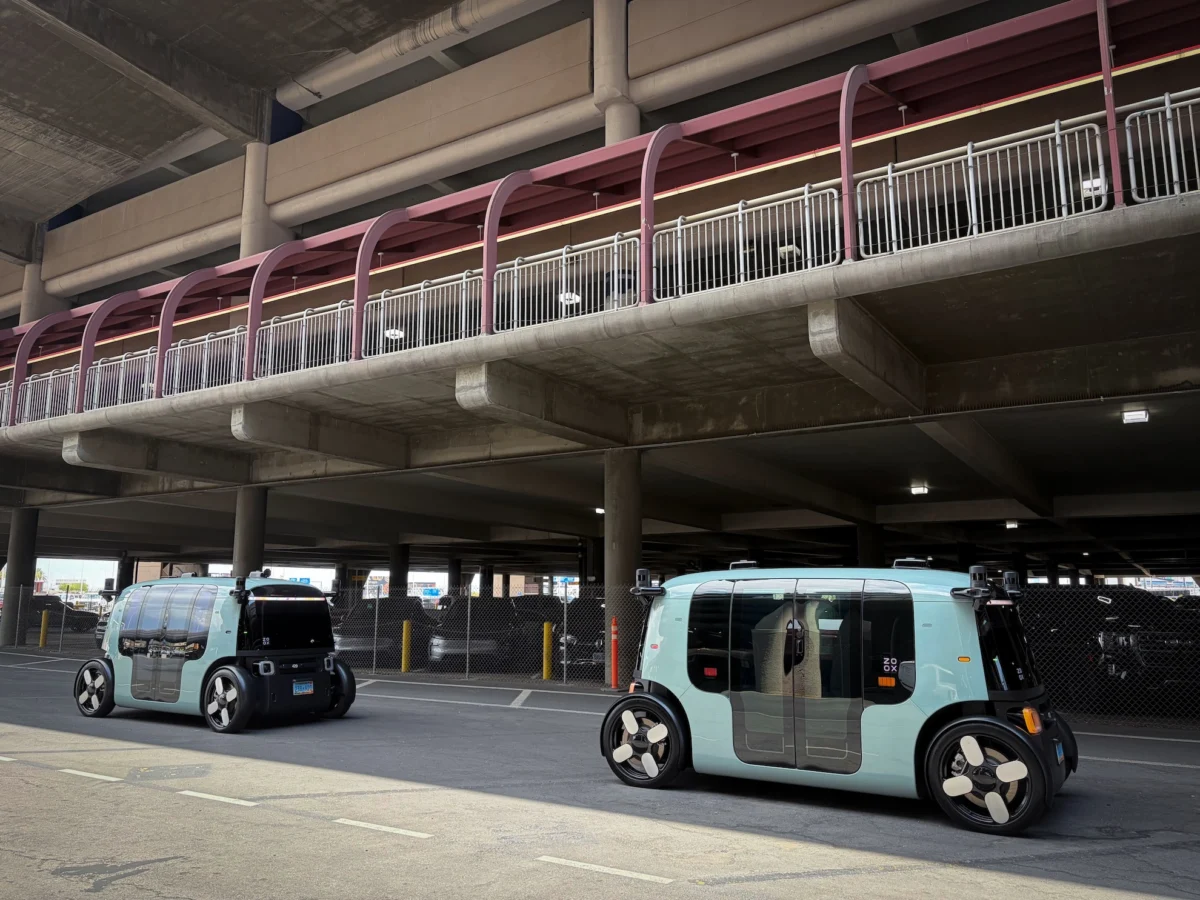
The Amazon-owned autonomous vehicle company Zoox has officially announced the expansion of its commercial robotaxi operations in Las Vegas to include Harry Reid International Airport, marking a significant escalation in the race to dominate the urban mobility sector. Starting this Thursday, travelers arriving in or departing from the world-famous gambling and entertainment hub will be able to hail a ride in Zoox’s custom-built, fully autonomous vehicle, which notably lacks traditional driver controls such as a steering wheel or pedals. This development follows a pivotal regulatory breakthrough in August, which transitioned the company from an experimental phase into a revenue-generating commercial entity.
The expansion into airport transit represents a strategic masterstroke for Zoox, as Harry Reid International Airport serves as the primary gateway for millions of visitors annually. By securing the ability to pick up and drop off passengers directly at both airport terminals near baggage claim, Zoox is positioning itself to disrupt the established order currently dominated by traditional ride-hailing giants Uber and Lyft. For the first time, an autonomous vehicle service is competing directly on convenience, offering a curbside experience that traditional app-based services have struggled to maintain due to local airport regulations.
Strategic Advantage and Passenger Experience
The logistical advantage Zoox now holds at the Las Vegas airport cannot be overstated. Currently, passengers using Uber or Lyft at Harry Reid International Airport are required to navigate a five-to-ten-minute walk from the baggage claim area to a designated pickup zone located on the upper floors of a parking garage. This "hike" has long been a point of friction for weary travelers carrying heavy luggage. In contrast, Zoox has secured permissions to operate at the terminal curb, mirroring the convenience of premium limousine services or traditional taxis.
The vehicle itself offers a departure from the standard automotive experience. Designed as a "carriage-style" cabin, the Zoox robotaxi features two benches facing one another, accommodating up to four passengers. The absence of a driver’s seat and dashboard allows for a more spacious interior, geared toward social interaction or relaxation. Each vehicle is equipped with individual climate control, wireless charging for mobile devices, and interactive touchscreens that allow passengers to control music, view their route, and monitor the vehicle’s progress.
The Regulatory Path to Commercialization
Zoox’s rapid expansion is the direct result of a decade of intensive research and development, culminating in a significant legal victory. In late July 2024, the National Highway Traffic Safety Administration (NHTSA) granted Zoox a temporary exemption from several Federal Motor Vehicle Safety Standards (FMVSS). This exemption was necessary because the Zoox vehicle, being a purpose-built autonomous pod, does not comply with standards designed for human-driven cars—specifically those requiring windshield defrosting systems, traditional braking controls, and steering-related safety mechanisms.
The federal exemption is valid for a period of two years and permits Zoox to deploy a fleet of up to 2,500 vehicles across the United States. This regulatory green light was the "final hurdle" that allowed the company to pivot from offering free "test" rides to employees and select partners to charging the general public for transportation. On August 10, 2024, Zoox officially began its paid commercial service in the Las Vegas Strip area, and the inclusion of the airport is the first major expansion of that service map.
Chronology of Zoox’s Evolution
The journey from a Silicon Valley startup to a major player in the Amazon ecosystem is a testament to the long-term vision of its founders and investors.
- 2014: Zoox is founded by Jesse Levinson and Tim Kentley-Klay with the goal of building a ground-up autonomous vehicle rather than retrofitting existing cars.
- June 2020: Amazon acquires Zoox for an estimated $1.2 billion, providing the capital necessary to sustain the expensive development and testing cycles.
- December 2020: Zoox unveils its "carriage-style" robotaxi to the public, showcasing its bidirectional driving capabilities and four-wheel steering.
- 2023: The company begins testing its vehicles on public roads in Las Vegas and Foster City, California, initially limited to employee shuttles.
- July 2024: The NHTSA grants a two-year exemption for Zoox’s unique vehicle design.
- August 10, 2024: Zoox launches its first paid commercial service in Las Vegas.
- September 2024: The company announces expansion to Harry Reid International Airport and reveals plans for testing in San Diego, California, and Houston, Texas.
The Competitive Landscape in Clark County
Las Vegas has long served as a petri dish for autonomous vehicle (AV) technology due to its predictable weather, wide roads, and high density of tourists. However, the market is becoming increasingly crowded. Last month, the Nevada Transportation Authority (NTA) issued commercial permits to three other major entities: Tesla, Uber, and Waymo (the autonomous driving subsidiary of Alphabet).
The NTA has authorized the deployment of up to 8,000 robotaxis across Clark County over the next 12 months. While Zoox utilizes its own proprietary vehicle, other companies are taking different approaches. Waymo uses modified Jaguar I-PACE SUVs, while Uber’s strategy involves a multi-pronged partnership approach. Uber intends to integrate robotaxis into its existing app through partnerships with both Zoox and Motional (a joint venture between Hyundai and Aptiv).

Industry analysts suggest that the "purpose-built" nature of Zoox’s vehicle gives it a unique brand identity compared to the modified consumer vehicles used by Waymo. However, Waymo currently holds a lead in terms of total miles driven and active service areas, having already established robust operations in Phoenix, San Francisco, and Los Angeles.
Supporting Data and Economic Impact
The move to the airport is backed by staggering passenger statistics. In 2023, Harry Reid International Airport handled an all-time record of 57.6 million passengers. Even a small capture of this market represents a massive revenue opportunity for Zoox and its parent company, Amazon.
The economic implications extend beyond passenger fares. For Amazon, the Zoox acquisition is a long-term play in the logistics and mobility space. While the current focus is on passenger transport, the underlying technology—the autonomous "skate" platform—could eventually be adapted for last-mile delivery services, potentially reducing the costs of Amazon’s massive shipping network.
From a local perspective, the influx of 8,000 robotaxis in Clark County could have profound effects on the labor market. Las Vegas has one of the highest concentrations of professional drivers in the United States, including taxi drivers, limousine chauffeurs, and ride-hail contractors. While Zoox maintains that its service is intended to complement existing infrastructure, labor advocates have expressed concerns about the long-term displacement of human drivers as AV technology scales.
Safety Framework and Public Perception
To combat public skepticism regarding self-driving technology, Zoox recently released its comprehensive "Safety Framework." This document outlines the redundant systems built into the vehicle, including a sensor suite consisting of LIDAR, radar, and cameras that provide a 360-degree field of vision with no blind spots. The vehicle is also designed with "bi-directional" capabilities, meaning it can drive forward or backward with equal ease, reducing the need for complex U-turns in tight airport loading zones.
The company has emphasized that its vehicles are capped at speeds appropriate for urban environments (up to 35 mph initially), prioritizing safety over high-speed transit. This cautious approach is a response to the setbacks faced by competitors like Cruise, which had its permits suspended in California following a high-profile accident in late 2023. By moving slowly and securing federal exemptions before scaling, Zoox is attempting to build a reputation for reliability and regulatory compliance.
Broader Implications and Future Outlook
The expansion of Zoox into the airport transit market signals a shift in the autonomous vehicle industry from "if" to "where next." The company has already identified San Diego and Houston as its next testing grounds, indicating a desire to prove the technology in diverse urban environments with different climates and traffic patterns.
The success of the Las Vegas airport rollout will be a litmus test for the viability of the "carriage-style" AV model. If passengers embrace the convenience of curbside baggage claim pickup and the novelty of the face-to-face interior, Zoox could set a new standard for airport transfers globally.
Furthermore, the integration of Zoox into the Uber app—a partnership announced earlier this year—means that the company will not have to rely solely on its own app to find customers. This "platform-agnostic" approach allows Zoox to tap into Uber’s massive user base while maintaining control over its specialized fleet.
As the two-year federal exemption period progresses, the industry will be watching closely to see if Zoox can maintain its safety record while scaling to the 2,500-vehicle limit. If successful, this period will likely serve as the foundation for a permanent change in federal motor vehicle standards, paving the way for a future where steering wheels and pedals are considered optional features of the American commute. For now, the neon lights of Las Vegas and the bustling terminals of Harry Reid International Airport serve as the primary stage for this technological revolution.
