

The smart speaker pioneer Sonos has officially announced a sweeping strategic pivot, transitioning its identity from a hardware-centric manufacturer to what company leadership describes as a holistic "audio operating system." This rebranding effort coincides with the launch of Sonos 27, a next-generation software platform infused with generative artificial intelligence, alongside the introduction of the Beam Ultra soundbar and the Ace Ultra over-ear headphones. This announcement serves as a pivotal moment for the Santa Barbara-based company as it attempts to recover from a turbulent 2024, characterized by a critically panned app redesign that severely damaged its standing with its core enthusiast community.
The shift toward a software-first philosophy is led by a new executive vision. Brandon Holley, the interim hardware lead at Sonos, articulated this change by noting that while the public has viewed the company as a speaker manufacturer for decades, its true value lies in the underlying software that manages complex multi-room environments. This "audio operating system" approach is intended to streamline the user experience across diverse hardware categories, from home theaters to portable audio, while integrating the latest advancements in machine learning and voice interaction.
A Chronology of Crisis and Recovery
To understand the weight of the Sonos 27 announcement, it is necessary to examine the events of 2024, which became a case study in how software updates can alienate a loyal customer base. In May 2024, Sonos released a comprehensive overhaul of its mobile application. The update was intended to modernize the interface but instead resulted in the loss of critical features. Users reported the disappearance of basic functions such as volume control, sleep timers, and the ability to edit local music libraries.
The backlash was immediate and severe. Perhaps most damaging was the impact on accessibility; the update initially broke tools used by blind and low-vision users to navigate the system. The company’s response underwent several phases: initial defense of the update, followed by a public admission of failure, and a period of internal debate regarding whether to revert to the legacy app version. The crisis eventually led to a significant leadership transition, including the departure of the CEO and the elevation of executives like Tom Conrad and Sid Patel, who were tasked with a "listening tour" to repair the relationship with the Sonos community.
The launch of Sonos 27 represents the culmination of this recovery strategy. Sid Patel, Vice President of Software, acknowledged the apprehension users feel toward the phrase "new Sonos app," emphasizing that the current development cycle utilized a "customer-centric feedback listening approach." This involved active participation in forums such as Reddit and direct engagement with long-term users to ensure that basic functionality is prioritized alongside new AI features.

The Sonos 27 Ecosystem and Generative AI Integration
At the heart of the new strategy is Sonos 27, a platform designed to leverage generative AI to change how users interact with their sound systems. The most prominent feature is "Sonos Voice," which has entered an early access phase. Unlike traditional voice assistants that rely on rigid command structures, Sonos Voice utilizes large language models to interpret natural language. Users can request music based on abstract concepts, such as "mood" or "atmosphere," rather than specific artist or track names.
A significant technical addition to this platform is the implementation of the Model Context Protocol (MCP). This allows the Sonos system to interface directly with third-party AI services. For example, a user could theoretically link their ChatGPT account to the Sonos system, allowing the AI to manage playback or curate playlists based on complex conversational prompts. Furthermore, the company introduced "Sonos Custom Agents." These digital assistants can be customized with various personas and voices—ranging from a pirate to a professional chef—to handle specific tasks in different rooms of the house.
Despite the focus on AI, Sonos has committed to addressing the fundamental stability issues that plagued its previous software. The new app includes improved tab navigation, refined room sorting, and more responsive digital volume knobs. A "system health view" is scheduled for release in late 2024, which will provide users with diagnostic data to troubleshoot connection issues on a per-product basis.
Hardware Innovation: The Beam Ultra and Ace Ultra
Complementing the software pivot are two significant hardware releases that signal Sonos’ intent to dominate both the stationary and mobile audio markets. The Beam Ultra soundbar represents a substantial upgrade over the existing Beam (Gen 2). It features nine drivers—four more than its predecessor—including dedicated upward-firing drivers designed to bounce sound off the ceiling. This hardware configuration is intended to provide a more immersive Dolby Atmos experience in a compact form factor.
The Beam Ultra also incorporates "AI Speech Enhancement." By utilizing machine learning algorithms to isolate and boost frequencies associated with human speech, the soundbar aims to solve the common consumer complaint of muffled dialogue during action-heavy movie scenes. Connectivity options remain robust, with support for Wi-Fi, Bluetooth, and HDMI eARC.
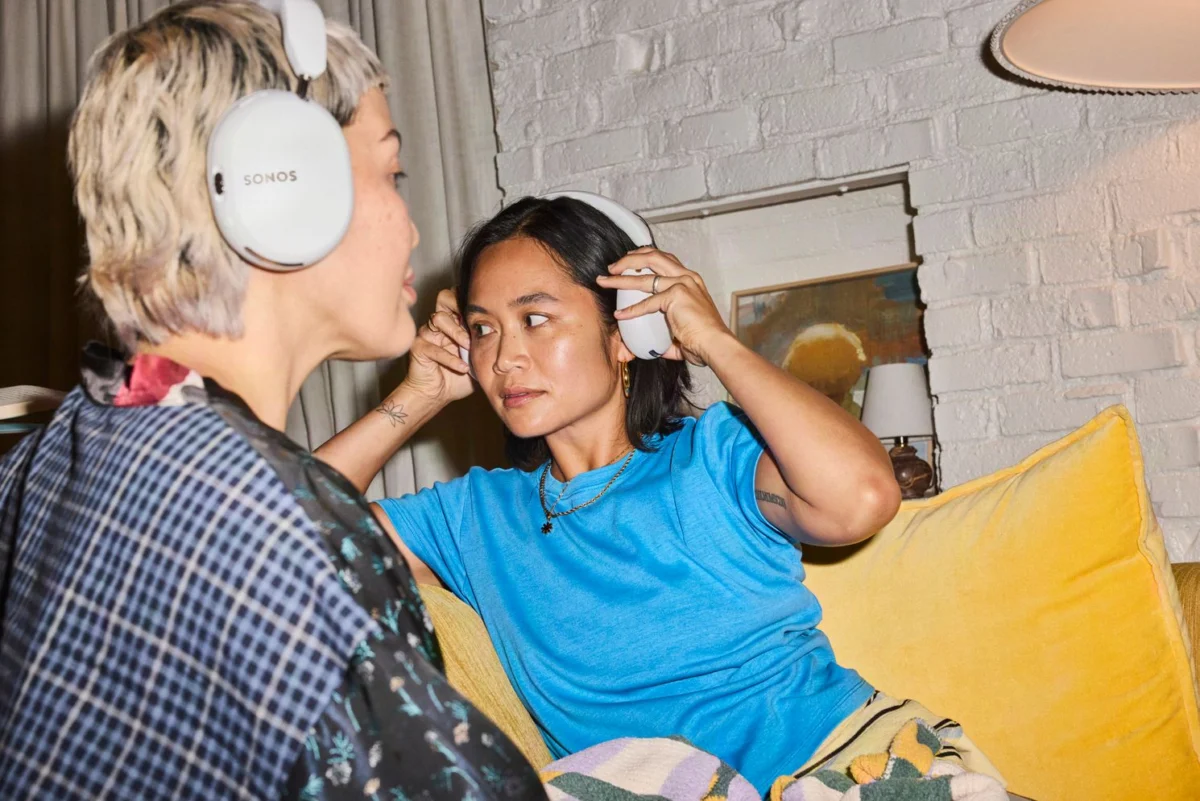
The second major hardware announcement is the Sonos Ace Ultra. Following the initial launch of the Sonos Ace in early 2024, the "Ultra" model seeks to address the primary criticism of the original: its lack of deep integration with the broader Sonos speaker ecosystem. The Ace Ultra features a 35-hour battery life and supports USB-C and 3.5mm wired connections. Most importantly, it operates on "Sonos Fabric," the company’s proprietary networking technology. This allows for "Headphone Linking," a feature that enables users to transfer audio from their home theater system to their headphones with a single button press, maintaining a seamless transition between public and private listening.

Technical Architecture and "Sonos Fabric"
The concept of "Sonos Fabric" is central to the company’s new "audio operating system" identity. While Sonos has always utilized a proprietary mesh network to sync audio across multiple rooms, "Fabric" is the formal branding of this technology. It represents the software layer that allows different hardware units to act as a single, cohesive entity.
One of the most anticipated features enabled by Sonos Fabric is "Portable Surround." Traditionally, setting up a surround sound system required a permanent configuration of speakers. Portable Surround allows users to temporarily move speakers from one room to another—such as moving a pair of Era 100s from the kitchen to the living room—where the system will automatically detect their new positions and re-calibrate the audio output to function as rear surrounds for a movie night. Once finished, the speakers can be returned to their original rooms and will revert to their previous settings automatically.
Legacy Support and Market Implications
As Sonos pushes toward a future defined by AI and high-performance software, the company faces the challenge of managing its legacy hardware. Sonos confirmed that the AI features of Sonos 27 will be compatible only with the S2 app environment. Users of the older S1 system, which supports legacy hardware from the early 2000s, will not have access to these new capabilities.
The company has adopted a stance of "transparency regarding limitations," stating that while security updates will continue for older products, the hardware requirements for generative AI are simply beyond the reach of older processors. However, Sonos has yet to release a detailed compatibility matrix or a formal upgrade path for users looking to transition from legacy systems to the Sonos 27 ecosystem.
The shift to an "audio operating system" model places Sonos in direct competition with tech giants like Apple, Amazon, and Google. While these companies offer smart speakers with integrated assistants, Sonos is betting that a dedicated, high-fidelity audio focus—combined with the flexibility to choose between different AI models—will differentiate its platform. Market analysts suggest that this move is also an attempt to diversify revenue streams, potentially moving toward software-based services or subscriptions in the future, although the company has not formally announced such plans.
Professional Analysis of the Strategic Shift
The transition from a speaker company to an audio operating system is a high-stakes gamble for Sonos. By centering its brand on software, the company is acknowledging that in the modern smart home, the interface is as important as the acoustic quality of the hardware. However, this strategy relies heavily on the company’s ability to maintain software stability—a feat it struggled with throughout 2024.

The inclusion of generative AI is a double-edged sword. While features like natural language music discovery and AI speech enhancement offer genuine utility, the use of "Custom Agents" with novelty voices risks being perceived as "AI slop"—features that add complexity without significant value. The success of Sonos 27 will likely depend not on these flourishes, but on whether the core app can provide the seamless, "magical" experience that originally built the brand’s reputation.
For the consumer, the "Ultra" line of hardware suggests that Sonos is doubling down on the premium segment of the market. By integrating the Ace Ultra headphones more deeply into the home ecosystem, Sonos is finally delivering on the "unified system" promise that its users have demanded for years.
The company’s new "opt-in" approach for AI features is a direct response to the criticism of the 2024 update. By allowing users to choose whether they want to engage with the new AI tools, Sonos is attempting to rebuild trust through incrementalism rather than forced adoption. As the company moves into the fall release cycle, the industry will be watching closely to see if this "audio operating system" can harmonize a fractured user base and set a new standard for the connected home.
