

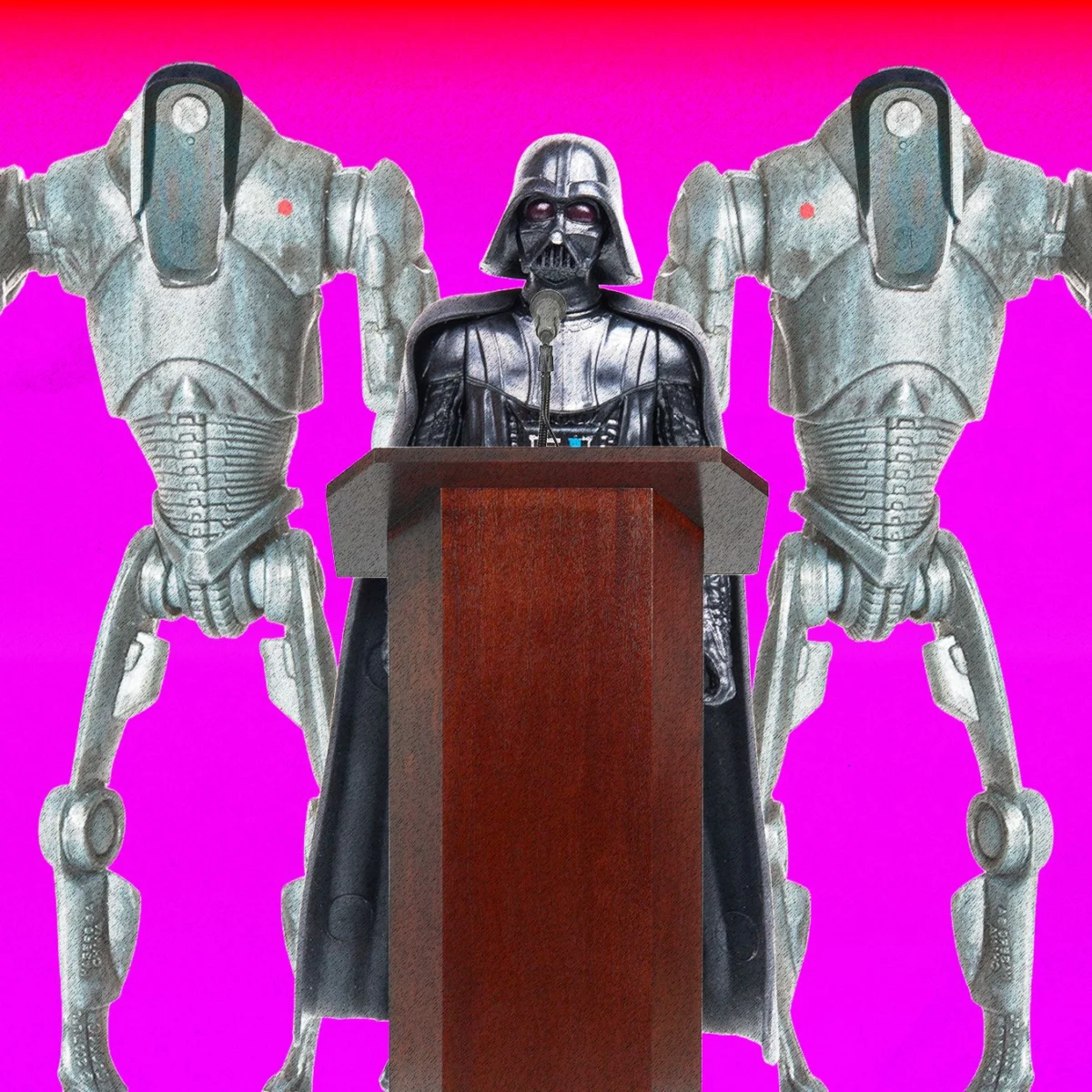
The chambers of the San Diego City Council, typically a venue for somber budgetary discussions and bureaucratic procedure, recently became the stage for a viral piece of political satire that has resonated across the globe. Anthony Ralphs, a local event producer and activist, appeared before the council dressed as the iconic Star Wars antagonist Darth Vader to protest the city’s continued investment in automated surveillance technology. The performance, which has since garnered millions of views on social media platforms like TikTok and Instagram, was specifically aimed at the council’s decision to renew and expand its contract with Flock Safety, a controversial provider of Automated License Plate Recognition (ALPR) systems.
Ralphs’ appearance was not merely a whimsical costume choice but a calculated act of "guerrilla theater" designed to highlight what he describes as the "Orwellian" nature of modern policing. Speaking through a voice modulator and punctuated by the heavy, mechanical breathing synonymous with the Sith Lord, Ralphs praised the council for its commitment to surveillance. "The emperor is a fan of Flock," Ralphs told the council members. "And we must continue utilizing Flock technologies so that we can follow and surveil the rebel scum as they move from playground to playground, from playground to pool, from pool to gymnasium."
While the stunt provided a moment of levity for viewers online, the underlying issues are deeply serious, touching on constitutional rights, municipal fiscal responsibility, and the efficacy of artificial intelligence in public safety.
The Chronology of San Diego’s Surveillance Expansion
The path to Ralphs’ August 19, 2026, appearance began nearly a year prior. San Diego has a complex history with surveillance technology, having previously faced public outcry over its "Smart Streetlights" program, which utilized cameras and sensors initially billed as energy-saving tools but later repurposed for law enforcement.
In late 2023, the San Diego City Council began debating a new contract with Flock Safety. Despite a landmark 2022 Privacy Ordinance intended to increase transparency regarding the acquisition of surveillance gear, the council moved forward with the Flock integration. On December 9, 2023, a pivotal meeting took place where over 300 residents gathered to voice their opposition. According to Ralphs, roughly 95 percent of the public testimony was against the technology. Nevertheless, the council voted in favor of the contract, citing the San Diego Police Department’s (SDPD) assertion that the cameras serve as a "force multiplier" essential for solving crimes in an era of staffing shortages.
Ralphs, who had recently begun attending council meetings as part of his studies in labor and theater, found the disconnect between public sentiment and legislative action jarring. Following the December vote, he observed a sharp decline in attendance at subsequent meetings, realizing that the exhausting nature of the bureaucratic process often thins the ranks of active dissenters. This realization prompted him to take time off from his studies at San Diego Mesa College and San Diego City College to commit to consistent advocacy.
Technical Capabilities and the WIRED Investigation
The technology at the heart of the protest, developed by the Atlanta-based firm Flock Safety, has seen rapid adoption by thousands of law enforcement agencies across the United States. While traditionally marketed as a tool for capturing license plate numbers to identify stolen vehicles or suspects in Amber Alerts, recent investigations suggest the technology’s scope is far broader.
A review of code for Flock’s new AI tools, conducted by WIRED, revealed that the system is capable of tracking much more than just alphanumeric plate data. The software can identify specific vehicle characteristics, including make, model, color, and even unique identifiers like roof racks, bumper stickers, or custom rims. This "fingerprinting" of vehicles allows police to track the movements of individuals across a network of cameras even if their license plate is obscured or missing.
Critics argue that this creates a "dragnet" surveillance system that monitors law-abiding citizens without reasonable suspicion. The ability to track a vehicle "from playground to pool," as Ralphs satirically noted, raises significant privacy concerns regarding the patterns of life that can be mapped by government entities through the accumulation of metadata.
The Human Cost: The Case of Hugo Parra
Central to the opposition in San Diego is the case of Hugo Parra, a local resident whose experience has become a rallying cry for privacy advocates. Parra was arrested and incarcerated for 30 days after a Flock Safety camera erroneously flagged his vehicle in connection with a crime. Despite evidence that Parra was miles away from the scene at the time of the incident, the automated "hit" from the surveillance system led to his prolonged detention.
Parra and a friend, who was also detained, have filed a lawsuit against the City of San Diego seeking $1.5 million in damages. This legal challenge highlights a critical flaw in the "force multiplier" argument: the potential for "automation bias," where law enforcement officers may over-rely on technological alerts, leading to the infringement of civil liberties and costly legal liabilities for the municipality.
Fiscal Tensions and Budgetary Prioritization
The $2.2 million contract for Flock Safety comes at a time when San Diego is grappling with a projected $120 million budget deficit. To address the shortfall, the city has implemented cuts to various public services, including several arts and community programs.
Ralphs and other activists argue that the prioritization of high-tech surveillance over community investment is a strategic error. "They cut several arts programs, and while they did that, they also provided the $2.2 million for Flock’s contract," Ralphs noted. He further argued that when the costs of potential legal settlements—such as the Parra case—are added to the initial contract price, the true cost to taxpayers far exceeds the sticker price of the technology.
This economic argument has gained traction among residents who feel that the "luxury surveillance" being implemented does not address the root causes of crime or improve the quality of life in heavily policed neighborhoods.
Guerrilla Theater and the Art of Civic Engagement
Anthony Ralphs’ decision to don the Darth Vader costume was born of a desire to break through the "stale" atmosphere of local government. With a background in theater and experience as a DJ on picket lines for the American Federation of Teachers, Ralphs understood the power of performance to shift a narrative.
The costume itself was a meticulous assembly. Ralphs used a 2004 Hasbro model helmet, chosen for its built-in voice changer, and a silk cape sourced from Turkey. He spent weeks rewatching the original Star Wars trilogy to master the character’s gesticulations and presence. During the council meeting, Ralphs utilized the helmet’s sound effects—including the iconic breathing—to maintain the persona even when not speaking at the podium. In one notable moment, he reportedly stood near the Chief of Police and activated a button on the helmet that played the line: "Your powers are weak!"
Ralphs views this as a necessary evolution of protest. "I want to make it cool to engage in one’s civic responsibility again," he stated. By using satire, he aimed to hold a mirror up to the council, suggesting that if a fictional galactic tyrant would approve of their policies, perhaps those policies warrant a second look.
Broader Implications and National Trends
The San Diego incident is a microcosm of a national debate over the "democratization" of surveillance. Companies like Flock Safety and Amazon’s Ring have created vast, interconnected networks of cameras that blur the lines between private security and state surveillance.
The American Civil Liberties Union (ACLU) and the Electronic Frontier Foundation (EFF) have frequently warned that the lack of federal regulation regarding ALPR data retention and sharing could lead to a permanent record of every American’s movements. In San Diego, the ACLU has been an active participant in committee meetings, advocating for stricter oversight and the potential decommissioning of systems that fail to prove their efficacy or safety.
The viral nature of Ralphs’ protest has successfully reframed the conversation for a younger, digitally native audience. By translating complex privacy concerns into the recognizable vernacular of pop culture, the "Darth Vader of San Diego" has forced a broader segment of the population to consider the implications of living in what he calls an "Orwellian-digital, fully surveilled hellscape."
Conclusion: The Narrative Shift
As the City of San Diego moves forward with its surveillance programs, the fallout from the August meeting continues to influence public discourse. The city council has yet to issue a formal response to the viral video, but the pressure from constituents appears to be mounting.
For Anthony Ralphs, the goal of the stunt has already been achieved: the narrative has shifted. The technology is no longer being discussed solely in the terms provided by law enforcement and tech vendors. Instead, it is being viewed through the lens of moral fortitude, creativity, and the fundamental right to move through public spaces without being tracked by an algorithm.
"Some people didn’t know what Flock was a week ago," Ralphs observed. By bringing the Sith to the city hall, he ensured that the "rebel scum"—the ordinary citizens of San Diego—are now watching the watchers.
