

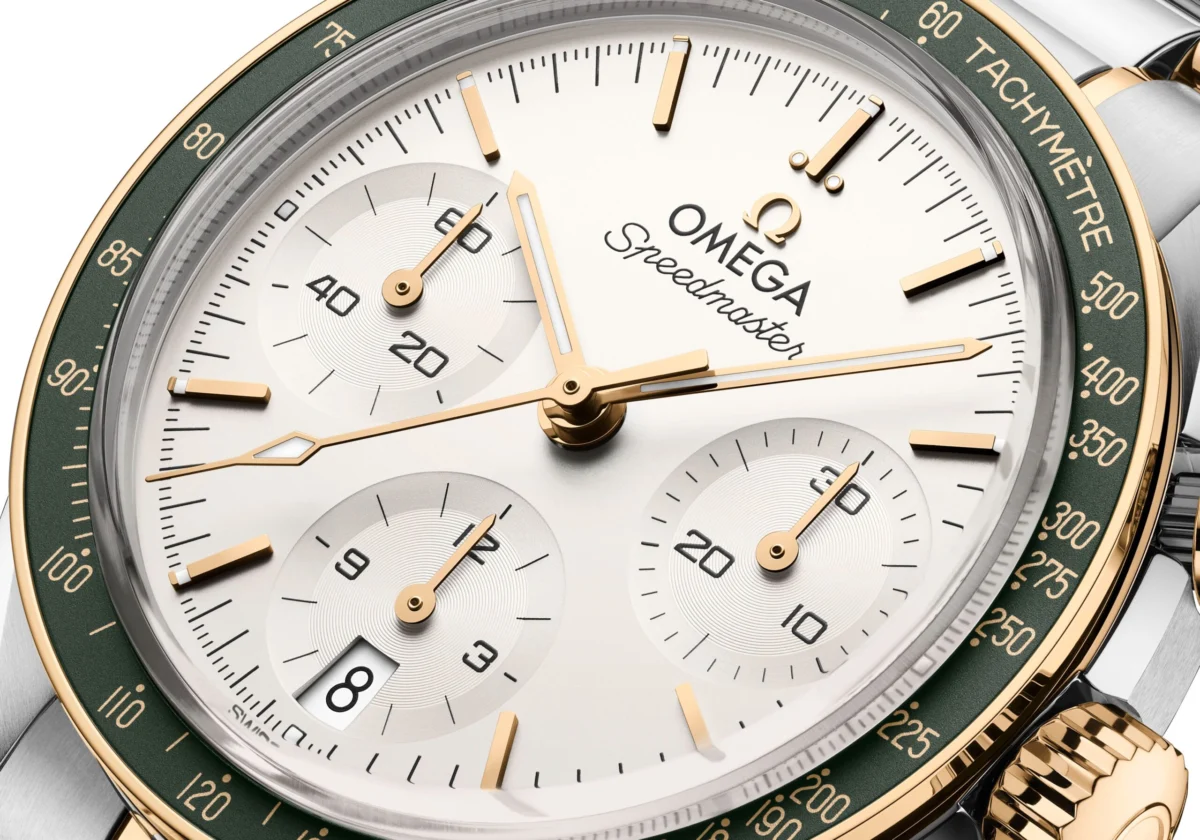
The landscape of luxury horology is witnessing a decisive shift toward classical proportions, a movement underscored by Omega’s latest expansion of its Speedmaster 38-mm collection. This release, comprising seven new references, signals a strategic refinement of the brand’s mid-sized chronograph line, moving away from the more experimental design cues of previous iterations and aligning more closely with the iconic "Moonwatch" DNA. By integrating historical markers such as the "Dot-Over-Ninety" (DON) bezel and transitioning from oval to circular subdials, Omega is positioning the 38-mm series not merely as a smaller alternative, but as a sophisticated, heritage-focused pillar of the Speedmaster family.
Evolution of the 38-mm Silhouette
For nearly two decades, the watch industry was defined by a "bigger is better" philosophy. Between the late 1990s and the early 2010s, case diameters frequently exceeded 44 mm, with some models reaching 48 mm or larger. While these dimensions appealed to a specific aesthetic of ruggedness, they often alienated collectors with smaller wrist profiles. In recent years, the market has corrected toward the "Goldilocks zone"—the 38-mm to 40-mm range—which offers a balance of presence and ergonomics suitable for a broader demographic.

Omega’s update to the Speedmaster 38-mm collection is a direct response to this market stabilization. The most significant aesthetic shift in the new references is the abandonment of the oval-shaped subdials that characterized earlier 38-mm models. These have been replaced with traditional rounded registers, a design choice that mirrors the Speedmaster Professional "Moonwatch." This change, coupled with a thicker bezel featuring the historically significant Dot-Over-Ninety tachymeter scale, elevates the collection from a fashion-forward derivative to a serious tool watch with vintage sensibilities.
Technical Specifications and Movement Architecture
The new collection is divided by its internal architecture, utilizing two distinct self-winding movements to cater to different functional requirements. Six of the seven references are powered by the Omega Caliber 3330. This movement is a COSC-certified chronometer that features a column-wheel mechanism and a Co-Axial escapement, providing enhanced long-term precision and durability. It also incorporates a silicon "Si14" balance spring, which offers superior resistance to magnetic fields and shocks.
Among the Caliber 3330 models, the "Cappuccino" reference stands out as a high-concept luxury offering. Priced at $11,700, it features an ivory-colored main dial with contrasting brown PVD-coated subdials. The construction utilizes a blend of stainless steel for the case and 18K Sedna gold—Omega’s proprietary rose gold alloy—for the bezel and crown. This model includes a date window at the 6 o’clock position, integrated into the bottom subdial to maintain symmetry.

The seventh reference, however, represents a pivot toward purist horology. Powered by the Caliber 3332, this black-dial model omits the date function entirely. By removing the date window, Omega has achieved a clean, uncluttered matte-finish varnished dial that aligns almost perfectly with the signature look of the Moonwatch. Priced at $6,500, this reference serves as an entry point for collectors seeking the classic Speedmaster aesthetic in a more compact form factor.
Historical Chronology: The Speedmaster Reduced Legacy
To understand the significance of the new 38-mm collection, one must look back to 1988, when Omega launched the Speedmaster Reduced (Reference 3510.50). At the time, the standard Moonwatch was considered large by contemporary standards, and the Reduced was introduced as an automatic, smaller alternative with a 38.5-mm case.
The 1988 Reduced became a cult favorite, though it possessed several quirks that distinguished it from the "Professional" line. Most notably, the crown and pushers were not horizontally aligned due to the modular nature of its movement (an ETA base with a Dubois-Dépraz chronograph module). Furthermore, the subdial layout featured running seconds at 3 o’clock, a 12-hour totalizer at 6 o’clock, and a 30-minute totalizer at 9 o’clock.

The new 2024 Speedmaster 38-mm models represent a technical evolution over the original Reduced. The subdial layout has been reversed to match the Moonwatch: the 30-minute totalizer is now at 3 o’clock and the running seconds are at 9 o’clock. Additionally, the modern 38-mm case features better-integrated pushers and a more robust five-link bracelet that takes cues from the current generation of the Speedmaster Professional.
Market Analysis and Consumer Reception
Industry analysts view the expansion of the 38-mm line as a tactical move to capture the "unisex" luxury segment. While watch brands historically categorized smaller watches as "ladies’ models," the modern consumer is increasingly gender-neutral in their preferences, focusing instead on wrist-to-case ratios and vintage-inspired dimensions.
"The move to round subdials is a significant win for the enthusiast community," notes a market report on luxury trends. "The oval subdials were often seen as a departure from the Speedmaster’s tool-watch heritage. By returning to the Moonwatch design language, Omega is validating the 38-mm size as a core professional offering rather than a secondary fashion line."

The pricing strategy also places Omega in a competitive position. At $6,500 for the black-dial model, the watch sits comfortably below the price of the 42-mm Speedmaster Professional (which currently retails between $7,000 and $8,000 depending on the crystal and caseback configuration). This makes the 38-mm model the most accessible entry point into the black-dial Speedmaster ecosystem, potentially attracting younger buyers or those making their first foray into luxury mechanical chronographs.
Comparative Data: New 38-mm vs. Historical Precedents
| Feature | 1988 Speedmaster Reduced | 2024 Speedmaster 38-mm (Black) | Moonwatch Professional (42mm) |
|---|---|---|---|
| Case Size | 38.5 mm | 38.0 mm | 42.0 mm |
| Movement | Automatic (Modular) | Automatic (Co-Axial 3332) | Manual (3861 Master Chrono) |
| Bezel | Standard Aluminum | Dot-Over-Ninety Aluminum | Dot-Over-Ninety Aluminum |
| Subdials | Oval (Visual illusion) | Round | Round |
| Date Window | No | No (on Ref 324.30.38.50.01.002) | No |
| Price (Approx) | Discontinued (Secondary ~$3k) | $6,500 | $7,000+ |
Broader Implications for the Watch Industry
Omega’s decision to "miniaturize" its most iconic design language without sacrificing technical specifications reflects a broader industry trend toward "Neo-Vintage" styling. Brands like Tudor, Zenith, and Rolex have all experimented with returning to 36-mm to 39-mm cases for their flagship sport watches.
The inclusion of the Dot-Over-Ninety bezel is particularly telling. This feature, where the dot on the tachymeter scale is positioned above the ’90’ rather than next to it, was a hallmark of pre-1970 Speedmasters, including the Reference 105.012 worn during the Apollo 11 moon landing. By including this detail on a 38-mm model, Omega is signaling to collectors that they are not cutting corners on heritage, regardless of the case size.

Furthermore, the introduction of the five-link bracelet on the 38-mm models provides an ergonomic advantage. Smaller links allow the bracelet to drape more naturally over the wrist, increasing comfort for daily wear. This focus on "wearability" is becoming a primary metric for luxury consumers who prioritize the tactile experience of a timepiece as much as its brand prestige.
Conclusion: A Strategic Alignment
The new Omega Speedmaster 38-mm collection represents a successful synthesis of modern manufacturing and historical reverence. By banishing the oval subdials and embracing the "Mini Moonwatch" aesthetic, Omega has addressed the primary criticisms of its mid-sized chronograph line.
For the consumer, the result is a versatile timepiece that provides the prestige and history of the Speedmaster in a package that is both technically superior to the "Reduced" models of the past and more wearable than the oversized models of the previous decade. As the luxury market continues to favor classical proportions, Omega’s 38-mm collection is poised to become a staple for those who value the "Goldilocks" balance of size, style, and substance. Whether in the opulent 18K Sedna gold "Cappuccino" variant or the purist black-dial version, these pieces reaffirm that in the world of high-end horology, sometimes less truly is more.
