

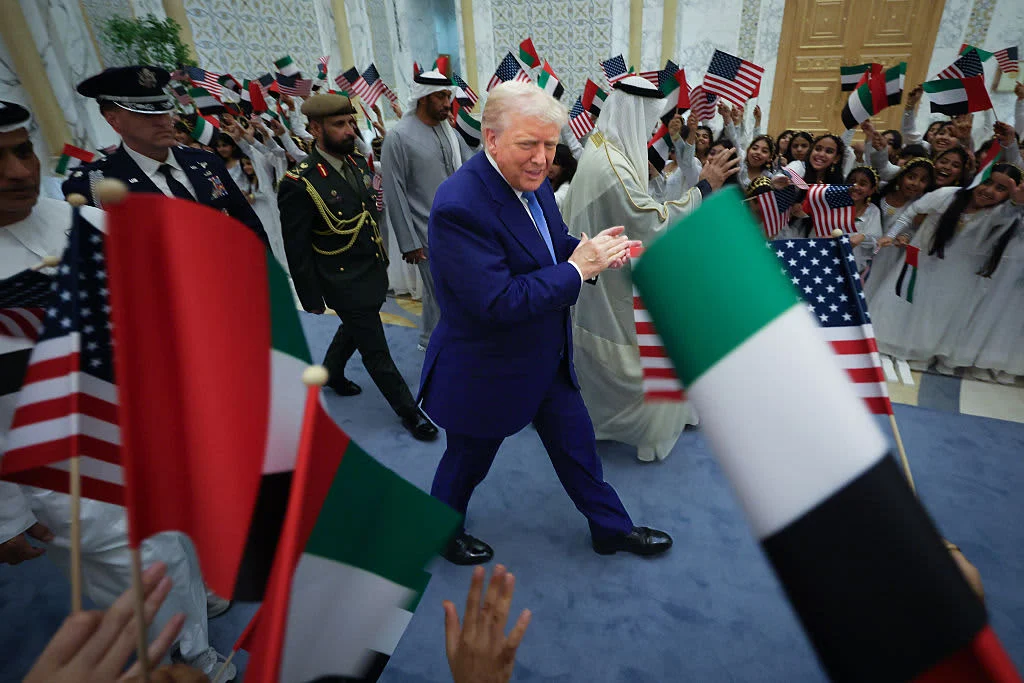
President Donald Trump’s foreign real-estate licensing business experienced a remarkable surge during his initial year back in office, generating an impressive $59.5 million in 2025. This significant financial uptick was fueled by international developers’ willingness to pay a premium for the prestigious Trump brand on luxury towers, golf courses, and coastal resorts across the globe. The reported revenue for foreign licensing, encompassing the use of the Trump name on various properties worldwide, marked a substantial 71% increase from 2024 figures and was nearly ten times higher than in 2023. This dramatic financial rebound, according to a CNBC analysis of Trump’s annual financial disclosure, signals a clear reversal of the Trump Organization’s initial first-term commitment to pursue "no new foreign deals whatsoever."
The Trump Organization’s updated ethics policy for the second term, while prohibiting new material transactions with foreign governments, explicitly permits deals with private foreign companies. This distinction has become a focal point for ethics watchdogs and legal experts, particularly as a substantial portion of the licensing income—more than 60%—originated from projects in Gulf countries. Many of the developers involved in licensing the Trump name were simultaneously engaged in significant U.S. investments, seeking government permits, or advocating for favorable economic and diplomatic relations with the Trump administration. Furthermore, some Trump-branded ventures relied on state-owned land, sovereign investment, or partnerships with government-controlled entities, blurring the lines between private enterprise and state influence.
A New Chapter for Trump’s Global Brand
The year 2025 marked a pivotal moment for the Trump Organization’s international business strategy. Following a period where foreign dealings were under intense scrutiny during his first presidential term, the company has seemingly re-embraced its global expansion. The financial disclosure revealed that four Trump-affiliated licensing LLCs, which were not even listed in his 2024 disclosure, collectively generated $20.25 million in 2025, accounting for 82% of the overall increase. An additional $9.64 million was accrued from five other licensing LLCs that had previously been categorized as inactive. This reactivation and expansion of the licensing portfolio underscore a deliberate shift towards capitalizing on the Trump brand’s global appeal, particularly in emerging luxury markets.
The strategic pivot to re-engage with foreign developers comes amidst ongoing debates about the intersection of presidential power and private financial interests. Ethics watchdogs have voiced strong concerns, highlighting what they describe as an unprecedented collision between the president’s public authority and his private wealth. Legal experts, too, have pointed to unresolved questions surrounding the Constitution’s Foreign Emoluments Clause, which prohibits federal officeholders from accepting certain benefits from foreign states without congressional consent. While CNBC found no direct evidence that any specific licensing payment influenced an administration decision, that a developer received special treatment, or that Trump intervened on a company’s behalf, the inherent optics of such arrangements continue to fuel public and expert debate.
The Trump Organization has consistently maintained that it operates "completely separate from the presidency," adheres to all ethics and conflict-of-interest laws, and employs an outside ethics adviser to mitigate potential conflicts. However, the organization declined to respond to specific inquiries regarding individual foreign licensing projects. A White House spokesperson, when questioned about Trump’s foreign deal-making, avoided addressing the arrangements directly. Instead, the spokesperson asserted that "the only special interest guiding" Trump’s decisions is "the best interest of the American people," pointing to over $2 trillion in investment commitments and a multitude of commercial, defense, aviation, and technology deals announced during the president’s May 2025 Gulf trip.
Scott Greytak, deputy executive director of Transparency International U.S., an anti-corruption nonprofit, articulated the core concern: "Foreign governments and politically connected businesses now have a direct, incredibly visible way to put money into the sitting president’s pocket." He further emphasized, "The conflict is already in plain sight right now. We don’t need to wait for some kind of smoking gun to see a quid pro quo." This sentiment reflects a broader apprehension among ethics advocates that the mere appearance of a conflict can erode public trust and create undue influence, regardless of whether a direct quid pro quo can be proven.
A Chronology of Engagement and Financial Growth (2023-2025)
- 2023: Trump’s foreign licensing revenue was at its lowest point, reflecting the "no new foreign deals" pledge’s lingering effects.
- 2024: Revenue saw a modest increase but remained significantly below 2025 levels. Eric Trump told The New York Times that the family "did everything imaginable to avoid any appearance of impropriety" but "got crushed anyway," indicating a shift in their approach, stating, "We can’t just sit out in perpetuity, and I won’t."
- January 2025: President-elect Trump hosted Damac Properties CEO Hussain Sajwani at Mar-a-Lago, where Sajwani announced plans for a significant $20 billion investment in U.S. data centers. Trump publicly praised the commitment, promising expedited environmental and regulatory reviews for companies investing over $1 billion. Donald Trump was even more direct in a January interview with The Times regarding foreign deals, stating, "I found out that nobody cared. I’m allowed to."
- April 30, 2025: Dar Global and Qatari Diar announced plans for a Trump-branded golf club and luxury villas in Qatar, a project that is part of the Simaisma coastal development.
- May 2025: President Trump embarked on his first major foreign-policy trip of his second term, visiting Gulf nations including Saudi Arabia, Qatar, and the UAE. During his stop in Doha, he announced major aviation, defense, and economic agreements with Qatar. Coincidentally, Eric Trump attended the groundbreaking ceremony for the Trump International, Hung Yen resort and golf course project in Vietnam. Vietnamese Prime Minister Pham Minh Chinh publicly stated that Eric Trump’s visit had "motivated us to expedite this project."
- July 2025: President Trump signed an executive order directing federal agencies to accelerate permitting for qualifying data centers and their supporting energy infrastructure, a policy that could directly benefit companies like Damac.
- December 2025: A Damac subsidiary purchased eight parcels of land near Canton, Ohio, for $36.5 million, earmarked for a proposed data center. This property had been acquired for $8.55 million just two days prior, raising questions about valuation and timing.
- Throughout 2025: The Trump Organization’s foreign licensing revenue surged to $59.5 million, marking a 71% increase from 2024, with over 60% of this income originating from projects in Gulf countries.
The Gulf Connection: A Hub for Trump’s Licensing Deals
The Arabian Gulf region emerged as a primary driver of Trump’s foreign licensing income in 2025. Projects linked to the United Arab Emirates alone generated approximately $22 million, followed by Saudi Arabia with $9 million and Qatar with $5 million. Much of this revenue was channeled through two prominent Gulf real-estate developers: Saudi-linked Dar Al Arkan (and its Dubai-based international arm, Dar Global) and UAE-based Damac. Trump’s disclosures showed $25.8 million tied to projects involving Dar Al Arkan and Dar Global, with Damac-linked projects contributing another $11.3 million.
Under the prevailing licensing model, local developers typically finance and construct the properties, while the Trump Organization receives fees for the use of its prestigious name and, in some instances, for managing the properties. This model has flourished in the Gulf, which is currently experiencing a boom in "branded residences"—luxury properties that leverage celebrity or designer names to command premium prices. In Dubai, for example, branded-home transaction volume saw a 26% year-over-year increase during the first nine months of 2025, with sales value climbing 51%, according to CBRE’s latest available data.
Critics argue that the Trump name offers a unique allure beyond other luxury brands: the implicit suggestion of access to the power and influence of the presidency. Ben Freeman, director of the Democratizing Foreign Policy program at the Quincy Institute for Responsible Statecraft, noted that association with the Trump brand could signal political access for developers—or their governments—who have vested interests in Washington. "Is this an America First foreign policy, or is this a Trump First foreign policy?" Freeman questioned, highlighting the potential for conflated national and personal interests.
Damac’s U.S. Ambitions and the Data Center Initiative
Damac, founded by billionaire Hussain Sajwani, provides a compelling case study of this overlap between private business interests and public policy. The $11.3 million in licensing payments from Damac included two newly disclosed $5 million fees linked to Damac’s Abu Dhabi projects, despite the Trump Organization having no active developments there. This is possible because developers can secure the contractual right to use the Trump brand through upfront or milestone-based fees, even before construction begins.
These payments coincided directly with Damac’s aggressive pursuit of a major U.S. expansion. In January 2025, Sajwani, a long-time friend of Trump, joined the then president-elect at Mar-a-Lago to announce plans to invest at least $20 billion in U.S. data centers. Trump publicly endorsed this commitment, promising expedited environmental and regulatory reviews for companies making such substantial investments. Sajwani enthusiastically declared at the time that "the sky is the limit" for Damac’s U.S. investment.
Six months later, Trump formalized this promise by signing an executive order directing federal agencies to accelerate permitting for qualifying data centers and their essential energy infrastructure. This broad policy had direct implications for Damac, which soon advanced a major data-center project that could qualify for expedited federal support under the order. By December, a Damac subsidiary had purchased land near Canton, Ohio, for $36.5 million for a proposed data center, a property that had sold for $8.55 million just two days earlier. This project will necessitate close coordination with local officials on critical infrastructure like power and water.
Scott Greytak commented on the situation, stating, "A developer whose project depends on federal permitting and energy policy has a direct financial interest in the administration’s decisions." While Canton city spokesperson Christian Turner affirmed that Damac Digital is "subject to the same requirements as any other developer" and that no incentives have been approved, the perception of conflict remains.
Kedric Payne, ethics director at the Campaign Legal Center, expressed his concerns, stating, "It seems as though this Damac project was padding the president’s private business to help grease the wheels for data centers affected by Trump policies." He added, "When presidential decisions appear directly connected to his financial interests, you have, at the very least, the appearance of an ethics problem." Although CNBC found no evidence that Damac’s payments directly influenced the executive order or that Trump intervened on the company’s behalf, the confluence of financial and policy interests raises significant ethical questions. The timing of these events, from Sajwani’s announcement at Mar-a-Lago to the executive order and subsequent land purchase, creates a compelling narrative for ethics watchdogs. Adding to the scrutiny, CNBC recently reported that Sajwani’s son, Abbas Sajwani, acquired the megayacht Amadea from the U.S. government for $187 million, a vessel previously valued at over $300 million and seized under sanctions against Russian oligarchs.
State-Controlled Entities and "Private" Deals
Beyond Damac, other projects in the Persian Gulf present a different facet of conflict questions, particularly concerning the distinction between "private" developers and state influence. In Qatar and Oman, the Trump Organization secured licensing agreements with private developers, adhering to its ethics policy’s stated prohibition on direct agreements with foreign governments. However, both projects involve entities that are either state-controlled or have significant government backing.
Ben Freeman of the Quincy Institute highlighted that the line between a private developer and a foreign government can be "meaningless in many cases" within the Gulf region. "The largest stakeholders can be the royal families, or they might be sitting on the board," he explained. "There are almost always enormous entanglements between the governments and corporations cutting these deals, even if they’re ostensibly private."
Trump’s disclosure revealed $5.25 million in licensing income tied to Dar Global’s plans for a Trump-branded golf club and luxury villas in Qatar. This project, however, is part of the larger Simaisma coastal development spearheaded by Qatari Diar, a real estate investment company established by Qatar’s sovereign wealth fund and chaired by the country’s municipality minister. The timing of these disclosed payments is also noteworthy: Dar Global and Qatari Diar announced the Trump-licensed project on April 30, 2025, just two weeks before President Trump’s visit to Doha as part of his first major foreign-policy trip of his second term. During this visit, significant aviation, defense, and economic agreements were finalized with Qatar.
Greytak underscored the concern: "It is that Qatar was putting money into the president’s business while seeking major agreements from his administration, raising unavoidable questions about whose interests shaped the relationship." While CNBC found no evidence that the Trump project directly influenced these agreements, the Qatari government and Qatari Diar did not respond to inquiries about whether the Trump project was discussed alongside the new U.S. agreements.
A similar structure is evident in Oman, where Trump reported nearly $1 million in licensing income from Aida, a development being constructed through a joint venture between Dar Global and Omran Group, the Omani government’s tourism-development arm. The Omani government and Omran Group also did not respond to detailed questions about the state-owned company’s involvement in the project or its role in the Trump licensing agreement.
Beyond the Gulf: The Vietnam Connection
The reach of Trump’s foreign licensing revenue extended beyond the Gulf to Southeast Asia. In Vietnam, Trump reported $5 million tied to a planned $1.5 billion golf development outside Hanoi. This project advanced during a sensitive period when Vietnamese officials were negotiating with the Trump administration to avert a threatened 46% tariff on Vietnamese goods. In a high-profile moment, then-Prime Minister Pham Minh Chinh joined Eric Trump at the project’s May 2025 groundbreaking, publicly stating that Eric Trump’s visit had "motivated us to expedite this project."
Kedric Payne noted the perceived correlation: "It’s hard to say that there’s a coincidence when official decisions happen so close in time to the family business receiving financial benefits." Although CNBC found no evidence that the Trump project directly influenced the tariff negotiations or the rate imposed on Vietnamese goods, the Vietnamese government did not respond to questions regarding whether the project was discussed during the negotiations or why its approval was expedited.
The Enduring Shadow of the Emoluments Clause
The projects in Qatar and Oman, in particular, reignite unresolved legal questions regarding the Constitution’s Foreign Emoluments Clause. This clause prohibits federal officeholders from accepting certain benefits from foreign states without congressional consent. Legal experts like Scott Anderson, a Brookings Institution senior fellow and Lawfare blog general counsel, highlight the central issue: "The central issue is whether payments routed through a private developer can still be attributed to a foreign state when a government-controlled company owns the land, finances the project or participates in its development."
Courts have yet to definitively resolve this complex question. During Trump’s first term, several lawsuits alleging violations of the clause were ultimately dismissed by the Supreme Court as moot after he left office in 2021, without a ruling on the merits. Anderson, a former legal adviser at the U.S. Embassy in Baghdad, acknowledged that "obviously, the framers didn’t anticipate licensing fees." However, he stressed that the clause’s "pretty broad scope" strongly suggests that officials should not financially benefit from foreign governments without congressional approval.
The ongoing debate surrounding these foreign licensing deals underscores a fundamental tension in American governance: how to manage the private business interests of a sitting president, particularly one with extensive global commercial ties, while upholding the highest standards of public trust and avoiding even the appearance of impropriety. The significant increase in the Trump Organization’s foreign revenue in 2025 ensures that these questions will remain at the forefront of ethical and legal discourse throughout his second term.
