

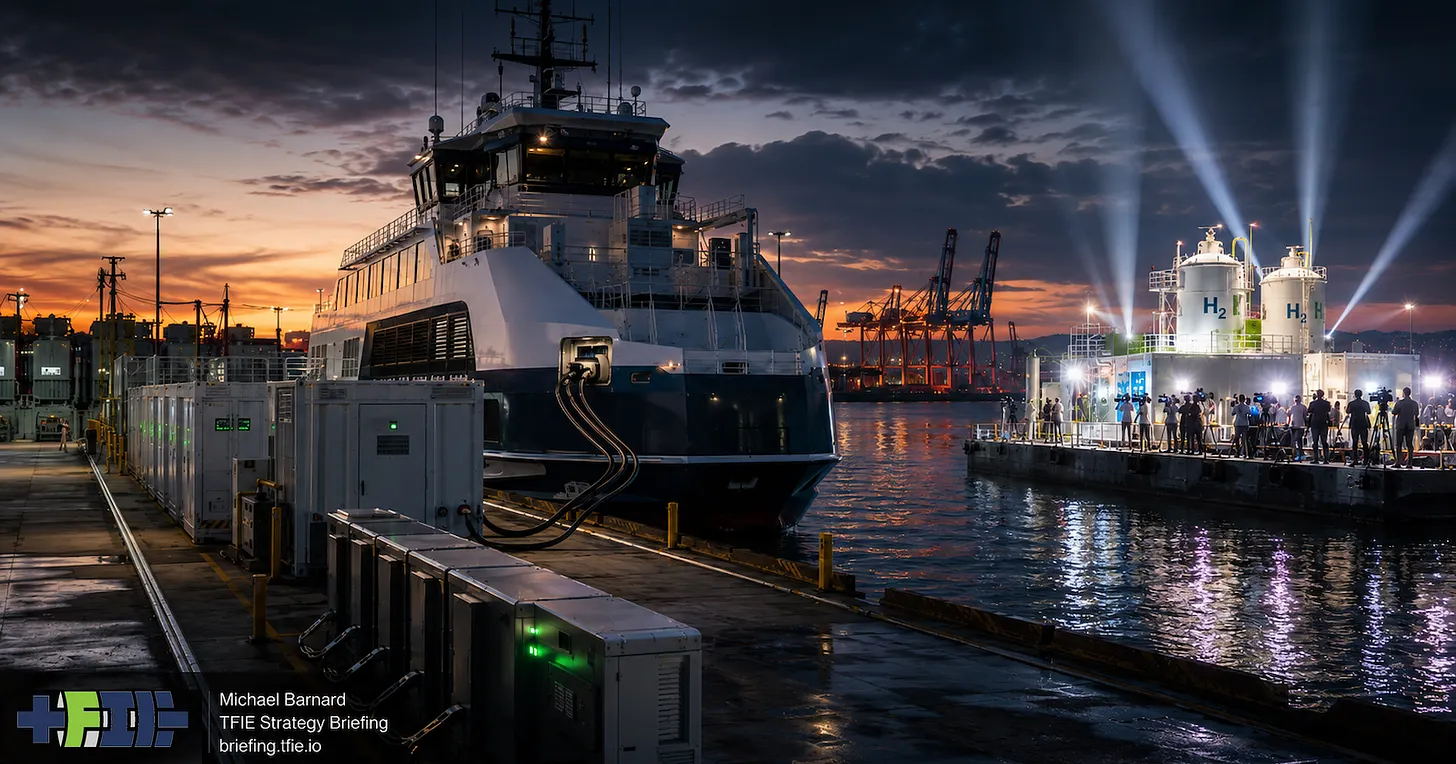
The Tilbury Demonstration: A Technical Overview
The demonstration at the Port of Tilbury was designed to address a very real constraint facing modern ports: the inability of existing electrical grids to handle the high instantaneous loads required by electric vessels. As the shipping industry moves away from heavy fuel oil and diesel, the demand for high-power charging at the quayside is skyrocketing. GeoPura’s solution involved using green hydrogen to generate electricity via fuel cells, which was then fed through a charger into the ship’s onboard batteries.
The system delivered a steady 300 kW stream of power, a significant amount for a mobile unit but only a fraction of what large-scale commercial vessels will eventually require. By placing the HPU on a floating platform, the project demonstrated a "mobile" charging solution that could theoretically be moved to different berths, bypassing the need for permanent, land-based infrastructure. While the demonstration was a success in proving the technical feasibility of the hydrogen-to-battery charging loop, it also underscored the logistical and energetic complexity of using hydrogen as an intermediary for battery-electric ships.
The Thermodynamic Efficiency Gap
One of the primary hurdles for the "hydrogen loop" in maritime charging is the significant loss of energy during the conversion process. According to GeoPura’s own technical data, the round-trip efficiency of this process is relatively low. To produce 1 megawatt-hour (MWh) of usable electricity at the fuel cell, approximately 3.1 MWh of renewable electricity must be fed into the initial electrolysis process.
This 3:1 ratio is a result of cumulative losses across the supply chain. First, the process of electrolysis—splitting water into hydrogen and oxygen—typically operates at 60% to 80% efficiency. Second, the hydrogen must be compressed, transported, and stored, each step consuming further energy. Finally, the fuel cell itself, which converts the hydrogen back into electricity, generally operates at an efficiency of 50% to 60%. When compared to the direct charging of a battery from the grid, which typically sees efficiencies of 85% to 90%, the hydrogen route appears energetically expensive.
For temporary applications—such as construction sites, outdoor events, or remote locations where the grid simply does not exist—the 3.1:1 efficiency penalty is often an acceptable trade-off to replace noisy, polluting diesel generators. However, in a permanent industrial setting like a major port, where the ultimate goal is high-capacity vessel charging, the economic and environmental justification for inserting a hydrogen loop becomes more difficult to maintain.
The Port Power Constraint: Peak Demand vs. Grid Capacity
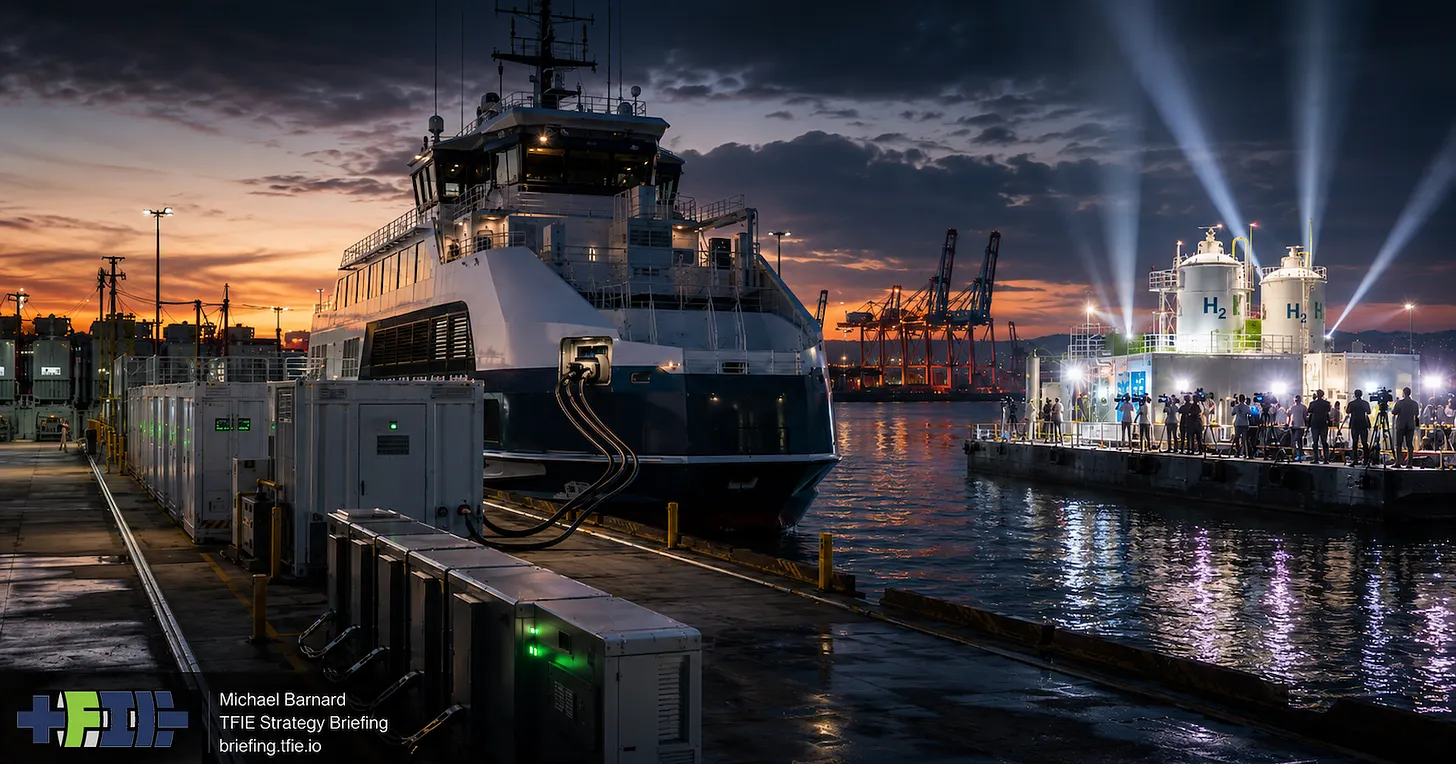
The problem that GeoPura is attempting to solve is a genuine bottleneck in maritime decarbonization. Most ports were built for an era of fossil fuels, with electrical infrastructure designed for lighting, cranes, and office buildings, not for the massive power draws of electric ship propulsion. A single medium-sized electric ferry or workboat may require several hundred kilowatts or even several megawatts of power for a short duration while docked.
Upgrading the local distribution network to support these instantaneous loads is a monumental task. It involves years of planning, significant capital expenditure, and the physical challenge of trenching and cabling through industrial sites that are often congested or built on reclaimed land. Furthermore, if a ship only docks for one hour a day, the grid infrastructure would sit underutilized for the remaining 23 hours, making the return on investment for a massive cable upgrade difficult to justify.
The Case for Stationary Battery Buffering
Industry analysts suggest that the "awkward electrical problem" described at Tilbury is more naturally suited to a battery-storage solution than a hydrogen one. A stationary Battery Energy Storage System (BESS) can be connected to a relatively small, existing grid connection. This battery can charge slowly and steadily throughout the day and night when demand is low. When a vessel arrives, the BESS releases that stored energy at a high rate, providing the "burst" of power the ship needs without overwhelming the local grid.
In this scenario, the electricity network sees a smooth, manageable load, while the ship receives the high-power charging it requires. This "peak shaving" approach is already being deployed in various sectors, from electric bus depots to Tesla Supercharger stations. In the maritime context, containerized batteries offer an additional layer of flexibility; they can be swapped out entirely, allowing the vessel to depart with a full battery while the depleted unit stays behind to charge at a slower pace. This decoupling of charging time from vessel turnaround time is seen as a key driver for commercial viability.
Infrastructure: The "Unphotogenic" Path to Success
The maritime transition is currently caught between the "spectacle" of new technology and the "mundanity" of scalable infrastructure. Hydrogen deployments are inherently more "photogenic" because they involve a complex ballet of new production facilities, specialized storage tanks, fuel delivery logistics, and advanced fuel cell applications. Each of these components represents a technological milestone often celebrated with press releases and government grants.
In contrast, the infrastructure required for mass-market electrification—transformers, substations, power electronics, and rows of stationary batteries—is largely invisible and unexciting. However, this "quiet" infrastructure is what becomes more valuable as more vessels adopt electric propulsion. A robust port grid and charging network can serve not only ships but also electric drayage trucks, port handling equipment, and nearby industrial buildings.

The transition will be complete when the sight of a ship charging at a quay becomes as unremarkable as a ship refueling with diesel. This shift from "demonstration" to "system" is the true threshold of commercial significance. For the Port of Tilbury and others like it, the success of a charging solution will eventually be measured not by the novelty of the fuel source, but by the cost per kilowatt-hour delivered and the reliability of the service across hundreds of vessel calls.
Analysis of Broader Impacts and Implications
The debate between hydrogen-mediated charging and direct battery-buffering has significant implications for the UK’s "Clean Maritime Plan" and global efforts by the International Maritime Organization (IMO) to reach net-zero emissions by 2050.
- Capital Allocation: Governments and private investors must decide whether to subsidize hydrogen "firsts" or invest in the fundamental grid upgrades required for wide-scale electrification. While hydrogen is essential for long-haul, deep-sea shipping where batteries are too heavy, it may be an over-engineered solution for short-sea shipping and port operations.
- Standardization: For electrification to scale, charging interfaces and voltage levels must be standardized across ports. The "bespoke" nature of hydrogen power units may hinder this standardization if they are viewed as permanent solutions rather than stop-gaps.
- Commercial Viability: The shipping industry operates on thin margins. If the "hydrogen loop" results in electricity costs that are three times higher than grid-supplied power due to efficiency losses, vessel operators will likely wait for grid-based solutions or opt for stationary battery buffering to keep operational costs low.
Conclusion: Beyond the First Demonstration
The Tilbury project proved that hydrogen can, indeed, be used to charge an electric ship. It served as a vital proof of concept for addressing port power constraints in the short term. However, the accumulation of "technological firsts" can sometimes mask a weakness in commercialization. If a demonstration does not lead to a second, third, and hundredth deployment, it remains an expensive outlier rather than a scalable system.
The future of the maritime industry will likely be bifurcated. Hydrogen and its derivatives (like green ammonia or methanol) will likely dominate the high-seas routes where energy density is paramount. Conversely, the "boring" work of coastal shipping, ferries, and port operations will be handled by batteries, supported by a vast, quiet, and highly efficient network of cables and stationary storage. The true sign of progress in the maritime transition will be less about the "lights and cameras" of hydrogen and more about ships arriving, charging, and leaving on schedule, powered by an invisible but invincible electrical grid.
