

The Chinese automotive landscape underwent a seismic shift in July 2026, as internal combustion engine (ICE) vehicle sales experienced a historic collapse while plug-in electric vehicles (EVs) surged to unprecedented market dominance. According to the latest registration data, the total passenger vehicle market in China contracted by 21% year-over-year, settling at approximately 1.5 million units. However, this overall decline masked a profound divergence between traditional and modern powertrains. While pure petrol-powered models saw sales crash by 44% compared to July 2025, the market share for plug-in vehicles—encompassing both battery-electric vehicles (BEVs) and plug-in hybrids (PHEVs)—reached a record-breaking 65%.
This milestone represents an 11-percentage-point improvement over the 54% share recorded in July 2025. Industry analysts point to a combination of factors driving this transition, including volatile global oil prices, a rapidly expanding public charging infrastructure, and a relentless wave of technologically superior domestic BEV launches. If current trends persist, the world’s largest automotive market appears on track to achieve full electrification before 2030, with a transition to 100% battery-electric sales potentially realized by 2035.
The Divergent Performance of Powertrains
The July data highlights a significant "ICE meltdown" that has bypassed the gradual transition period many legacy automakers anticipated. Pure petrol models bore the brunt of the disruption, with their 44% year-over-year decline signaling a rapid abandonment of traditional engines by Chinese consumers. Interestingly, traditional non-plug-in hybrids (HEVs) proved more resilient than their plug-in counterparts in terms of sales volume retention, dropping only 4%. In contrast, plug-in hybrids (PHEVs) fell by 21% and extended-range electric vehicles (EREVs) declined by 17%.
The sole bright spot in the domestic market was the pure electric segment. Despite a reduction in direct government purchase incentives, BEV sales rose 6% year-over-year to 647,000 units. This growth allowed BEVs to capture a record 44% share of the total market on their own. When combined with the 21% share held by PHEVs, the total "plug-in" share of 65% sets a new benchmark for major global economies.
The data further suggests a shifting internal dynamic within the EV sector. While PHEVs initially gained ground earlier in the year due to price-war strategies, BEVs are regaining momentum. The sales breakdown in July stood at 68% BEV versus 32% PHEV, a return toward the 80/20 split seen in the early years of China’s EV adoption. Analysts suggest this shift is driven by the upcoming expiration of tax exemptions for PHEVs and EREVs scheduled for 2027, prompting consumers to pivot toward pure electric options.
Domestic Dominance and the Export Surge
A secondary but equally critical transformation is occurring in the export sector. In July 2026, Chinese automakers exported over 500,000 vehicles, representing a massive 148% increase year-over-year. The electrification of these exports is keeping pace with the domestic market, with EVs accounting for 59% of all exported units, up from 45% in July 2025.
This "export push" is creating a dual-pronged challenge for legacy global automakers. Not only are they losing ground within China, but they are also facing increased competition from highly competitive Chinese EVs in international markets. Industry experts warn that the strategy of maintaining ICE-heavy portfolios in markets outside China is becoming a "pipe dream" as Chinese manufacturers leverage their scale and technological lead to electrify global trade routes.
Competitive Landscape: The Rise of Startups and the Fall of Giants
The monthly ranking of best-selling brands and models reveals a market in the midst of a total reshuffle. Traditional foreign powerhouses, once considered invincible in China, are now seeing their sales figures "crater."
Legacy OEM Struggles
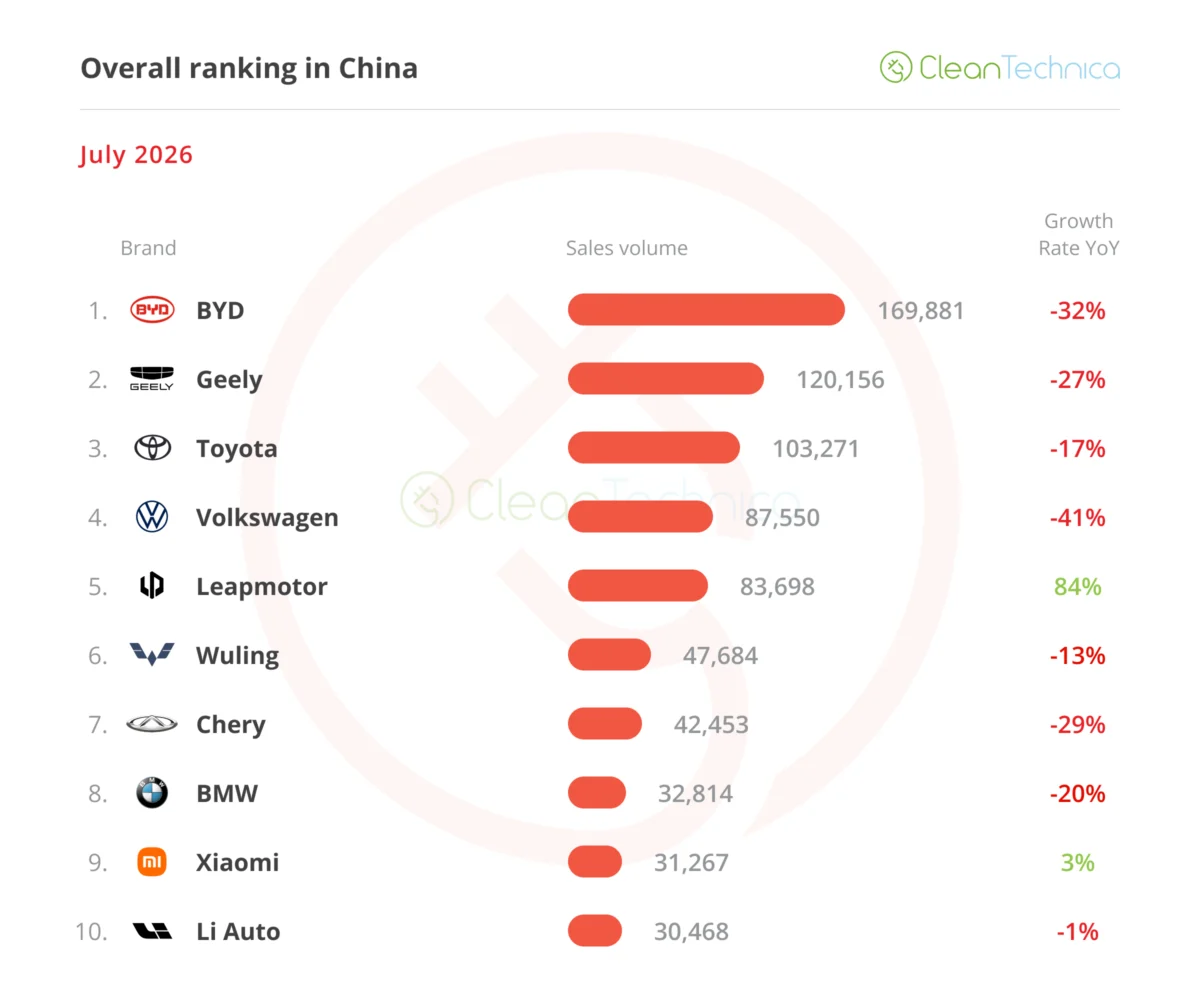
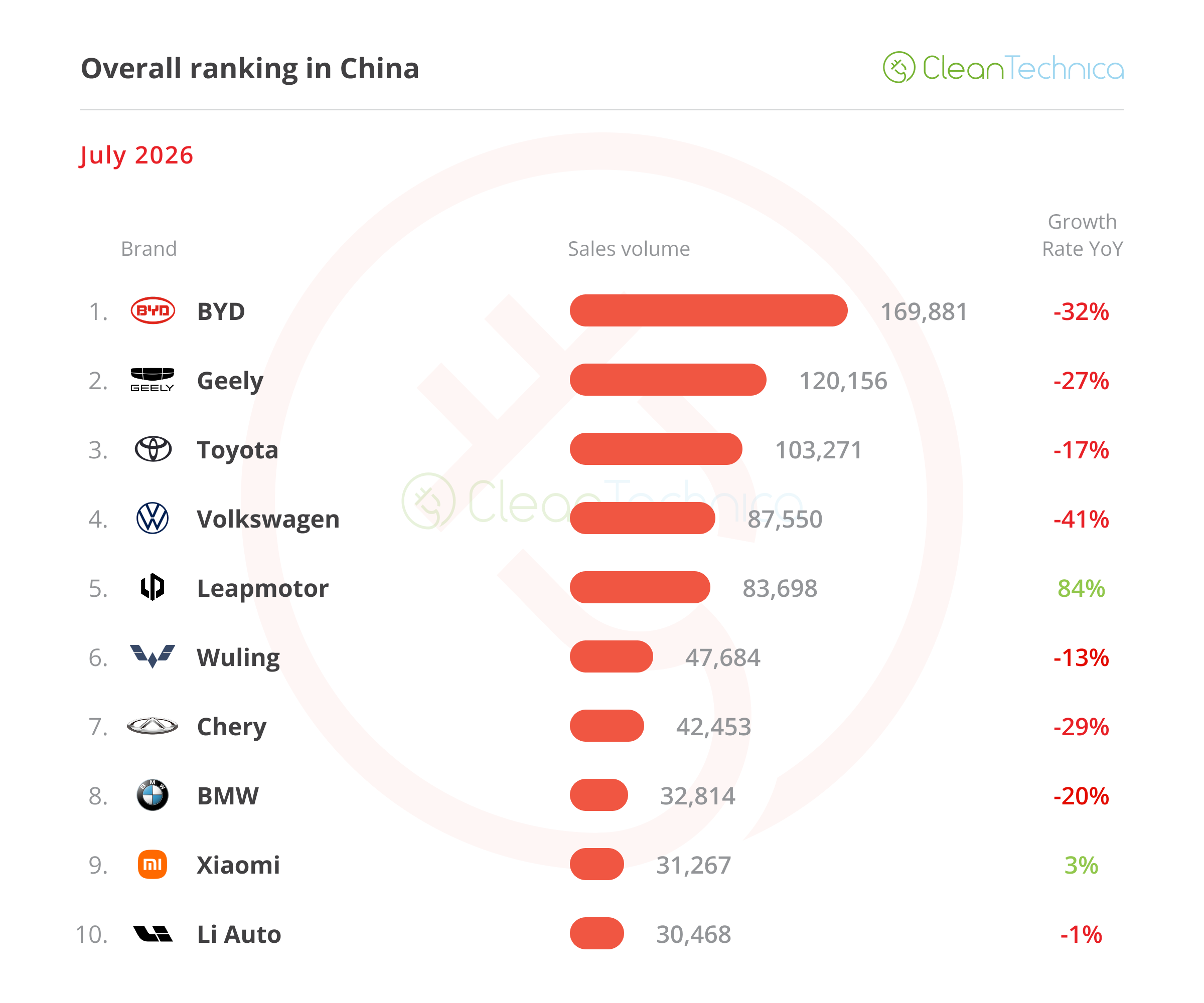
Volkswagen, formerly the market leader in China, saw its sales crash by 41% in July. Toyota and Honda were not spared, with the latter experiencing a 44% drop to just 25,000 units—a quarter of Toyota’s volume for the same period. The American presence is also fading; General Motors has confirmed the withdrawal of the Chevrolet brand from the Chinese market, while Buick sales fell by 37%. Smaller players like Ford, Peugeot, and Citroen have seen volumes dwindle to a few thousand units, effectively rendering them marginal participants in the market.
The New Leaders
In contrast, local startups and EV-focused brands are experiencing exponential growth. Leapmotor emerged as a standout performer in July, with registrations surging 84% year-over-year to 83,698 units. This puts the Hangzhou-based startup within striking distance of Volkswagen’s total sales volume. Other gainers include Geely’s premium arm, Zeekr (up 75%), and BYD’s Fang Cheng Bao (up 109%).
Top 5 Model Analysis
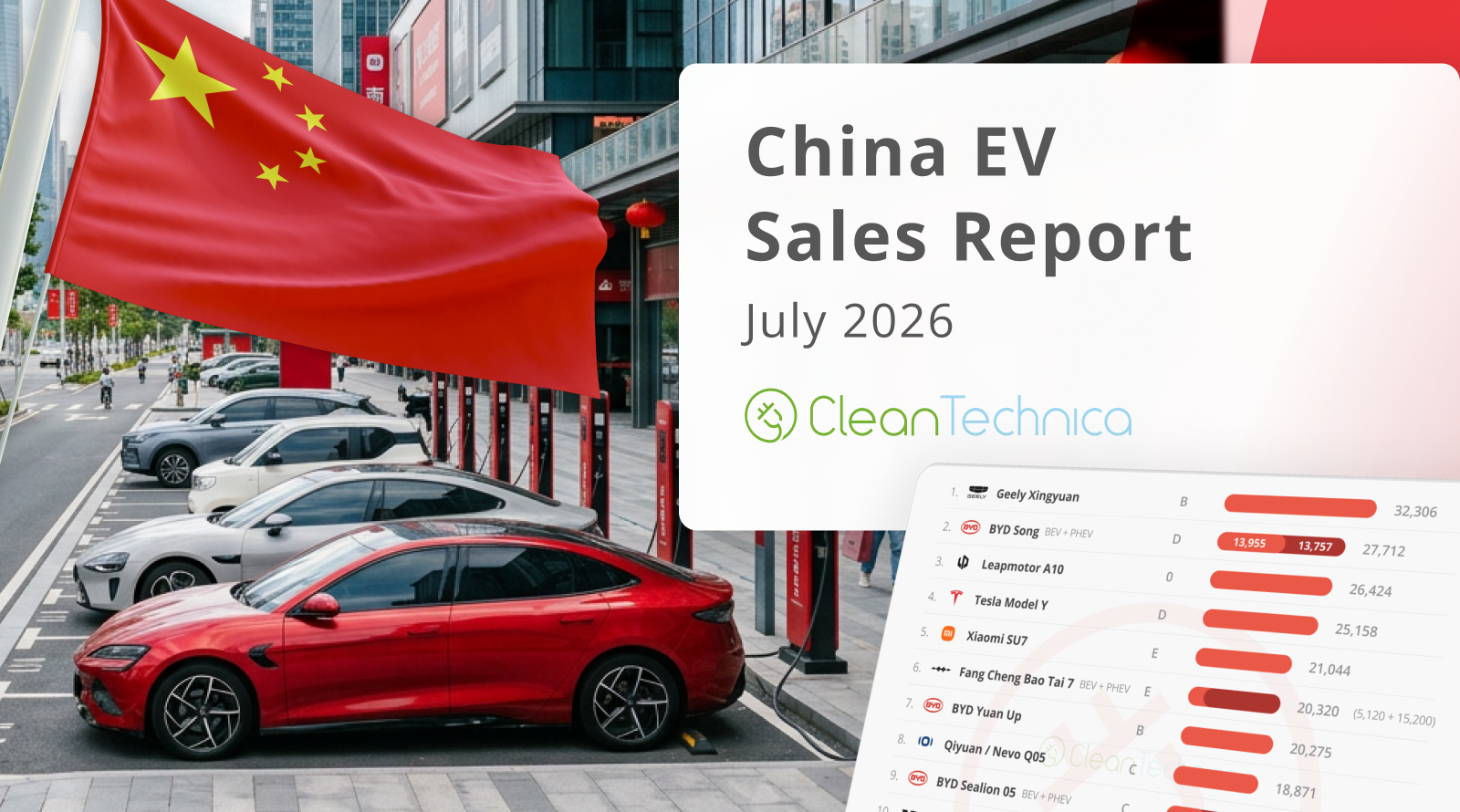
The list of the top five best-selling electric models in July 2026 provides a snapshot of the current consumer preferences in China, where value, technology, and design are the primary drivers of success.

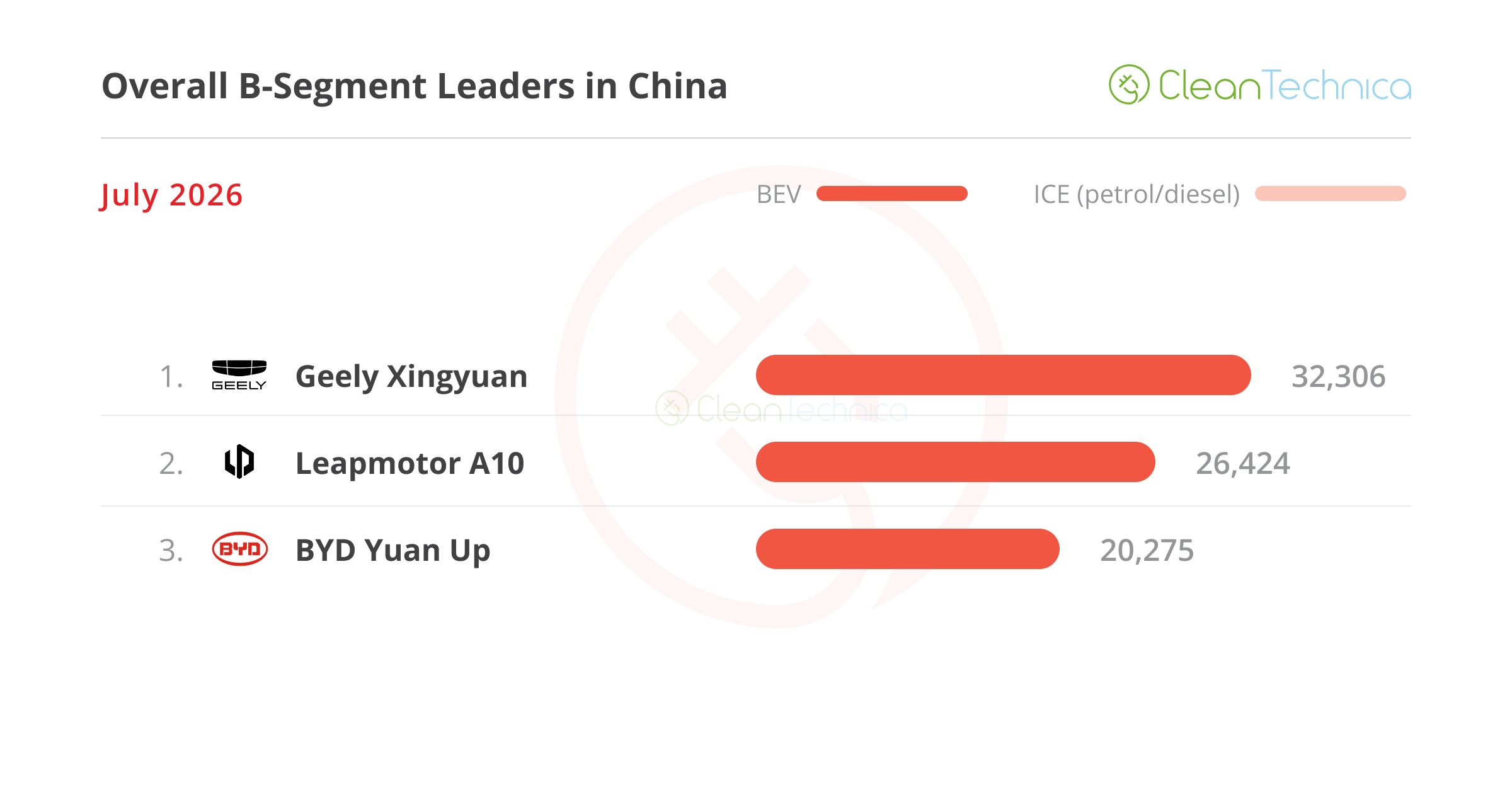
- Geely Xingyuan (32,306 units): Despite a 27% drop from the previous year due to intensifying competition, this small hatchback remains a dominant force. Its success is attributed to offering "BYD Dolphin" specifications at a "BYD Seagull" price point (approx. $10,000 USD).
- BYD Song BEV+PHEV (27,712 units): BYD’s midsize SUV is currently in a transition phase. The new "Ultra" generation, featuring lidar and 1,500 kW DC fast charging, is expected to drive a second half-year surge. Its starting price of $22,000 significantly undercuts Western competitors like the Tesla Model Y.
- Leapmotor A10 (26,424 units): This small crossover has become a breakout hit for the startup brand. With a starting price of roughly $10,000, it combines high value-for-money with a distinct design language that moves away from the "white product" look of earlier models.
- Tesla Model Y (25,158 units): While still a top contender, the Model Y saw an 18% decline in July. The introduction of an extended wheelbase "L" version has helped maintain interest, but the six-year-old platform is facing stiff competition from newer 800V architecture models from domestic brands.
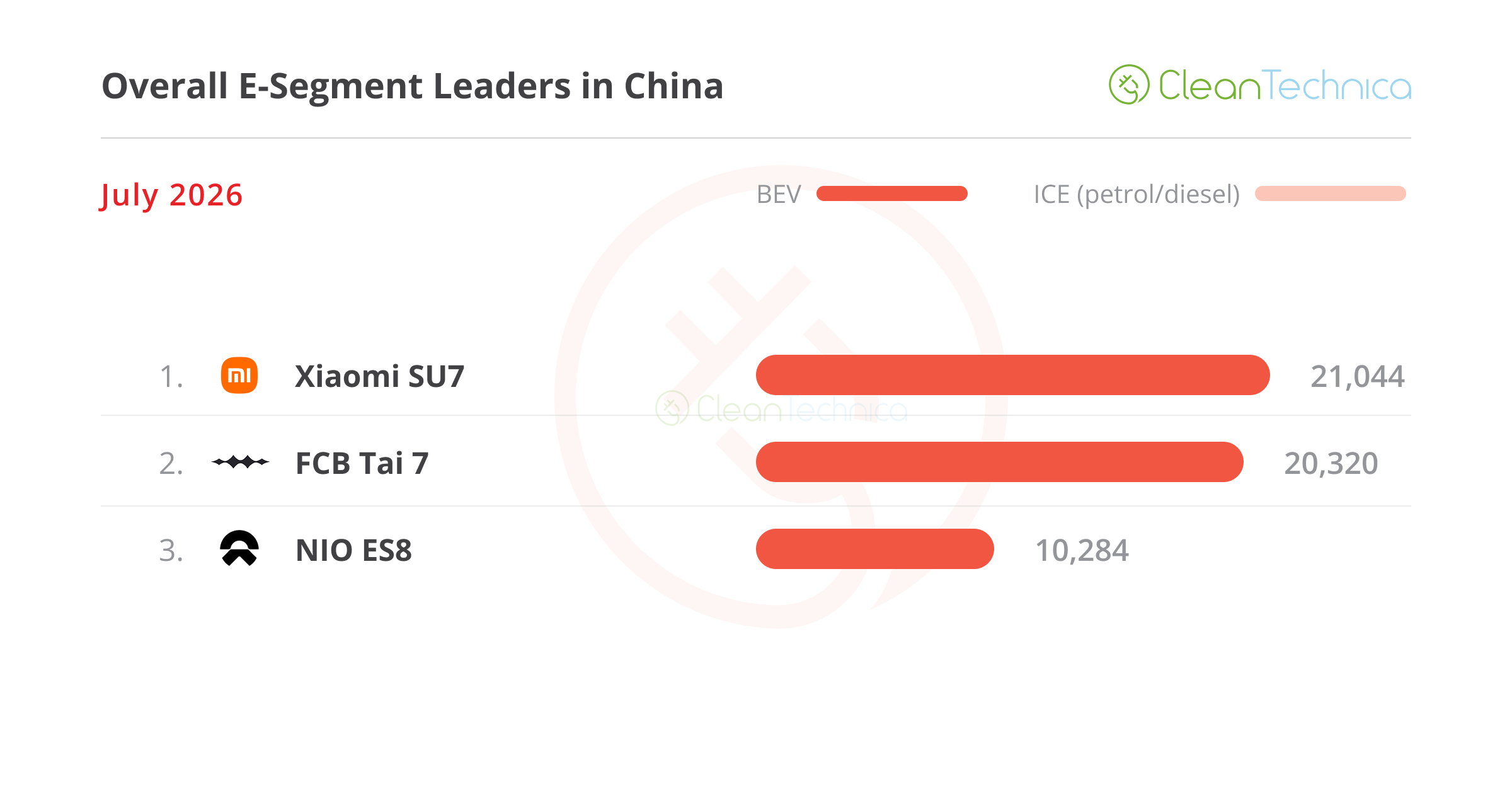
- Xiaomi SU7 (21,044 units): The "King of Sedans" continues to prove that there is significant demand for sporty, high-tech sedans. Xiaomi’s successful entry into the automotive space highlights the advantage of integrating consumer electronics expertise with vehicle manufacturing.
Segment Trends and the Decline of the Tesla Model 3
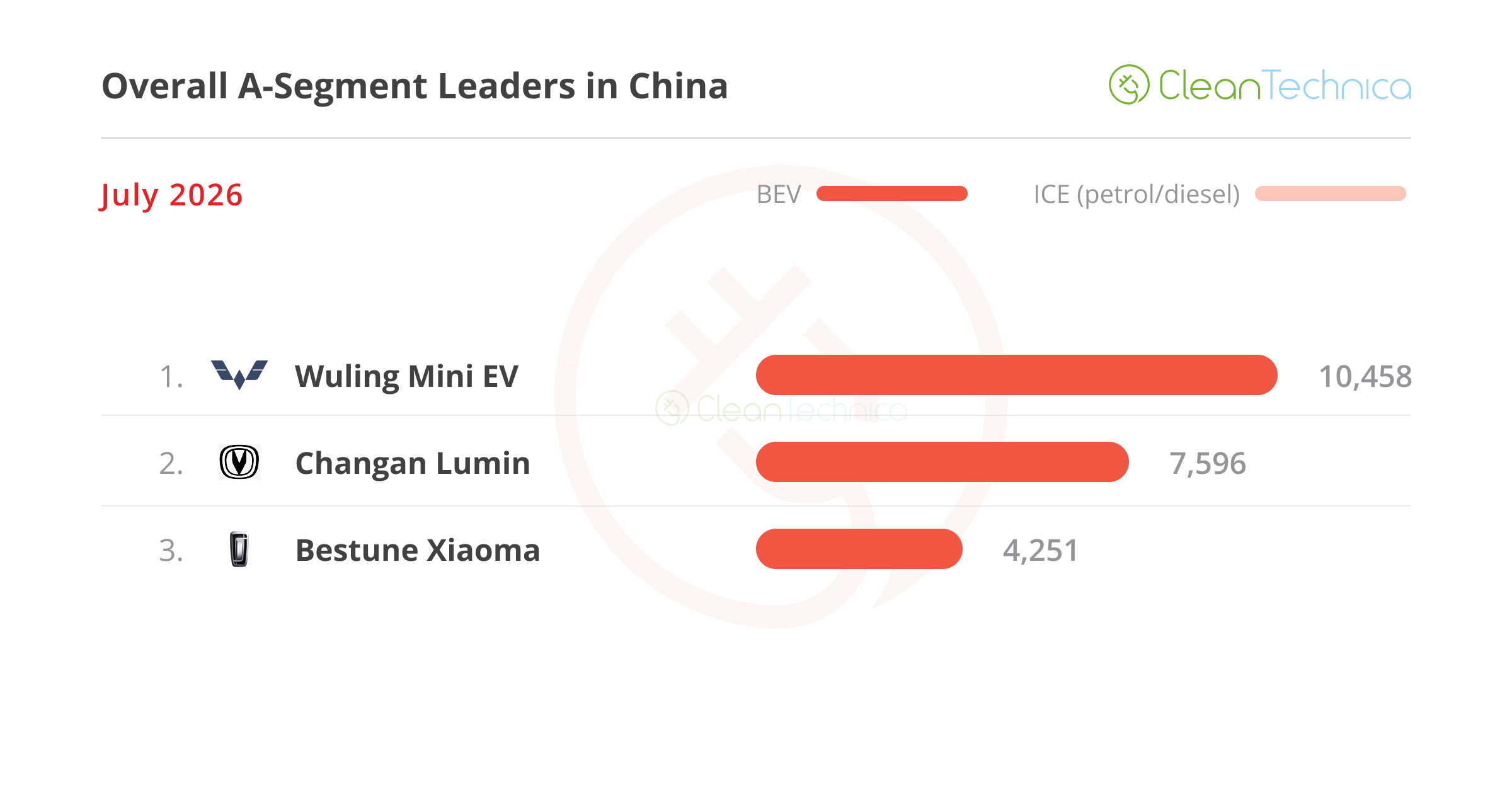
The July data also revealed a notable trend in vehicle segments. Crossovers and SUVs continue to dominate, occupying 12 of the top 20 spots. However, the subcompact and city car categories are seeing a revival as brands introduce "fresh metal" to replace older models affected by subsidy cuts.
Perhaps the most symbolic data point of the month is the continued decline of the Tesla Model 3. Once the best-selling EV in China (2020), the Model 3 dropped out of the top 20 entirely in July, delivering only 2,091 units—a staggering 78% year-over-year decline. Analysts point to the "Model 3’s new reality": it can no longer compete on price against domestic rivals like the BYD Seal 06 or the XPeng Mona M03, nor can it match the perceived value and "sexiness" of the Xiaomi SU7, which retails for a similar price.
Strategic Implications and Future Outlook
The rapid electrification of the Chinese market has profound implications for the global automotive industry. First, the collapse of ICE sales suggests that further investment in internal combustion R&D is increasingly viewed as a sunk cost. Manufacturers who have not yet pivoted their supply chains toward electrification are finding themselves with stranded assets and declining revenue streams.
Second, the success of "all-EV" top 10 rankings in the overall market (not just the EV sub-category) proves that the transition is no longer a niche phenomenon but a total market takeover. In July, seven of the top ten overall best-selling vehicles in China were pure electric models.

Finally, the rise of companies like Leapmotor suggests a new hierarchy is forming. By maintaining a focused but broad lineup that covers everything from city cars to full-size "land yachts," these startups are avoiding the "byzantine" complexity of legacy lineups while offering superior tech-to-price ratios. Some analysts now project that by 2030, startups like Leapmotor could potentially rival the global volumes of established players like Tesla.
As 2026 progresses, the industry expectation for the full-year EV market share in China has been revised upward to 60%, with BEVs expected to account for over 40% of all sales. For the global "Big Auto" players, the July results are a stark reminder that the Chinese market is no longer a reliable source of ICE-based profits, but rather a hyper-competitive laboratory that is defining the future of transport.
