

The first half of 2026 has been a crucible for global business leaders, marked by a relentless surge of geopolitical conflicts, disruptive trade policies, and unpredictable policy shifts that have forced a strategic recalibration. As the year progresses, Chief Executive’s latest CEO Confidence Index reveals a significant pivot in executive priorities, with revenue and market-share growth now at the forefront, closely followed by profitability and operational efficiency. This strategic tightening contrasts sharply with the ambitious, broad-ranging agendas that CEOs outlined at the beginning of the year, underscoring the profound impact of an unsettled global landscape on boardroom decision-making.
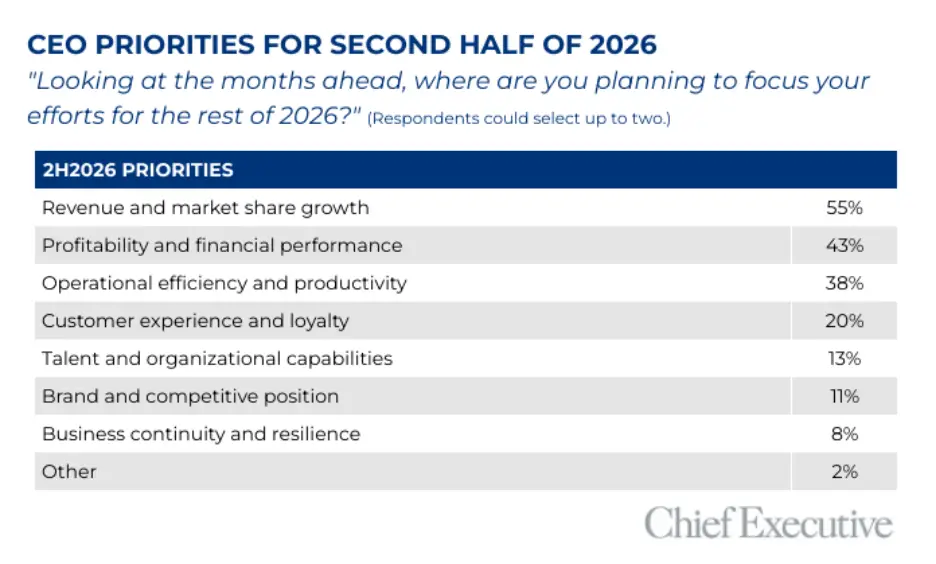
The August 4-5 CEO Confidence Index, surveying 285 chief executives, indicates a clear mandate for immediate financial performance. Revenue and market-share growth were identified as the top priorities by 55 percent of respondents, a stark indicator of the pressure to deliver tangible results amidst economic uncertainties. Profitability and financial performance followed closely, cited by 43 percent, with operational efficiency and productivity rounding out the top three at 38 percent. These three areas collectively represent a decisive shift from the more expansive strategic horizons of January 2026, when CEOs expressed aspirations for market entry, product development, technological investment, and enhanced customer experience.
The divergence in survey methodologies between January and August is worth noting. The earlier survey allowed for up to three priorities from a more extensive list, encompassing both broad objectives and specific initiatives. The August survey, conversely, narrowed the focus to just two broader areas of concentration. Despite this difference, the combined results strongly suggest a strategic conversion of initial strategic groundwork into a more focused drive for concrete outcomes. Artificial Intelligence (AI) has emerged as a critical tool in this renewed push for growth and efficiency, permeating many of the strategic considerations for the remainder of the year.
The Ascendancy of AI in a Volatile Landscape
The strategic reorientation observed in the August survey is deeply intertwined with the increasing integration of Artificial Intelligence across various business functions. Several CEOs highlighted the imperative of aligning organizational structures with the rapid pace of growth, particularly as it relates to AI implementation. One executive articulated this challenge as "managing growth pace against operational structures and consistencies," pointing to the inherent difficulty in scaling agile AI initiatives within potentially more rigid corporate frameworks.
For a significant cohort of CEOs, AI is not merely a technological upgrade but a fundamental component of their strategy to navigate economic headwinds and secure future revenue streams. One CEO, prioritizing revenue growth and operational efficiency in the latter half of 2026, explained the necessity of "spinning up new business lines in AI to make up for legacy product stagnation." This sentiment reflects a proactive approach to mitigating the risks associated with mature product lines by leveraging the transformative potential of AI to create new avenues for income and market penetration.
The tangible benefits of AI adoption are already being observed across industries. Bill Estes, president of Geokon, a manufacturer of geotechnical and structural instrumentation, shared his company’s experience: "Adoption of AI is significantly improving efficiency and data intelligence." This sentiment is echoed by Jim Donnelly, CEO of Wayne Bank, based in Honesdale, PA. He is actively focused on "making the business more efficient" by implementing and scaling new technologies designed to "minimize operational constraints." These efforts underscore a broader trend of leveraging AI to streamline processes, enhance decision-making, and reduce operational friction, thereby freeing up resources for growth-oriented activities.
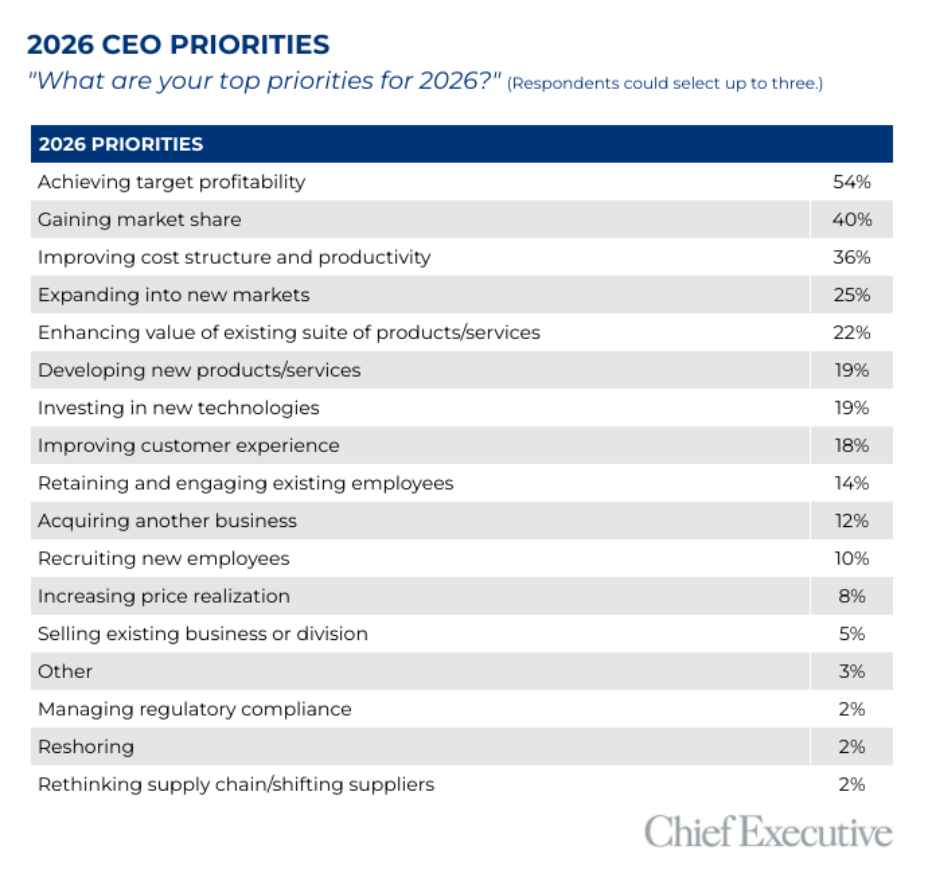
The current AI focus builds upon the foundational priorities identified at the start of the year, including market expansion, product enhancement, new offering development, technological investment, and customer experience improvement. Paul Riedl, Jr., CEO of River Run, a managed IT and cybersecurity services firm in Glendale, Wisconsin, emphasizes the critical need for companies to master the judicious use of AI to accelerate their growth trajectories. "Our business is affected by AI," he stated, warning other leaders that the pressure to adapt will only intensify. His personal focus for the coming months is "AI implementation and getting people to use it as a tool to leap forward." This highlights not only the technological adoption but also the crucial human element of change management and skill development required for successful AI integration.
The implications of this AI push are far-reaching. Companies that successfully integrate AI can expect to see enhanced productivity, improved customer insights, and the potential for entirely new business models. Conversely, those that lag in AI adoption risk falling behind competitors, facing obsolescence in an increasingly AI-driven market. The challenge for many will be to balance the rapid adoption of AI with the need for robust data governance, ethical considerations, and a workforce capable of leveraging these new tools effectively.
The Understated Importance of Talent and Resilience
While AI and revenue growth command significant attention, the August survey also illuminates areas that, despite their inherent importance, are receiving less explicit prioritization from a majority of CEOs. Talent and organizational capabilities, for instance, were cited as top-two focus areas by only 13 percent of respondents. This stands in stark contrast to the persistent visibility of workforce-related issues throughout the survey.
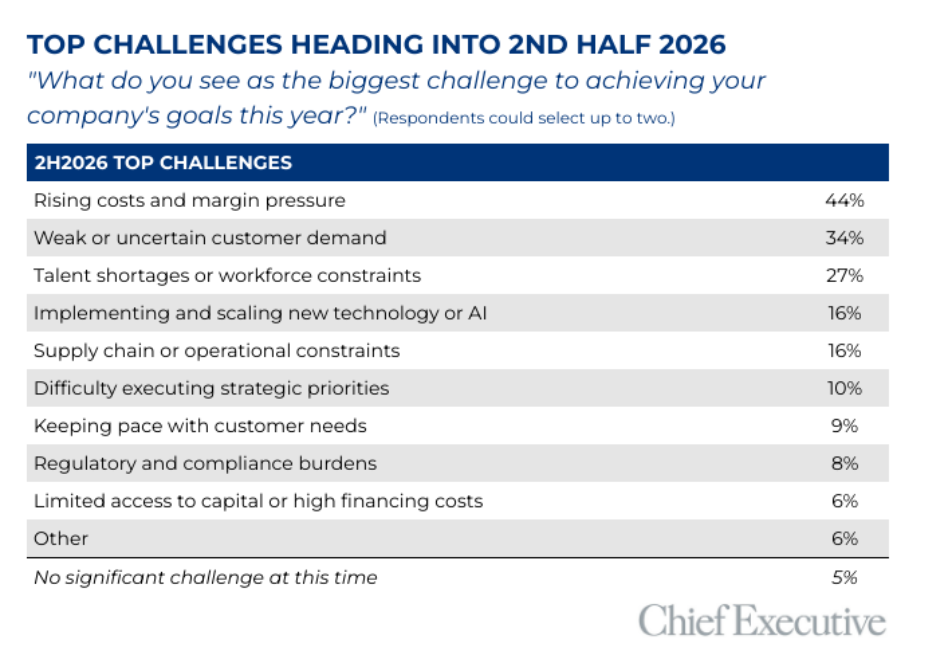
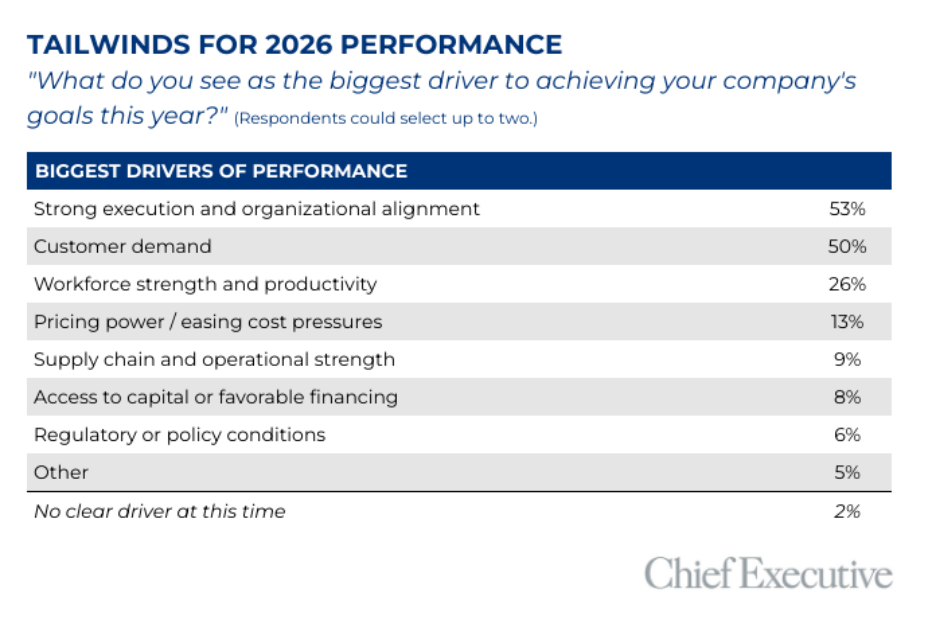
A substantial 27 percent of CEOs identified talent shortages or workforce constraints as significant challenges to achieving their goals. Furthermore, 26 percent pointed to workforce strength and productivity as key drivers of success, while 22 percent flagged workforce availability and labor costs as major external risks. This disconnect between the perceived importance of talent as a challenge or driver and its prioritization as a strategic focus area suggests a potential blind spot or a deferred commitment to addressing fundamental human capital needs.
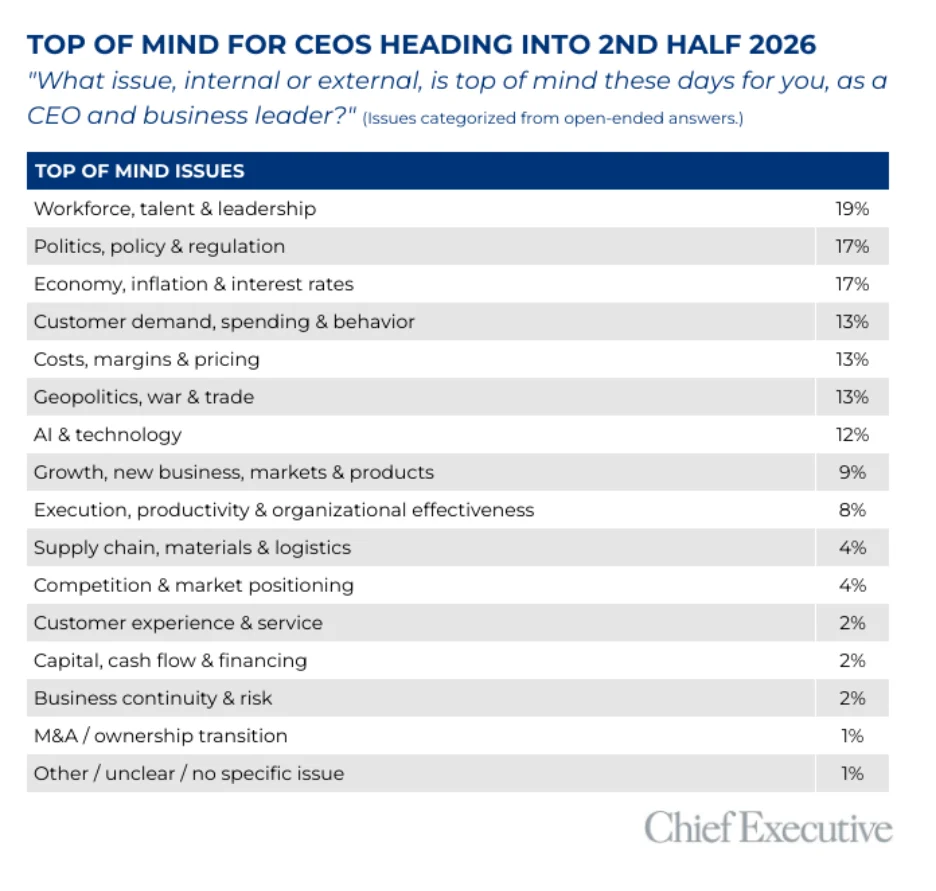
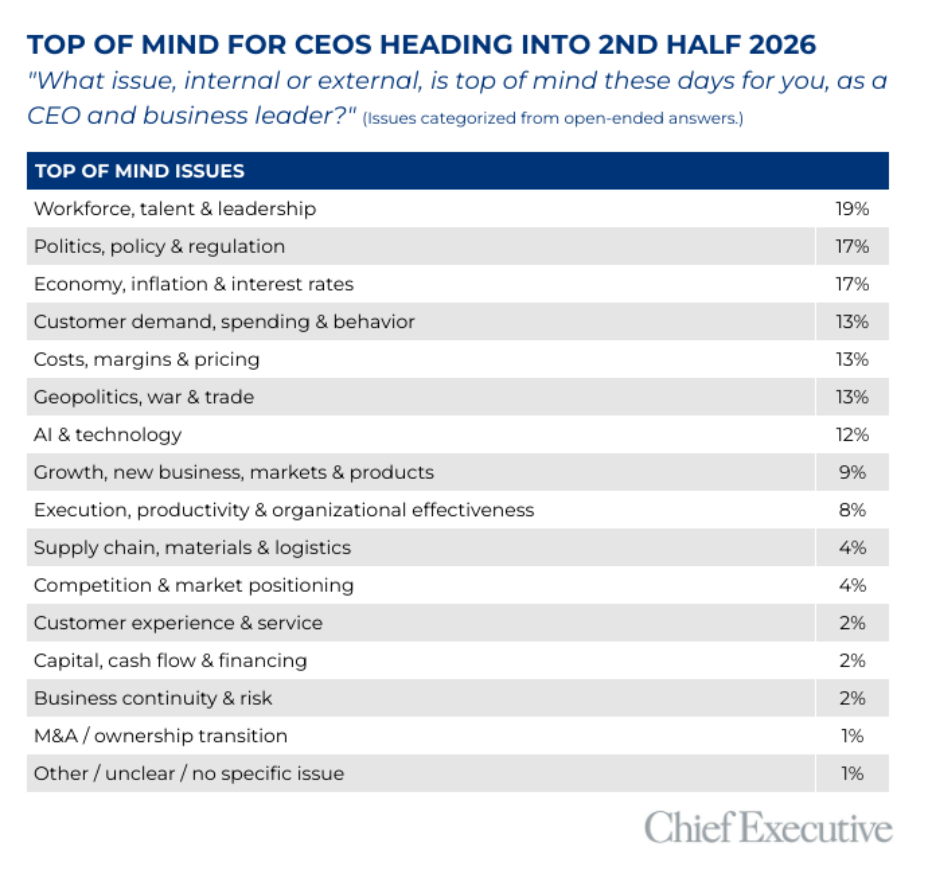
The qualitative feedback further amplifies this observation. When asked independently about their top concerns, "workforce," "talent," and "leadership" emerged as the most frequently cited themes, appearing in 19 percent of open-ended responses. Gladiola Unzueta, founder and CEO of MultiGla Strategies, a provider of integrated financial services and business consulting, underscored the enduring significance of human capital: "The companies that will lead in the coming years will not simply adopt new technology; they will build strong cultures, invest in their people, and remain adaptable." She further posited, "AI is transforming business, but trust, leadership, and execution will continue to be the true competitive advantages." This perspective emphasizes that while technology is a powerful enabler, it cannot fully replace the foundational elements of strong organizational leadership and a committed workforce.
Chris Burkhard, president and founder of Placers Staffing & Recruitment, observes an accelerating pace in the labor market, characterized by both hiring and firing. He notes, "There is a normalization to the market churn that is just beginning," adding that labor shortages and skill gaps are making workforce strategy critically relevant once again. Burkhard’s assertion that "AI falls short in replacing humans" serves as a poignant reminder of the irreplaceable human element in many business functions, particularly those requiring nuanced judgment, empathy, and creativity.
The CEOs who are explicitly prioritizing talent appear to be those with more optimistic growth projections. Nearly 90 percent of these leaders anticipate revenue increases, compared to 73 percent among those who did not select talent as a top priority. Similarly, 63 percent expect to expand their headcount, a significantly higher proportion than the 44 percent among their peers who deprioritized talent. This correlation suggests that a strategic investment in talent is intrinsically linked to ambitious growth plans and the capacity to execute them effectively.
A similar question arises regarding business continuity and resilience. Only 8 percent of CEOs listed this as a primary focus area, despite a considerable portion acknowledging significant external risks. Forty-five percent identified inflation and economic conditions as major risks, while 39 percent cited geopolitical conflict or trade disruption. The apparent de-prioritization of resilience planning in the face of such evident threats could leave businesses vulnerable to unforeseen shocks.
Navigating Competitive Pressures and External Risks
The landscape of competitive positioning also presents a notable tension within the survey results. Just 11 percent of CEOs designated brand and competitive position as a top focus. However, a more substantial 25 percent identified competition and market disruption as a significant external risk. When asked about their top concerns without predefined options, 12 percent independently raised AI or technology as a key issue, often expressing apprehension about AI-driven disruption and the imperative to adapt business models swiftly. This suggests an awareness of competitive threats, particularly from emerging technologies, that is not always translating into explicit strategic prioritization of brand and competitive advantage.
Potential Hurdles on the Horizon
Despite the prevailing focus on growth and efficiency, several challenges continue to cast a shadow over business objectives. Rising costs and margin pressure remain the most pervasive concern, cited by 44 percent of CEOs as a primary obstacle. Weak or uncertain customer demand follows at 34 percent, with talent shortages or workforce constraints identified by 27 percent.
The perception of customer demand is bifurcated. While half of the polled CEOs view it as a significant tailwind, a substantial third perceive weak or uncertain demand as a challenge. For some businesses, this demand is indeed fueling their growth aspirations. As one CEO noted, "Demand is accelerating," while another observed that "the market has remained stronger than expected for longer than expected." Conversely, for others, the economic climate is exerting a negative impact. One respondent lamented that "high costs/inflation is finally shrinking consumer demand," illustrating the divergent economic realities faced by different sectors and businesses.
External risks continue to be substantial and multifaceted. Inflation and economic conditions lead the list of concerns, followed closely by geopolitical conflict or trade disruption. Competition and market disruption, workforce availability and labor costs, and evolving customer behavior also represent significant external threats.
Despite these acknowledged challenges and risks, the strategic imperative for revenue and market-share growth remains paramount for 55 percent of CEOs as they navigate the remainder of 2026. Complementing this drive, 53 percent of leaders cite strong execution and organizational alignment as critical factors enabling them to achieve their objectives. This emphasis on operational excellence suggests a recognition that even in a turbulent environment, the ability to effectively implement strategy and maintain cohesive organizational direction is as crucial as the strategy itself. The interplay between leveraging advanced technologies like AI, managing human capital effectively, and navigating a complex geopolitical and economic landscape will undoubtedly define the success of businesses in the coming months and years. The findings of the CEO Confidence Index serve as a critical barometer, highlighting the evolving priorities and persistent challenges faced by leaders at the helm of global commerce.
