

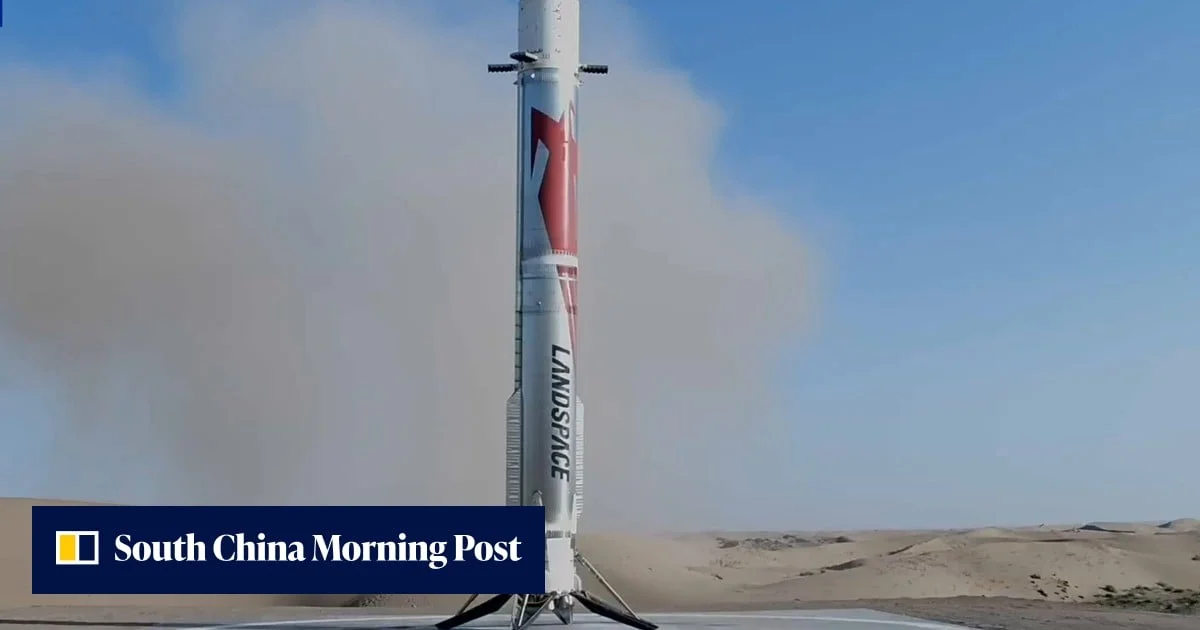
China’s commercial space sector reached a definitive turning point on Wednesday as LandSpace, a leading private aerospace manufacturer, successfully launched its Zhuque-3 rocket into orbit and subsequently recovered its first-stage booster. This achievement represents a global first for a stainless-steel rocket booster recovered after an orbital mission, positioning LandSpace as a formidable competitor in the international race for reusable launch vehicle technology. The mission, which originated from the Jiuquan Satellite Launch Centre in the Gobi Desert, signifies a major leap forward in China’s strategic efforts to reduce the cost of access to space and establish a sustainable, high-frequency orbital delivery system.
The Zhuque-3 rocket, a 66-meter (217-foot) tall powerhouse fueled by a combination of liquid methane and liquid oxygen (methalox), lifted off at 7:35 a.m. local time. According to reports from the state-run Xinhua news agency, the flight proceeded according to plan, with the rocket successfully deploying a Honghu-3 internet satellite into its designated sun-synchronous orbit. Following the separation of the stages, the first-stage booster performed a controlled descent, utilizing its engines to navigate back toward Earth. It executed a precise vertical touchdown at a designated recovery site in Minqin county, Gansu province, located approximately 390 kilometers (242 miles) southeast of the initial launch pad.
A Technical Triumph in Materials Engineering
The success of the Zhuque-3 mission is particularly noteworthy due to the rocket’s primary construction material: stainless steel. While traditional rockets often utilize high-strength aluminum alloys or expensive carbon fiber composites to minimize weight, LandSpace has opted for high-grade stainless steel for the Zhuque-3’s airframe and propellant tanks. This choice mirrors the design philosophy of SpaceX’s Starship and its Super Heavy booster, which are currently undergoing testing in the United States.
The advantages of stainless steel in aerospace engineering are multi-faceted. Primarily, the material offers exceptional thermal resistance, which is critical during the intense heat of atmospheric re-entry. Unlike aluminum, which begins to lose structural integrity at relatively low temperatures, stainless steel maintains its strength under extreme thermal stress, potentially reducing the need for heavy and complex heat-shielding tiles. Furthermore, stainless steel is significantly more cost-effective and easier to manufacture than specialized aerospace alloys, allowing for faster production cycles and lower capital expenditures. By proving that a stainless-steel booster can survive the rigors of an orbital launch and return safely for reuse, LandSpace has validated a low-cost pathway for the future of heavy-lift rockets.
Chronology of the Zhuque-3 Development Program
The path to Wednesday’s success was paved by years of iterative testing and a previous high-profile attempt that ended in a partial failure. LandSpace, founded in 2015, has consistently pushed the boundaries of the Chinese private space sector.
In December 2023, LandSpace conducted the maiden flight of the Zhuque-3. During that mission, the second stage of the rocket performed flawlessly, successfully reaching orbit and demonstrating the reliability of the company’s methalox engine technology. However, the attempt to recover the first stage did not go as planned. During the final moments of its powered descent, the booster experienced a technical anomaly, resulting in a dramatic explosion upon contact with the landing pad.
Undeterred by the setback, LandSpace engineers spent the subsequent months analyzing flight data and refining the guidance, navigation, and control (GNC) systems of the booster. The successful recovery this week demonstrates the company’s ability to rapidly diagnose complex engineering failures and implement effective solutions—a hallmark of the "fail fast, learn faster" methodology popularized by modern commercial space firms.
The Significance of Methalox Propulsion
Central to the Zhuque-3’s design is the use of liquid methane and liquid oxygen. LandSpace made history in July 2023 when its Zhuque-2 rocket became the world’s first methalox-fueled launch vehicle to reach orbit, beating out global competitors like SpaceX’s Starship, Blue Origin’s New Glenn, and United Launch Alliance’s Vulcan Centaur.
Methane is increasingly viewed as the "fuel of the future" for reusable rockets. Unlike kerosene (RP-1), which is used in the SpaceX Falcon 9 and many traditional rockets, methane burns cleanly and does not leave behind "soot" or carbon deposits inside the engine’s plumbing. This lack of coking makes the engines much easier to refurbish and reuse multiple times without extensive overhauls. Additionally, methane can be stored at temperatures similar to liquid oxygen, simplifying the rocket’s internal insulation and plumbing requirements. The Zhuque-3 utilizes LandSpace’s proprietary Tianmei-12 (TQ-12) engines, which provide the high thrust-to-weight ratio necessary for both orbital insertion and the delicate vertical landing maneuvers required for recovery.
Competitive Landscape and Global Context
The successful recovery of the Zhuque-3 booster places LandSpace in an elite category of aerospace entities. Currently, SpaceX remains the only other organization to have mastered the vertical recovery of orbital-class boosters on a commercial scale, primarily through its Falcon 9 and Falcon Heavy programs. However, LandSpace’s achievement with a stainless-steel airframe puts it in a unique position relative to SpaceX’s ongoing development of the Starship.
While SpaceX’s Super Heavy booster is significantly larger and designed for much heavier payloads, it is still awaiting final regulatory approval from the US Federal Aviation Administration (FAA) for a successful recovery during an orbital flight. By achieving this milestone first with the Zhuque-3, LandSpace has signaled that the gap between American and Chinese commercial space capabilities is narrowing.
The mission also highlights the rapid maturation of China’s private space industry. Since the Chinese government opened the sector to private capital in 2014, dozens of companies—including Galactic Energy, Deep Blue Aerospace, and iSpace—have emerged. LandSpace, however, has consistently led the pack in terms of technological complexity and payload capacity. The company is currently moving closer to a planned initial public offering (IPO) in Shanghai, which is expected to value the firm at over US$1 billion, providing the necessary capital to scale production of the Zhuque-3.
Supporting Data and Mission Logistics
The recovery of the booster 390 kilometers away from the launch site provides insight into the mission’s trajectory and the energy management required for such a feat. In a typical "downrange" recovery, the booster follows a parabolic arc, and rather than returning to the launch site (which requires a significant amount of fuel for a "boost-back" maneuver), it lands at a distant location. This allows the rocket to dedicate more of its fuel to carrying a heavier payload into orbit.
The payload for this mission, the Honghu-3 satellite, is part of a broader push by China to develop its own mega-constellations for satellite internet. These projects, such as the "G60 Starlink" and the "Guowang" national network, aim to provide global high-speed internet coverage, mirroring the capabilities of SpaceX’s Starlink. The ability to launch these satellites using reusable rockets like the Zhuque-3 is essential for the economic viability of such large-scale constellations, as it drastically reduces the cost per satellite deployed.
Broader Implications for the Aerospace Industry
The implications of LandSpace’s success extend far beyond a single company. For the Chinese government, the success of the Zhuque-3 validates its policy of encouraging "civil-military integration" and fostering a competitive commercial ecosystem alongside state-owned giants like the China Aerospace Science and Technology Corporation (CASC).
From a global perspective, the successful use of stainless steel and methalox in a reusable format suggests that the barriers to entry for high-capacity, low-cost spaceflight are falling. As LandSpace refines its recovery process, the industry expects a significant reduction in the price of commercial satellite launches. This could open the door for more nations, research institutions, and private enterprises to utilize space-based assets for telecommunications, Earth observation, and scientific research.
Furthermore, the vertical landing capability demonstrated by the Zhuque-3 is a prerequisite for future deep-space exploration. The technology required to land a booster on Earth is fundamentally similar to the technology needed to land craft on the Moon or Mars. By mastering these maneuvers in the Gobi Desert, LandSpace is contributing to the foundational knowledge necessary for humanity’s expansion into the solar system.
Future Outlook for LandSpace and Zhuque-3
Looking ahead, LandSpace intends to transition the Zhuque-3 into a high-cadence operational phase. The company has stated that the rocket is designed to be reused up to 20 times, which would represent a massive shift in the economics of Chinese space launches. Plans are also underway for a larger iteration of the rocket, potentially capable of carrying even heavier payloads to Geostationary Transfer Orbit (GTO) and beyond.
Industry analysts suggest that the next twelve to eighteen months will be critical for LandSpace as it seeks to move from experimental success to commercial reliability. The focus will likely shift toward shortening the "turnaround time"—the duration between a booster’s landing and its next launch. If LandSpace can demonstrate that the Zhuque-3 can be refurbished and reflown within weeks, it will solidify its position as a global leader in the new space economy.
In conclusion, the successful orbital launch and recovery of the Zhuque-3 booster marks a historic achievement for LandSpace and the Chinese aerospace sector. By successfully integrating stainless-steel construction with methalox propulsion and vertical landing technology, LandSpace has not only achieved a global first but has also set a new standard for the future of reusable, cost-effective space exploration.
