

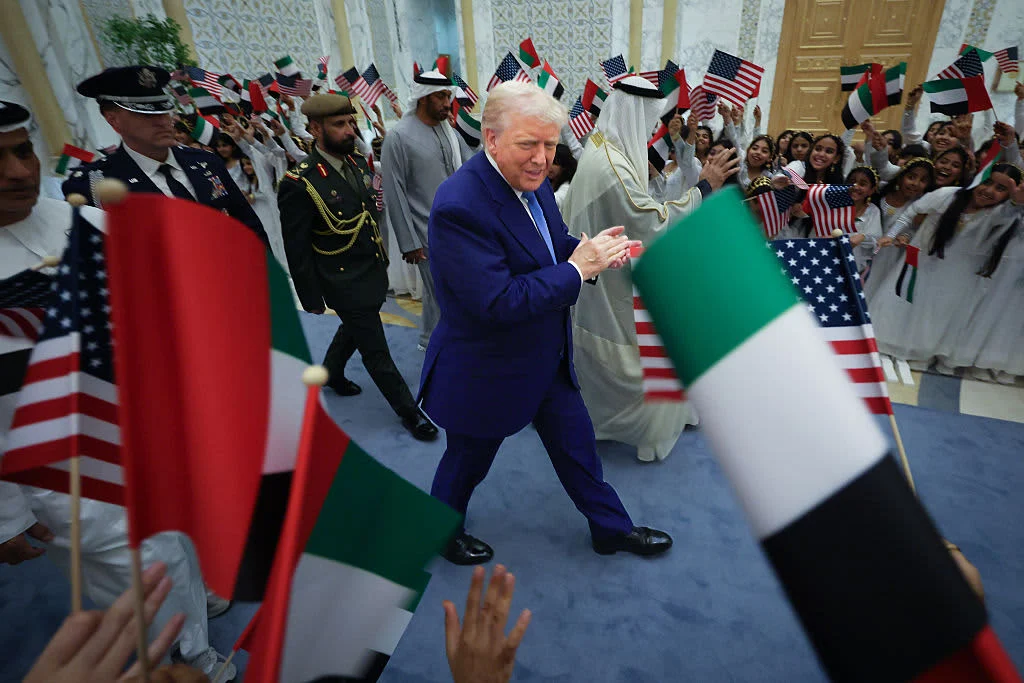
President Donald Trump’s foreign real estate licensing business experienced a significant boom during his first year back in office, generating a remarkable $59.5 million in 2025. This surge was driven by international developers willing to pay a premium to associate their luxury towers, golf courses, and coastal resorts with the globally recognized Trump brand. The reported revenue from foreign licensing, which encompasses the use of the Trump name on various properties worldwide, marked a substantial 71% increase from 2024. This figure was nearly ten times higher than the revenue recorded in 2023, according to a CNBC analysis of Trump’s annual financial disclosure. This exponential growth was largely fueled by the Trump Organization’s decision to reverse its first-term pledge to pursue "no new foreign deals whatsoever," a commitment that had been a cornerstone of its initial ethics policy.
The Trump Organization’s ethics policy for its second term, established on January 10, 2025, by Quinn Emanuel, stipulates a bar on new "material transactions" with foreign governments. However, it explicitly permits deals with private foreign companies. This distinction has become a focal point of debate among ethics watchdogs and legal experts. A significant portion of the revenue increase, $20.25 million, originated from four Trump-affiliated licensing LLCs that were not listed in his 2024 disclosure, accounting for 82% of the total rise. Additionally, five other licensing LLCs, previously listed as inactive, contributed another $9.64 million to the impressive sum. Over 60% of this substantial licensing income was derived from projects situated in the strategically important Gulf countries, highlighting the region’s prominent role in the Trump Organization’s global expansion.
The Nexus of Power and Private Wealth: Ethical Concerns Emerge
The nature of these international agreements has ignited a fresh wave of ethical concerns, as some of the developers licensing the Trump name were simultaneously pursuing significant U.S. investments, seeking government permits, or lobbying for favorable economic and diplomatic relations from the Trump administration. Furthermore, several Trump-branded projects relied on state-owned land, sovereign investment, or partnerships with government-controlled companies, further blurring the lines between private enterprise and state influence.
Ethics watchdogs have characterized this situation as an unprecedented collision between the president’s public power and his private wealth. Legal experts have also pointed to unresolved questions surrounding the Constitution’s Foreign Emoluments Clause, which prohibits federal officeholders from accepting certain benefits from foreign states without congressional consent. While CNBC found no direct evidence that any specific licensing payment directly influenced an administration decision, resulted in special treatment for a developer, or led to Trump’s direct intervention on a company’s behalf, the appearance of conflict remains a central concern.
The Trump Organization, in response to inquiries, asserted that it operates "completely separate from the presidency," adheres to ethics and conflict-of-interest laws, and utilizes an outside ethics adviser to mitigate potential conflicts. However, the organization declined to address specific questions regarding individual foreign licensing projects. A White House spokesperson, when asked about Trump’s foreign deal-making, did not directly address the arrangements but emphasized that "the only special interest guiding" Trump’s decisions is "the best interest of the American people." The spokesperson also highlighted over $2 trillion in investment commitments and commercial, defense, aviation, and technology deals announced during the president’s May 2025 Gulf trip, implying that the administration’s focus was on broader national interests.
Scott Greytak, deputy executive director of Transparency International U.S., an anti-corruption nonprofit, expressed profound concern: "Foreign governments and politically connected businesses now have a direct, incredibly visible way to put money into the sitting president’s pocket. The conflict is already in plain sight right now. We don’t need to wait for some kind of smoking gun to see a quid pro quo."
Echoing past sentiments, Eric Trump, Executive Vice President of the Trump Organization, told The New York Times in 2024 that the family "did everything imaginable to avoid any appearance of impropriety" but "got crushed anyway," concluding, "We can’t just sit out in perpetuity, and I won’t." Donald Trump himself was more direct, telling The Times in January, "I found out that nobody cared. I’m allowed to." These statements underscore a differing interpretation of ethical obligations and the permissible scope of a president’s business dealings.
Chronology of Key Developments and Regional Focus
The significant increase in foreign licensing revenue in 2025 was concentrated in specific regions and involved key players. Projects linked to the United Arab Emirates generated approximately $22 million in licensing income for Trump, followed by Saudi Arabia with $9 million and Qatar with $5 million. Much of this revenue was channeled through two prominent Gulf real estate developers: Saudi-linked Dar Al Arkan and UAE-based Damac.
Trump’s financial disclosures reported $25.8 million tied to projects involving Dar Al Arkan and its Dubai-based international arm, Dar Global. Damac-linked projects contributed another $11.3 million. Under the common licensing model, local developers typically finance and construct the properties, while the Trump Organization receives fees for the use of its prestigious name and, in some instances, for managing the properties. This model capitalizes on the burgeoning trend of branded residences in the Gulf region, where luxury and celebrity names command premium prices. According to CBRE, a commercial real estate services and investment company, Dubai saw a 26% year-over-year increase in branded-home transaction volume during the first nine months of 2025, with sales value climbing 51%. The Trump name, however, offers a unique value proposition: the implicit suggestion of access to the power of the presidency.
Ben Freeman, director of the Democratizing Foreign Policy program at the Quincy Institute for Responsible Statecraft, a think tank advocating for diplomacy, articulated this concern: "Is this an America First foreign policy, or is this a Trump First foreign policy?" He argued that an association with the Trump brand could signal political access for a developer, or even its government, when they have interests before Washington.
Case Study: Damac and U.S. Data Center Investments
Damac offers a salient example of the intricate overlap between business dealings and potential policy influence. The $11.3 million in licensing payments from Damac included two newly disclosed $5 million fees specifically tied to Damac’s Abu Dhabi projects, despite the Trump Organization having no active developments there. This is possible because developers can secure the contractual right to use the Trump brand before a project’s physical construction begins, often through upfront or milestone-based fees.
These payments coincided with Damac’s aggressive pursuit of a major U.S. expansion. In January 2025, Hussain Sajwani, Damac’s billionaire founder and a long-time friend of Trump, joined then President-elect Trump at Mar-a-Lago. During this high-profile event, Sajwani announced plans to invest at least $20 billion in U.S. data centers. Trump publicly praised this commitment, promising expedited environmental and regulatory reviews for companies investing at least $1 billion. Sajwani, at the time, enthusiastically declared to CNBC that "the sky is the limit" for Damac’s U.S. investment.
Six months later, Trump signed an executive order directing federal agencies to accelerate permitting for qualifying data centers and their supporting energy infrastructure. While the policy was broadly applied, Damac swiftly advanced a major data-center project that could directly benefit from the expedited federal permitting and other support offered under the order. By December, a Damac subsidiary had purchased land near Canton, Ohio, for $36.5 million for a proposed data center, according to county property records. Notably, the same eight-parcel property had been acquired for $8.55 million just two days prior, suggesting a rapid appreciation or strategic acquisition. The project will necessitate extensive coordination with local officials on critical infrastructure like power and water.
Scott Greytak underscored the inherent conflict: "A developer whose project depends on federal permitting and energy policy has a direct financial interest in the administration’s decisions." Christian Turner, a Canton city spokesperson, stated that Damac Digital is "subject to the same requirements as any other developer" and that the project remains under review with no incentives yet approved.
While CNBC found no direct evidence linking Damac’s payments to the executive order or Trump’s intervention, ethics experts maintain that the confluence of financial and policy interests creates, at minimum, the appearance of a conflict. Kedric Payne, ethics director at the Campaign Legal Center, commented, "It seems as though this Damac project was padding the president’s private business to help grease the wheels for data centers affected by Trump policies. When presidential decisions appear directly connected to his financial interests, you have, at the very least, the appearance of an ethics problem."
In a related development, CNBC reported that Sajwani’s son, Abbas Sajwani, purchased the megayacht Amadea from the U.S. government for $187 million, a vessel previously valued at over $300 million and seized as part of sanctions on Russian oligarchs. While not directly tied to licensing, this transaction further illustrates the extensive financial interactions between the Sajwani family and U.S. government entities during Trump’s presidency.
Private Deals, Public Backing: The Gulf Paradox
Other projects in the Persian Gulf raise a different set of conflict questions. In both Qatar and Oman, the Trump Organization entered into licensing agreements with private developers, not directly with foreign governments, thereby technically adhering to its stated ethics policy. However, both projects involve state-controlled entities, blurring the distinction between "private" and "governmental" in the Gulf context. As Ben Freeman of the Quincy Institute observed, the line between a private developer and a foreign government can be "meaningless in many cases" in the Gulf, where royal families often hold significant stakes or board positions in seemingly private corporations.
Trump disclosed $5.25 million in licensing income related to Dar Global’s plans for a Trump-branded golf club and luxury villas in Qatar. This project is integrated into the larger Simaisma coastal development, which is spearheaded by Qatari Diar, a real estate investment company established by Qatar’s sovereign wealth fund and chaired by the country’s municipality minister. The timing of these disclosed payments is also significant, coinciding with a major expansion of U.S.-Qatar ties. Dar Global and Qatari Diar announced the Trump-licensed project on April 30, 2025, just two weeks before President Trump’s visit to Doha in May 2025. This visit was part of the first major foreign-policy trip of his second term, during which significant aviation, defense, and economic agreements with Qatar were announced.
Greytak reiterated the concern: "The concern is not that these deals prove a quid pro quo. It is that Qatar was putting money into the president’s business while seeking major agreements from his administration, raising unavoidable questions about whose interests shaped the relationship." CNBC found no evidence that the Trump project directly influenced any of these agreements. The Qatari government and Qatari Diar did not respond to inquiries about whether the Trump project was discussed alongside the new U.S. agreements.
A similar structure is evident in the Oman project. Trump reported nearly $1 million in licensing income tied to Aida, a development being constructed through a joint venture between Dar Global and Omran Group, the Omani government’s tourism-development arm. The Omani government and Omran Group did not respond to detailed questions regarding the state-owned company’s role in the project or its involvement in the Trump licensing agreement.
Beyond the Gulf: Vietnam’s Trade and Development Crossroads
Foreign licensing revenue also extended beyond the immediate Gulf region. In Vietnam, Trump reported $5 million tied to a planned $1.5 billion golf development outside Hanoi. This project advanced significantly while Vietnamese officials were engaged in sensitive negotiations with the Trump administration to avert a threatened 46% tariff. In a notable display of synergy, then-Prime Minister Pham Minh Chinh joined Eric Trump at the project’s groundbreaking ceremony in May 2025. Prime Minister Chinh explicitly stated that Eric Trump’s visit had "motivated us to expedite this project," further fueling concerns about the intertwining of business interests and policy outcomes.
Kedric Payne commented, "It’s hard to say that there’s a coincidence when official decisions happen so close in time to the family business receiving financial benefits." Again, CNBC found no evidence that the Trump project directly influenced the tariff negotiations or the final rate imposed on Vietnamese goods. The Vietnamese government did not respond to questions regarding whether the project was discussed during negotiations or why its approval was expedited.
The Enduring Shadow of the Emoluments Clause
The projects in Qatar and Oman, particularly due to the involvement of state-controlled entities, revive unresolved legal questions concerning the Constitution’s Foreign Emoluments Clause. This clause, found in Article I, Section 9, Clause 8, prohibits any "Person holding any Office of Profit or Trust under them, shall, without the Consent of the Congress, accept of any present, Emolument, Office, or Title, of any kind whatever, from any King, Prince, or foreign State."
Scott Anderson, a Brookings Institution senior fellow and general counsel at the Lawfare blog, highlighted the central legal ambiguity: "The central issue is whether payments routed through a private developer can still be attributed to a foreign state when a government-controlled company owns the land, finances the project or participates in its development." Courts have yet to definitively resolve this complex question. During Trump’s first term, several lawsuits alleging violations of the clause were dismissed by the Supreme Court as moot after he left office in 2021, without a ruling on the merits of the constitutional arguments.
Anderson, a former legal adviser at the U.S. Embassy in Baghdad, acknowledged that "obviously, the framers didn’t anticipate licensing fees." However, he stressed that the clause’s "pretty broad scope" strongly suggests that federal officials should not financially benefit from foreign governments without explicit congressional approval, aiming to prevent foreign influence on U.S. policy. The continued financial activity of the Trump Organization in these state-linked projects ensures that this constitutional debate will remain a prominent feature of discussions surrounding presidential ethics and the intersection of public office and private enterprise.
Broader Implications for Presidential Ethics and U.S. Foreign Policy
The resurgence of President Trump’s foreign licensing business in his second term carries profound implications for the standards of presidential ethics and the conduct of U.S. foreign policy. While direct quid pro quo scenarios are difficult to prove, the very appearance of conflicts of interest can erode public trust, create vulnerabilities to foreign influence, and complicate diplomatic relations.
The argument put forth by ethics watchdogs is that the arrangement creates an environment where foreign entities might perceive that currying favor with the president’s private business interests could lead to preferential treatment or access, regardless of whether such a direct link exists. This perception alone can undermine the integrity of U.S. foreign policy decisions, potentially making them appear influenced by personal gain rather than national interest.
Furthermore, the legal ambiguities surrounding the Foreign Emoluments Clause continue to highlight a significant gap in modern constitutional law, particularly concerning how the business dealings of a sitting president’s private company should be regulated when those dealings intersect with foreign governments or state-controlled entities. Without clear judicial or legislative guidance, each new foreign deal by the Trump Organization will likely reignite debates about the appropriate boundaries for presidential conduct.
Ultimately, the significant increase in President Trump’s foreign licensing revenue in 2025 underscores a complex and challenging dynamic at the highest levels of American power. It forces a critical examination of the mechanisms in place – or lacking – to separate the public duties of the presidency from the private financial interests of the individual holding that office, and how these interactions shape both domestic perceptions and international relations.
