

Sergi Corbatera, Founder and CEO of DEF 14 Inc., shared insights from a recent DEF 14 memorandum detailing the evolving landscape of director appointments in U.S. activist campaigns. The analysis, which examined 1,048 board appointments involving 835 individuals from 2015 to the first half of 2026, reveals significant trends in the professional backgrounds, sector expertise, and gender representation of directors brought onto corporate boards through activist initiatives.
The core finding of the report is that the number of board seats secured by an activist investor is only a partial indicator of campaign success. A deeper understanding emerges when analyzing the professional profiles of the directors who gain board representation, shedding light on whether a campaign prioritizes direct investor input, operational experience, financial acumen, or industry-specific knowledge. This comprehensive study offers a valuable look at the motivations and strategies driving these boardroom changes.
Senior Operators and Finance Professionals Dominate Activist Appointments
The analysis highlights that senior operators and finance professionals are consistently the most sought-after candidates for activist-related board seats. Chief executives, presidents, and general managers constitute a significant portion of these appointments, typically bringing company-wide or divisional profit-and-loss responsibility and a degree of operational credibility. From 2015 to the present, these roles have consistently represented a substantial percentage of director appointments. Specifically, the data indicates that chief executives, presidents, and general managers accounted for 28 percent of all appointments and 32 percent of unique directors during the study period. Their inclusion often signals a focus on operational turnaround or strategic oversight.
Principals of the sponsoring activist firms also feature prominently, representing 27 percent of appointments. However, this figure is slightly higher than the 21 percent of unique directors they represent, a disparity attributed to repeat service, with some activist principals actively participating in multiple campaigns, sometimes serving on as many as nine boards within the study timeframe. This repeat engagement underscores the deep involvement and specific expertise these individuals bring to the activist strategy.
Furthermore, investment and asset management professionals not directly employed by the sponsoring activist firm make up a considerable segment of these appointments, accounting for 19 percent of all appointments and 18 percent of unique directors. This group includes executives from other investment firms, portfolio managers, and private equity professionals.
When combined, sponsoring-activist principals, external investment professionals, and finance executives represent a commanding 56 percent of all appointments and approximately half of the unique directors. This concentration clearly indicates that investment and finance-oriented roles are paramount among activist-related board appointments. The higher appointment-weighted result, compared to unique directors, is largely driven by the significant repeat service observed among activist principals.
Finance Expertise More Prevalent in Contested Elections
The pathway to board representation also correlates with differences in the professional backgrounds of the directors appointed. Directors seated through contested elections, as opposed to negotiated settlements, show a distinct pattern in their professional composition. Specifically, chief executives and sponsoring-activist principals form a smaller share of directors appointed via contested votes compared to those brought in through settlements. Conversely, external investment and asset management professionals are more heavily represented in appointments stemming from shareholder votes.
The most pronounced difference is observed among CFOs and other finance executives. These individuals comprise approximately 8 percent of directors appointed through settlements but surge to 17 percent of appointments that result from shareholder votes. This divergence suggests that activist investors may strategically nominate finance-centric candidates when they anticipate a contested election, possibly believing these profiles resonate more strongly with shareholders seeking financial discipline or restructuring. Alternatively, it could reflect companies’ willingness to concede finance expertise in settlements to avoid a protracted proxy fight, while shareholders in contested elections may more actively seek out such financial oversight.
Sector Expertise Varies Significantly
The analysis also reveals a notable variation in director expertise across different industry sectors. Investment professionals, encompassing both sponsoring-activist principals and unaffiliated investment and asset management executives, constitute more than half of all appointments in the energy and materials sectors. This prevalence can likely be attributed to the fact that activist campaigns in these industries often focus on strategic capital allocation, portfolio optimization, and asset valuation – areas where investment expertise is highly relevant.
In contrast, the proportion of investment professionals is lower in sectors like communication services, healthcare, industrials, and consumer staples. In these industries, the data suggests that operational or deep sector-specific knowledge might be prioritized over purely financial or investment-centric backgrounds. This highlights how activist strategies adapt to the unique characteristics and challenges of different industries, tailoring director nominations to address sector-specific needs.
Furthermore, within the investment professional category, there are observable differences based on affiliation. Sponsoring-activist principals represent a smaller share of appointments in sectors such as real estate and financials. In these same sectors, external investment professionals hold a larger proportion of the appointed director seats. This could indicate a strategic preference for independent financial expertise when dealing with companies in these particular industries, perhaps to ensure a balance of perspectives or to leverage specific market knowledge.

Repeat Appointments Extend Beyond Activist Principals
The study also sheds light on the phenomenon of repeat appointments, which are not limited to individuals directly affiliated with sponsoring activist firms. While repeat service is indeed more concentrated among sponsoring-activist principals, a meaningful number of external directors also gain multiple board seats through activist campaigns.
During the study period, a significant 60 out of 178 unique activist principals served on multiple boards, demonstrating a high degree of engagement from within the activist community. However, the data also shows that approximately 74 out of the 657 identified outside directors also experienced repeat appointments. This indicates a growing market for experienced independent directors who have a track record of working with activist investors.
A deeper dive into this cadre of repeat outside appointees reveals that they often possess expertise concentrated in technology, private equity, and financial services. A specific group of 12 directors, not directly affiliated with any single sponsoring activist, managed to secure at least three board seats during the study period. Their repeated appointments suggest the existence of a small but influential group of seasoned candidates who are familiar with the common objectives of activist campaigns. These priorities typically include optimizing capital allocation, conducting thorough portfolio reviews, navigating strategic transactions, and driving operational improvements. While the data provides a quantitative overview of this trend, it’s important to note that it does not delve into the specific reasons behind each individual’s selection or establish a direct causal link between their prior service and subsequent outcomes.
Gender Representation Varies by Professional Role
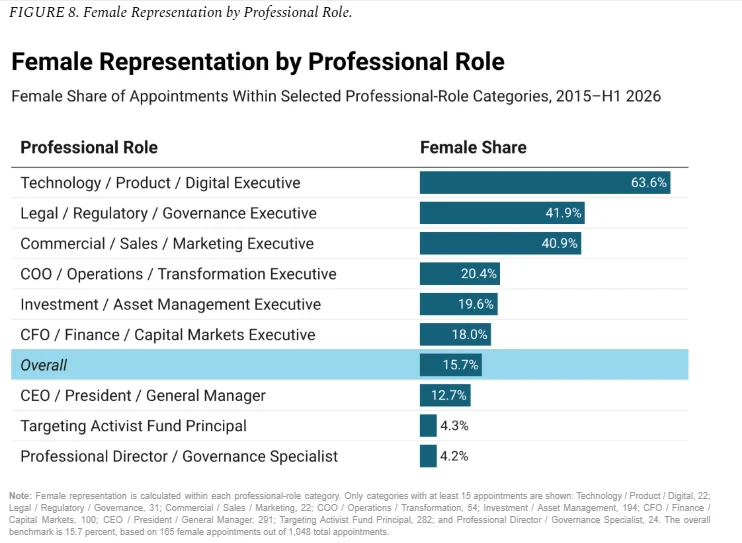
A critical aspect of the analysis is the examination of gender representation among appointed directors. The findings reveal a stark variation in female representation across different professional roles. Technology, product, and digital executives emerged as the leading category for female appointments, with women holding 63.6 percent of these seats. This was followed by legal, regulatory, and governance professionals (41.9 percent) and commercial, sales, and marketing executives (40.9 percent).
While female representation was moderately above the overall average in operations, investment management, and finance roles, it remained notably lower in key leadership positions. Chief executives saw female representation at a mere 12.7 percent. Even more striking, sponsoring-activist principals had only 4.3 percent female representation, and professional directors as a broad category had just 4.2 percent.
These figures suggest a persistent disparity, where women are more frequently found in certain functional areas but remain significantly underrepresented in the highest leadership roles and within the ranks of sponsoring-activist principals. This underrepresentation in critical sponsoring roles likely contributes to the lower overall share of board appointments held by women in activist campaigns.
Interestingly, the appointment pathways did not show a significant difference by gender. Among female appointments, 86.7 percent were a result of negotiated settlements, while 13.3 percent came through shareholder votes. For male appointments, these figures were nearly identical at 86.9 percent and 13.1 percent, respectively. This suggests that while the composition of the directors themselves may reflect gender imbalances in certain roles, the process by which they are appointed (settlement versus contest) does not appear to be heavily influenced by gender within this sample. However, the analysis does not account for the rates at which women are nominated or their success rates in contested elections, which could provide further insights into potential gender-related dynamics in the nomination process.
Conclusion: A Shifting, Multifaceted Director Market
In conclusion, the study by DEF 14 Inc. paints a detailed picture of the director market within U.S. activist campaigns since 2015. The appointed directors exhibit a diverse range of affiliations, professional roles, sector expertise, and gender representation, indicating that activist-related board changes are far from a monolithic phenomenon.
The data clearly points towards a director pool predominantly shaped by senior operators and finance professionals. While activist principals are the most frequent repeat appointees, a notable segment of experienced external directors also benefits from recurring engagements. The analysis also highlights significant differences in director composition depending on the appointment pathway, with finance expertise being more critical in contested elections. Sector-specific expertise also plays a crucial role, with investment professionals dominating appointments in energy and materials, while other sectors lean towards operational or industry-specific backgrounds.
A critical observation is the persistent gender disparity, particularly in leadership and activist principal roles. While women are well-represented in certain functional areas, their overall share of activist-appointed directors is limited by their underrepresentation in these key positions.
It is crucial to interpret these findings descriptively. The data illustrates the composition of activist-related board appointments but does not definitively establish whether these directors act as agents for the activists, if particular profiles lead to greater effectiveness, or if background characteristics determine post-appointment outcomes. Nonetheless, the systematic account of professional and demographic attributes provides a crucial foundation for future research into nomination patterns, board dynamics, and the ultimate impact of activist interventions. These insights are invaluable for understanding the nuanced strategies employed by activists and the evolving composition of corporate governance in the modern era.
