

Following a challenging July that saw the year-ahead outlook for manufacturing chief executive officers dip to its lowest point of the year, the sector is exhibiting encouraging signs of recuperation in August. While lingering concerns persist, an increase in demand and a perceived easing of geopolitical and domestic tensions are providing a much-needed boost to executive confidence, suggesting the most difficult period of the year may be behind them.
CEO Confidence Sees Notable Rebound
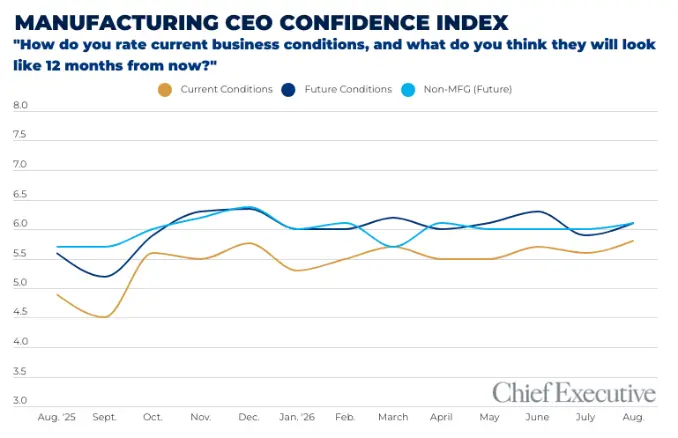
The latest CEO Confidence Index, conducted by Chief Executive on August 4th and 5th among 285 U.S. CEOs, reveals a significant uptick in sentiment. Manufacturers rated current business conditions at an average of 5.8 out of 10, a notable 4% improvement from July and a welcome break from the 5.5-5.7 range where confidence had hovered since February. This suggests that the operational environment, while still facing headwinds, is no longer deteriorating and is instead showing signs of stabilization.
The outlook for the next twelve months also saw a positive shift. The year-ahead forecast climbed to 6.1 out of 10, recovering from July’s 5.9 – which had marked the lowest forecast on record for 2026. This gain, which partially reverses a 7% decline experienced in the previous month, brings manufacturing CEOs’ forward-looking expectations into alignment with those of their non-manufacturing peers, who also forecast 6.1 out of 10. This convergence in sentiment could indicate a broader-based economic recovery gaining traction across different sectors.
Drivers of Renewed Optimism
When questioned about the catalysts for this improved outlook, manufacturers consistently cited an increase in demand as the primary driver. This suggests that consumer spending and business investment are beginning to pick up, providing a much-needed shot in the arm for an industry that has been grappling with softening order books.
"Demand is increasing, we are an automation company positioned well for success, and geopolitics is settling down," commented the CEO of a small-sized industrial manufacturer based in Ohio. This sentiment highlights a dual benefit: improved market conditions and a more stable international environment, both of which contribute to a more predictable operational landscape.
Other executives expressed confidence rooted in the belief that domestic volatility will subside. Andrew Ly, CEO of the large-sized consumer manufacturing firm Ly Brothers Corp., articulated this view, stating, "Political noise will calm down either way after [the] midterm elections. Politicians will need to get back to focus on the real issues." This suggests an anticipation that the focus will shift from partisan gridlock to addressing substantive economic challenges, potentially leading to more constructive policy decisions.
Furthermore, several executives pointed to the ongoing trend of reshoring activity and robust order backlogs as key contributors to their renewed confidence in investment and strategic planning. The repatriation of manufacturing operations, driven by a desire for more resilient supply chains and potentially favorable government incentives, is creating a sustained pipeline of work for domestic producers. Additionally, an improvement in profit margins, after an extended period of compression, is providing companies with greater financial flexibility.
Persistent Challenges and Economic Divergences
Despite the encouraging overall rebound in confidence, manufacturing CEOs continue to voice concerns regarding the persistent burden of tariff policies and regulatory inconsistencies. Dan Nibe, CEO of LBS Bookbinding, a mid-sized industrial manufacturer, highlighted these ongoing issues: "Tariffs are holding the economy back, inflation is squashing the U.S. consumer – but the job market remains strong." This statement encapsulates a nuanced economic reality where certain headwinds continue to impede progress, even as other indicators remain positive.
The economic outlook, as perceived by manufacturing CEOs, has seen a cooling of bullish expectations in August. While 53% of CEOs now forecast some form of economic growth over the next six months, this figure represents a decline from 65% in July. This shift is largely attributable to a significant increase in the proportion of manufacturers anticipating flat economic conditions, which surged by 59% from 22% to 35% month-over-month.
This hesitancy to predict robust growth is, in part, linked to ongoing inflationary pressures. Tim Zimmerman, CEO of Mitchell Metal Products, a mid-sized industrial manufacturing firm, explained, "Inflationary factors are leading to rapid and sustained price increases, which are squeezing our margins severely and pricing some of our products out of the market." This indicates that while demand may be recovering, the cost of production and the ability to pass those costs onto consumers remain critical challenges.
Conversely, fears of a recession appear to be abating. Only 11% of manufacturers forecast any kind of recessionary conditions in August, down from 13% in July. This indicates a growing consensus that a significant economic downturn is becoming less likely, even if sustained, robust growth remains uncertain for some.
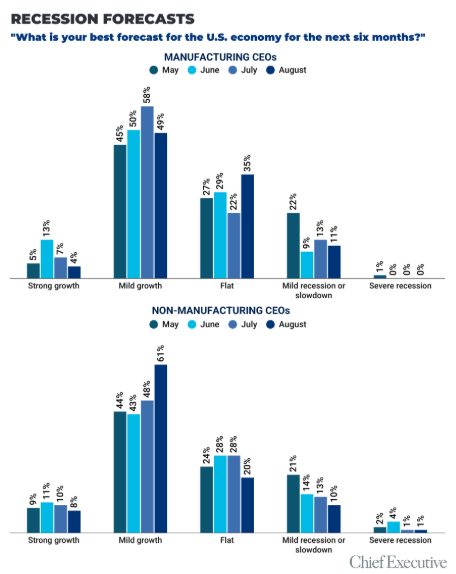
In contrast to manufacturers, non-manufacturing sectors have shown a more optimistic trajectory regarding economic growth. 69% of non-manufacturing CEOs forecast growth over the next six months, a sharp increase from 58% in July and the highest share recorded since May. Their recessionary fears also eased, with a similar proportion anticipating a slowdown rather than a contraction. This divergence suggests that the manufacturing sector, while recovering, is still navigating a more complex set of challenges compared to its service-oriented counterparts.
The Impact of International Exposure
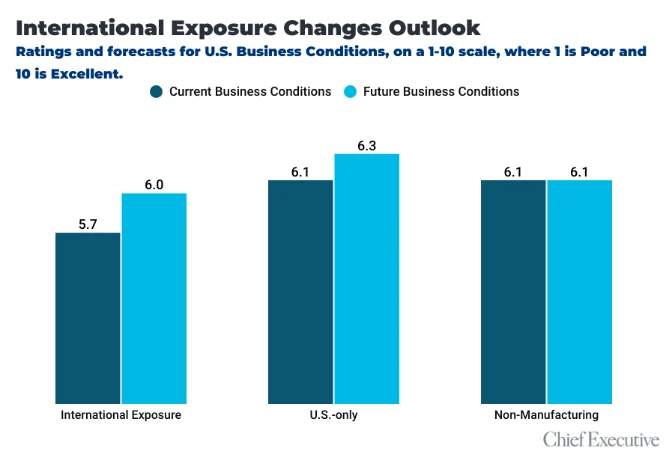
A significant and persistent factor influencing the manufacturing sector’s outlook is the divergence in performance and sentiment between companies with global operations and those focused solely on the domestic market. Manufacturers with international exposure rated current business conditions at 5.7 out of 10, whereas their domestic-exclusive counterparts reported a more optimistic 6.1.
This disparity can be partly attributed to a phenomenon known as "trade inversion." Chris Boyd, CEO of Antebellum Manufacturing, a mid-sized consumer firm with U.S.-exclusive operations, explained: "Tariffs on primary aluminum have driven the cost for aluminum more for domestic manufacturers than the 50 percent tariff on derivative products… imports are winning." In essence, some manufacturers are finding themselves penalized by tariffs on essential imported raw materials more than they are protected by tariffs on their finished goods. This can render domestic production less competitive against foreign imports, even in a protected market.
Both groups of manufacturers anticipate improvement over the next twelve months, but U.S.-exclusive CEOs remain more optimistic, forecasting business conditions to reach 6.3 out of 10 by this time next year, compared to a 6.0 forecast from internationally exposed firms. This persistent gap highlights the outsized impact that uncertainty surrounding trade policy, geopolitical volatility, and supply chain disruptions have had on companies with global footprints throughout 2026. The complexities of international trade agreements and global economic shifts continue to create a more challenging operating environment for these firms.
Corporate Forecasts: A Mixed Landscape
At the company level, manufacturing CEOs’ forecasts for their own businesses present a mixed picture in August, continuing the trend of month-to-month fluctuations. This suggests that many executives are still struggling to formulate consistent, long-term strategic plans in the current unpredictable economic climate. The inability to establish stable planning horizons can hinder investment decisions, recruitment efforts, and overall business expansion. The volatility in corporate forecasts underscores the ongoing need for clear and consistent economic policies to foster greater predictability for businesses.
Background and Context: A Year of Shifting Fortunes
The manufacturing sector has experienced a turbulent 2026. Early in the year, optimism was buoyed by signs of a post-pandemic economic rebound. However, persistent inflation, rising interest rates, and escalating geopolitical tensions began to weigh on sentiment throughout the spring and summer. The July pullback in CEO confidence was a direct reflection of these mounting pressures, with many executives expressing concern about a potential economic slowdown or even recession.
The August data suggests a potential turning point, driven by a confluence of factors. The easing of supply chain bottlenecks, which had plagued manufacturers for years, has begun to alleviate some cost pressures. Furthermore, a more stable energy market, following periods of significant volatility, has contributed to a more predictable cost of doing business. The U.S. Federal Reserve’s efforts to combat inflation, while leading to higher borrowing costs, are also seen by some as a necessary step towards long-term economic stability.
The impact of government policies, particularly those related to trade and industrial investment, continues to be a critical determinant of sector performance. Initiatives aimed at bolstering domestic manufacturing, such as the CHIPS Act and efforts to encourage reshoring, are beginning to yield tangible results, albeit with varying impacts across different sub-sectors.
Implications for the Broader Economy
The improved sentiment among manufacturing CEOs, while cautious, has broader implications for the U.S. economy. Manufacturing is a foundational sector, contributing significantly to employment, innovation, and overall economic output. A resurgent manufacturing sector can lead to job creation, increased consumer spending, and a more robust trade balance.
The divergence between domestic and internationally exposed firms also highlights the need for targeted policy interventions. Addressing the complexities of trade policy and its impact on input costs for domestic producers is crucial for ensuring a level playing field. Furthermore, continued investment in workforce development and technological innovation will be essential for manufacturers to remain competitive in a globalized economy.
The cautious optimism observed in August suggests that while the path forward may not be entirely smooth, the U.S. manufacturing sector is demonstrating resilience and a capacity for recovery. The coming months will be critical in determining whether this nascent trend of recuperation can be sustained and translate into broader, more robust economic growth.
About the CEO Confidence Index
Since 2002, Chief Executive Group has been polling hundreds of U.S. CEOs across organizations of all types and sizes to compile its CEO Confidence Index data. The Index tracks confidence in current and future business environments, based on CEOs’ observations of various economic and business components. For additional information about the Index and prior months’ data, visit ChiefExecutive.net/category/CEO-Confidence-Index/.
