

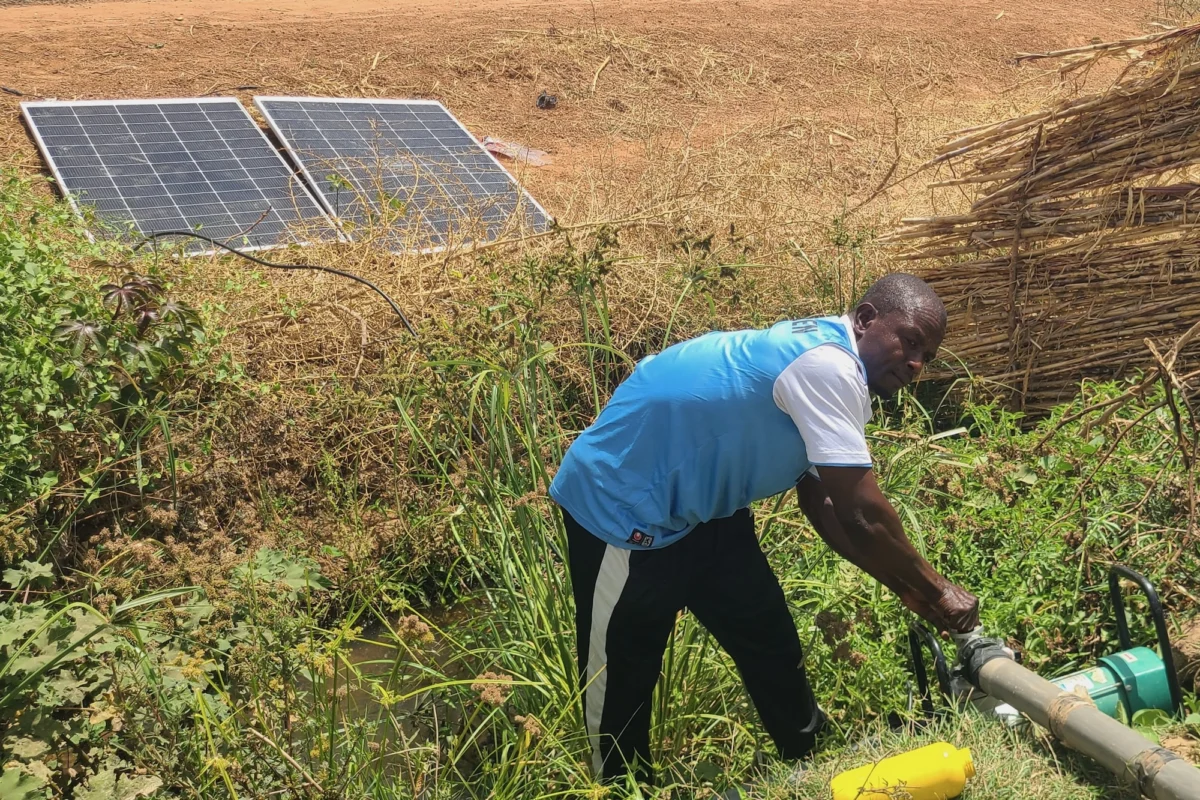
In the sprawling agricultural heartlands of Kano State, northwest Nigeria, the rhythmic chugging of diesel-powered water pumps, once a ubiquitous soundtrack to the dry-season farming cycle, is gradually being replaced by the silent, steady flow of solar-powered systems. For decades, the success of smallholder farmers in this region has been tethered to the availability and affordability of fossil fuels. However, a perfect storm of economic policy shifts, record-breaking inflation, and the intensifying pressures of climate change has rendered the old model of petrol-dependent irrigation nearly impossible to sustain. As a result, a growing number of farmers are pivoting toward solar energy, a transition that is proving to be as much about economic survival as it is about environmental stewardship.
On a typical early morning in May, 55-year-old Alhaji Bashir Sule walks through his five-hectare farm in the Bauje community. For over ten years, Sule relied on a petrol-powered pump to keep his fields hydrated during the harsh dry season. Today, he watches with visible relief as a solar-powered pump gushes water into his rice fields. The shift was not a matter of mere preference but of dire necessity. Following the Nigerian government’s decision to terminate the national fuel subsidy in mid-2023, petrol prices skyrocketed, sending shockwaves through every sector of the economy, particularly agriculture.

The Economic Backdrop: Fuel Subsidy Removal and Rural Poverty
The removal of the fuel subsidy, announced by President Bola Tinubu during his inauguration in May 2023, marked a turning point for Nigeria’s 200 million citizens. While the government argued the move was necessary to free up funds for infrastructure and social services, the immediate impact was a dramatic rise in the cost of living. In a country where the World Bank estimates that 140 million people—approximately 63 percent of the population—live below the poverty line, the surge in fuel costs has been catastrophic.
For farmers like Sule, the math no longer added up. "I spent about ₦12,000 [US$8.70] every three days on petrol to irrigate this land last year," Sule explained. "This is why most of my neighbors didn’t use their lands; they simply couldn’t afford it. But now, with a solar system that costs me about ₦2,500 [US$1.80] per day in rental fees, my rice farm stays wet without the constant worry of fuel prices."
The crisis in the farming sector has broader implications for national food security. As transportation and production costs rise, staple foods are becoming unaffordable for the average household. Rural communities, which are the backbone of Nigeria’s food production, are currently teetering on the brink of a hunger crisis, exacerbated by the inability of smallholders to cultivate their land during the dry season.

Climate Change and the Necessity of Dry-Season Farming
Nigeria’s agricultural sector is heavily dependent on rainfall, making it exceptionally vulnerable to the shifting patterns of a warming planet. In recent years, Nigeria has experienced increasingly irregular rainfall, characterized by delayed starts to the rainy season and devastating flash floods that wash away topsoil and standing crops. These climate-induced disruptions have made dry-season farming—which relies entirely on irrigation—more critical than ever for maintaining a consistent food supply.
Solar-powered irrigation systems (SPIS) offer a solution to this volatility. By providing a consistent and low-cost source of water, SPIS allows farmers to extend their growing seasons and mitigate the risks of drought. According to the Energy Commission of Nigeria, adopting solar-powered irrigation can help farmers cut their operational fuel costs by more than 60 percent. Furthermore, the ability to provide precise amounts of water at optimal times leads to healthier crops and significantly higher yields.
The impact is already being quantified. In the neighboring state of Kebbi, a study conducted by the YELF Climate Trust Foundation involving over 10,000 smallholder farmers found that more than 70 percent of those who switched to solar irrigation reported higher annual incomes. The study noted that these farmers not only saved money on energy but also saw a marked improvement in the quality of their produce, which fetched better prices in local markets.

Personal Success Stories: From Stunted Crops to Bumper Harvests
In the village of Sauki Dabula, 39-year-old Saidu Abba has witnessed a similar transformation. Last year, Abba’s harvest of cucumbers and maize was disappointing; the crops were stunted because he could not afford enough petrol to run his irrigation pump for the required duration. This year, after switching to a solar-powered system, his fields are lush and green.
"If not for this solar, with the way the petrol price is surging, the crops might have even become much more stunted than last year’s," Abba said. "The cost of petrol is simply too high for a small farm to bear."
The benefits extend to specialized crops as well. Ibrahim Badamasi, a 36-year-old onion farmer in the same community, reported that proper irrigation enabled by solar power allowed him to increase his harvest from four large sacks of onions to six sacks from the same plot of land. "Consistency is everything in onion farming," Badamasi noted. "Solar gives me that consistency without the financial stress."

Environmental Impact and Public Health Improvements
Beyond the economic advantages, the transition to solar energy is addressing a significant environmental and public health challenge. Nigeria’s agricultural sector is a major contributor to the country’s greenhouse gas emissions, producing nearly 86 million tons of carbon equivalent annually. This is roughly three times the annual emissions of Lagos, the country’s massive commercial hub.
The reliance on diesel and petrol generators on farms contributes to poor air quality, which the federal government has identified as a driver of a severe public health crisis in rural areas. Local residents are beginning to notice the difference. Haruna Muhammad, who lives near Saidu Abba’s farm, recalled the discomfort of the old system. "The fumes from the old petrol pump often blew in my face as I passed by. The air was heavy and sickening. But since he replaced it with solar, the air feels cleaner. I felt much happier when I saw the change."
Alhaji Bashir Sule shared a similar sentiment regarding his own health. "When I was using a fuel-based pump, I rarely spent more than an hour on the farm because the fumes made me feel sick," he said. "Now, I can spend hours tending to my plants because the air quality has improved so much."

Institutional Support and the Path to Scaling
Recognizing the potential of solar energy to transform the agricultural landscape, the Nigerian National Economic Council (NEC) has recently urged a nationwide shift toward the technology. The NEC has directed the Minister of Budget and Economic Planning to prioritize the funding, production, and distribution of solar-powered pumps to farmers across all 36 states.
International organizations are also playing a role. Horti Nigeria, a program funded by the Dutch government, has already provided solar irrigation systems to more than 2,000 farmers in Ogun, Oyo, Kaduna, and Kano states. These interventions are designed to enhance food and nutrition security while promoting sustainable farming practices.
However, despite the clear benefits, significant barriers to widespread adoption remain. The primary obstacle is the high upfront cost. A basic solar irrigation system can cost upwards of ₦500,000 (approximately US$360), a sum that is far out of reach for the average smallholder farmer.

To bridge this gap, innovative rental and financing models are emerging. Sule, for instance, rents his system from Women In Mechanized Agriculture (WIMA), a Nigerian nonprofit. WIMA rents equipment to male farmers in northern states like Kano—where cultural norms often limit women’s direct involvement in operating machinery—and uses the proceeds to fund agricultural programs specifically for women in other regions.
Challenges: Security, Maintenance, and Technical Expertise
While the technology is promising, it is not without its practical challenges. Security is a major concern for farmers who fear that expensive solar panels may be stolen if left in the fields overnight. Bashir Sule initially attempted to transport his panels back and forth from his home on a motorcycle, but the panels were cumbersome. "One day, a panel slipped and broke," he lamented. He has since hired a local security guard to watch the equipment, an additional expense that many farmers cannot afford.
Furthermore, there is a critical shortage of local technicians capable of repairing malfunctioning solar equipment in rural areas. Muhammad Hamza Abubakar, a sustainable agriculture strategist, emphasizes that without a robust maintenance infrastructure, the long-term viability of these systems is at risk. "We need to train a new generation of rural technicians who can service these pumps," Abubakar said. "Policy support must go beyond just handing out equipment; it must include the creation of a local support ecosystem."

Analysis: A Strategic Necessity for National Stability
The shift to solar-powered irrigation in Nigeria represents more than just a technological upgrade; it is a strategic necessity for national stability. Agriculture accounts for approximately 22 percent of Nigeria’s Gross Domestic Product (GDP) and employs over 38 percent of the total workforce. In rural areas, farming is the primary source of livelihood.
If solar-powered water pumps were adopted across all of Nigeria’s irrigated maize fields alone, it is estimated that 4 million tons of carbon emissions could be eliminated annually. More importantly, it would stabilize food prices by decoupling production costs from the volatile global oil market.
As the dry season approaches, the success of early adopters like Sule and Abba serves as a powerful testament to the potential of renewable energy. For these farmers, solar power has provided a way to reclaim their livelihoods from the twin pressures of economic inflation and climatic uncertainty. As Sule looks over his flourishing rice plants, his hope is that the government and private sector will work together to make this technology accessible to every farmer in the country. "It’s my life," he said. "And for the first time in a long time, I feel like I have control over it again."
