

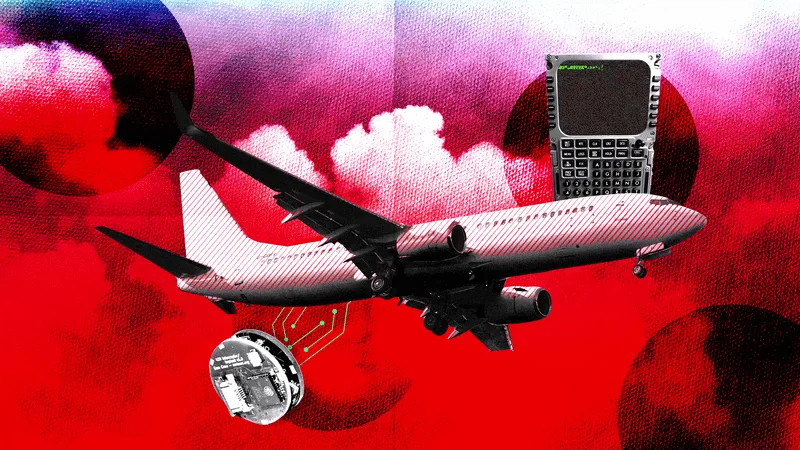
The traditional paradigm of aviation security has long rested on the assumption that the "air gap" between an aircraft’s critical flight systems and the outside world is an impenetrable barrier. While digital components in automobiles, medical infrastructure, and power grids have succumbed to various forms of cybersabotage over the last decade, commercial airliners were widely considered uniquely insulated from remote interference. However, a groundbreaking presentation at the Usenix Cybersecurity Conference has challenged this sense of security. Researchers from the University of California, San Diego (UCSD) and Oberlin College have demonstrated a sophisticated hacking technique capable of compromising the autopilot and flight management systems of a Boeing 737. This method, which requires brief physical access to an external port, allows an adversary to silently manipulate flight data, potentially leading to catastrophic outcomes ranging from runway overruns to unauthorized course deviations.
The research, led by UCSD computer science professor Stefan Savage and his colleagues, introduces a technique dubbed "Bus Driver." The core of the vulnerability lies in a hardware implant—a device roughly the size of a quarter, costing less than $100 to manufacture—that can be surreptitiously installed in a maintenance port located behind a hatch on the airplane’s exterior. Once connected, the Wi-Fi-enabled device can intercept and override electrical signals on the aircraft’s internal communication networks. This enables a remote attacker to feed false information to the Flight Management Computer (FMC) and the Multipurpose Control Display Unit (MCDU), effectively "lying" to both the autopilot and the pilots.
The Genesis of Aviation Cyber-Research
The journey toward this discovery began nearly fifteen years ago with a different mode of transport. The same research team was responsible for the first successful remote hack of a modern automobile, demonstrating in 2010 and 2011 that they could disable the brakes and engine of a Chevrolet Impala via its OnStar telematics system. That research triggered a massive shift in the automotive industry, forcing manufacturers to adopt robust cybersecurity protocols, launch bug bounty programs, and hire specialized security engineers. Following the success of their automotive work, the team, including research scientist Kirill Levchenko, turned their attention to the aviation sector.

Unlike the automotive industry, where a test vehicle can be purchased for a few thousand dollars, acquiring a Boeing 737 for research purposes was financially and logistically impossible for an academic department. Undeterred, the team spent several years and tens of thousands of dollars sourcing individual 737 computer components from the secondhand aerospace market. By 2019, they had successfully assembled "Triton," a sophisticated avionics test bed consisting of interconnected flight computers, display units, and sensors wired to simulate the digital environment of a functional 737 cockpit. This "Frankenstein" aircraft allowed the researchers to probe the system’s internal communication buses without ever leaving the laboratory.
Technical Mechanics: The Bus Driver Technique
The vulnerability centers on the internal communication "bus" that facilitates data exchange between the aircraft’s primary flight computers. Through meticulous analysis of hundreds of pages of Boeing wiring diagrams, student researcher Sam Crowe identified an externally accessible port that connects directly to this bus. This port, intended for maintenance and diagnostics, is typically protected only by a non-locking hatch and a standard dust cap.
The researchers discovered that by injecting electrical signals with a higher current than the legitimate signals used by the aircraft’s systems, they could override genuine data packets. This is the essence of the "Bus Driver" technique: the malicious device "out-drives" the legitimate hardware on the wire, ensuring the computer interprets the attacker’s data instead of the sensor’s data.
The implications of this signal overriding are profound. During the critical takeoff phase, pilots rely on the FMC to calculate "V-speeds"—the specific velocities required for a safe liftoff based on the plane’s weight, the outside air temperature, and the runway length. By using the implant to spoof a lower weight or a colder outside temperature, the researchers could trick the FMC into providing the pilot with incorrect, lower V-speeds. If a pilot attempts to rotate the aircraft at a speed that is too low for its actual weight, the plane may fail to lift off before reaching the end of the runway.

Stealth and Remote Control via In-Flight Wi-Fi
One of the most alarming aspects of the "Bus Driver" method is its potential for remote execution and stealth. The prototype device developed by the team is equipped with a Wi-Fi radio. In a theoretical attack scenario, an operative on the ground (such as a compromised maintenance worker or a stowaway device) could install the implant in less than 60 seconds. Once the plane is in flight, the device could connect to the aircraft’s onboard passenger Wi-Fi network.
By "beaconing out" through the plane’s internet connection, the device would allow a remote attacker anywhere in the world to send commands to the aircraft’s flight systems. The researchers demonstrated that the device could be used to alter waypoints in the autopilot’s flight plan. For instance, an attacker could subtly shift the plane’s heading by a few degrees. Over a long-haul transoceanic flight, such a change could lead the aircraft hundreds of miles off course, potentially into hostile airspace or toward a fuel exhaustion scenario over open water.
To ensure the pilot remains unaware of these changes, the researchers developed methods to spoof the cockpit displays. While the autopilot follows the malicious waypoints, the Multipurpose Control Display Unit (MCDU) can be manipulated to show the original, intended flight path. This creates a dangerous "reality gap" where the pilots believe they are on course while the aircraft is physically moving elsewhere.
Industry Response and Boeing’s Perspective
The research team has maintained a policy of responsible disclosure, working with Boeing for over six years to share their findings. They even demonstrated the attack within a Boeing laboratory facility to prove its viability on production-grade hardware. Despite this, Boeing has publicly downplayed the immediate risk to the flying public.

In a formal statement, Boeing emphasized the "layers of protection" inherent in aircraft design and the highly regulated operating environment of commercial aviation. The company argued that the combination of physical security at airports, pilot oversight, and the complexity of flight systems makes a real-world execution of such an attack extremely unlikely. Boeing’s technical experts expressed confidence that existing mitigations are sufficient to limit the feasibility of the "Bus Driver" technique.
However, the researchers note that Boeing has not committed to a specific technical patch for the vulnerabilities identified. Given the decade-long lifecycles of commercial aircraft and the rigorous certification processes required for any software or hardware change, the researchers speculate that a systemic fix could be years or even decades away.
Analysis of Implications and Operational Security
The "Bus Driver" research highlights a critical shift in the threat model for the aviation industry. Historically, physical security focused on preventing passengers from bringing weapons or explosives into the cabin. This new research suggests that the focus must expand to "operational security" (OPSEC) on the tarmac.
Beau Woods, a cybersecurity consultant and former adviser to the Cybersecurity and Infrastructure Security Agency (CISA), notes that the advancement of 21st-century tools has rendered many 20th-century security assumptions obsolete. The ability to shrink a powerful, Wi-Fi-connected computer to the size of a coin means that any unmonitored physical access—even for a minute—represents a significant risk.

The researchers have proposed several remediation strategies:
- Physical Hardening: The simplest and most immediate fix involves removing the vulnerable port or plugging it with permanent epoxy to prevent the insertion of unauthorized devices.
- Software Detection: Updating the aircraft’s software to detect signal anomalies or "contention" on the communication bus, which would signal that an unauthorized device is attempting to override data.
- Cryptographic Authentication: Implementing digital signatures for data transmitted between aircraft components. This would ensure that the Flight Management Computer only accepts commands from verified, legitimate sources, rendering an unauthenticated hardware implant useless.
Conclusion and Future Outlook
While the researchers emphasize that their findings are not a reason for the public to fear flying—noting that they themselves continue to travel on Boeing 737s—the study serves as a vital wake-up call for the aerospace industry. The "Bus Driver" technique demonstrates that as long as critical systems rely on unauthenticated, shared communication buses with external physical access points, the potential for sophisticated sabotage remains.
The transition from automotive hacking to aviation hacking underscores a broader trend in cybersecurity: no system is truly "unhackable" if an adversary has the time, resources, and physical proximity to probe its weaknesses. As the aviation industry moves toward more integrated and digitally dependent systems, the integration of "security by design"—incorporating cryptographic protections and robust physical access controls—will be essential to maintaining the impeccable safety record of modern flight. For now, the researchers’ work stands as a testament to the need for constant vigilance and the evolution of threat modeling in an increasingly connected world.
