

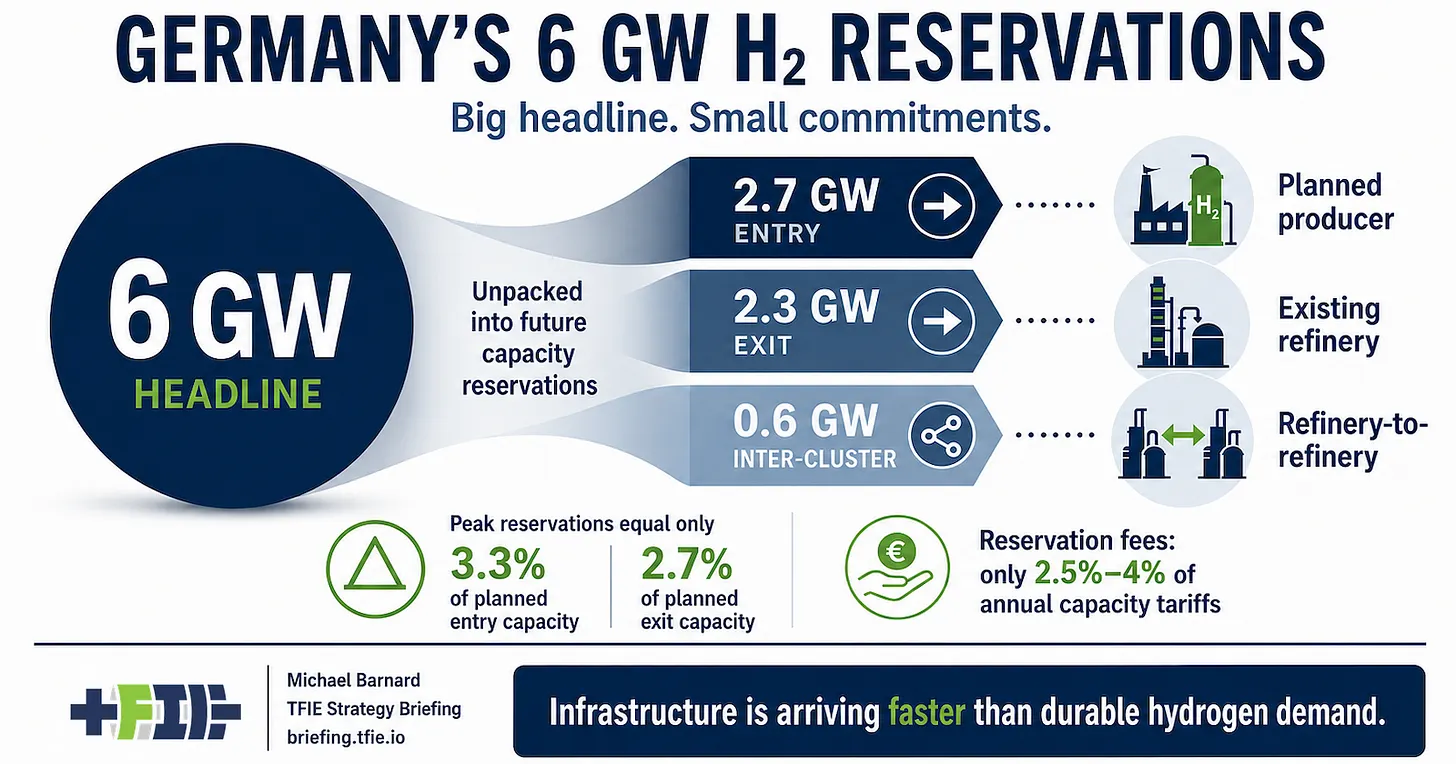
The announcement of nearly 6 gigawatts (GW) of paid reservations for Germany’s emerging hydrogen core network was initially greeted as a landmark moment for the European energy transition, yet a closer examination of the data suggests the headline figure may overstate the actual commercial momentum of the hydrogen economy. FNB Gas, the association representing Germany’s supra-regional gas transmission companies, presented these reservations as a definitive signal that industrial players are ready to transition toward a hydrogen-based future. However, when the technical accounting of these reservations is unpacked and compared against the massive scale of the planned infrastructure, a more complex picture emerges of a nascent market characterized by cautious, low-cost options rather than firm, long-term consumption commitments.
The Accounting Behind the 6 GW Headline
The widely circulated 6 GW figure is a composite of different network capacity categories that do not directly translate into 6 GW of actual hydrogen production or consumption. According to the data provided by the network operators, the total includes approximately 2.7 GW of hydrogen entry reservations (where hydrogen is injected into the system) and roughly 2.3 GW of exit reservations (where hydrogen is withdrawn by the end-user). Additionally, the figure includes 0.5 to 0.6 GW of inter-cluster transport capacity.
In the world of pipeline management, entry and exit capacities are standard metrics for balancing a system. However, for the purpose of measuring market demand, adding these figures together results in significant double-counting. Hydrogen that is produced and injected at one point in the network and subsequently withdrawn at another point is recorded twice in the cumulative headline. Consequently, the 6 GW figure does not represent the volume of hydrogen German companies have committed to use; rather, it is a network-capacity accounting metric that creates an impression of commercial scale that is roughly double the actual physical volume currently under reservation.
Scale of Infrastructure vs. Realized Demand
To understand the significance of these reservations, they must be viewed in the context of the Hydrogen Core Network (Wasserstoff-Kernnetz) approved by the German government. The planned infrastructure is a massive undertaking, designed to span approximately 9,040 kilometers with an estimated investment cost of €18.9 billion. The network is engineered to provide approximately 101 GW of entry capacity and 87 GW of exit capacity by the early 2030s.
When measured against these design targets, the current peak reservations appear remarkably small. The 2.7 GW of entry reservations represent only 3.3% of the planned entry capacity, while the 2.3 GW of exit reservations account for a mere 2.6% of the planned exit capacity. While it is standard practice to build infrastructure ahead of full demand—particularly in a "chicken and egg" scenario where customers require infrastructure before committing to fuel switches—the current gap raises questions about the projected utilization rates of the €18.9 billion network.
The Economics of Reservation: Low-Cost Options
A critical distinction in the current reservation phase is the nature of the financial commitment. These reservations are not binding long-term transport contracts. Instead, they function as low-cost options that allow industrial players to secure a place in the future network without a heavy immediate financial burden.

Under the frameworks established by transmission system operators (TSOs) such as ONTRAS and GASCADE, the cost to maintain these options is a fraction of the actual tariff. ONTRAS, for instance, charges customers only 2.5% of the applicable annual capacity tariff to hold a reservation. GASCADE charges roughly 4%.
The case of TotalEnergies provides a concrete example of this economic disparity. The energy giant has reserved up to 500 MW of hydrogen withdrawal capacity for its Leuna refinery, slated to begin around 2030. Under the current regulated hydrogen ramp-up tariff, a firm booking for 500 MW would cost approximately €12.5 million in annual capacity charges. However, by utilizing the reservation option, TotalEnergies is only required to pay roughly €312,500 per year. For a multinational corporation, this represents a negligible cost for strategic risk management, allowing the company to wait for further clarity on government subsidies, carbon pricing, and hydrogen supply chains before making a final investment decision.
Concentration in Existing Industrial Hubs
The identity of the companies making these reservations further narrows the scope of the current hydrogen market. The majority of identifiable withdrawal reservations are concentrated in sectors that already use hydrogen as a feedstock, specifically refineries and chemical plants.
TotalEnergies’ reservation for the Leuna refinery alone accounts for approximately 22% of the total 2.3 GW of exit capacity reserved for the 2030 period. This highlights a significant trend: the "new" hydrogen economy is currently being driven by the "old" hydrogen users. Refineries currently account for about 40% of global hydrogen demand, where the gas is used for desulfurization and hydrocracking.
The German government’s broader strategy has long promoted hydrogen as a versatile solution for heavy-duty trucking, residential heating, and decentralized power generation. However, the reservation data shows almost no participation from these sectors. Instead, the demand is coming from large-scale industrial sites where pipelines are a logical replacement for existing on-site fossil-based hydrogen production. While this is a credible and necessary step for decarbonization, it suggests that the broad-based "hydrogen economy" envisioned by policymakers may be much slower to materialize than the infrastructure plans assume.
Chronology of Germany’s Hydrogen Strategy
The development of the Hydrogen Core Network is the culmination of several years of legislative and strategic shifts in Berlin:
- June 2020: The German government adopts the National Hydrogen Strategy (NWS), identifying green hydrogen as a key component for meeting climate targets.
- July 2023: An updated National Hydrogen Strategy is released, doubling the 2030 domestic electrolysis target from 5 GW to 10 GW and emphasizing the need for a comprehensive pipeline network.
- May 2024: The German Parliament (Bundestag) passes the Energy Industry Act (EnWG) amendments, providing the legal framework for the financing and construction of the hydrogen network.
- October 2024: The Federal Network Agency (Bundesnetzagentur) officially approves the 9,040 km Hydrogen Core Network, paving the way for construction to begin.
- 2032-2037: The target window for the full commissioning of the network, connecting industrial clusters, storage facilities, and import points.
Official Responses and the "Chicken and Egg" Dilemma
Federal Minister for Economic Affairs and Climate Action, Robert Habeck, has consistently defended the scale of the network, arguing that Germany cannot afford to wait for demand to manifest before building the pipes. The government’s "bridge financing" model is designed to shield early users from prohibitively high tariffs by capping fees and using a state-backed account to cover the initial shortfall in revenue, which is intended to be repaid by users in later years when the market is mature.

FNB Gas has maintained a positive outlook, stating that the 6 GW of reservations provide the necessary "planning security" for TSOs to proceed with multi-billion euro investments. They argue that the willingness of companies to pay any reservation fee at all, even a small one, indicates a serious intent to transition.
However, critics and independent analysts, such as those from the TFIE (The Future Is Electric) Strategy Briefing, warn of the risk of "stranded assets." If the demand from sectors like heating and trucking fails to materialize, the massive cost of the network will fall on a small number of industrial users or, ultimately, the German taxpayer.
Broader Implications and Analysis
The current state of hydrogen reservations in Germany serves as a cautionary tale for other nations planning massive hydrogen infrastructure. The data suggests that while there is a clear path for decarbonizing existing industrial hydrogen use, the expansion into new sectors remains speculative.
The oversized nature of the planned network—designed for nearly 100 GW of capacity while seeing only ~2.5 GW of actual (non-double-counted) interest—indicates a significant bet on future technological breakthroughs and cost reductions in green hydrogen production that have yet to occur. Furthermore, the reliance on low-cost options means that the "6 GW" of momentum could evaporate if economic conditions shift or if alternative decarbonization technologies, such as direct electrification or carbon capture, become more cost-effective.
Germany is effectively building a "field of dreams," operating on the principle that if they build the pipelines, the consumers will come. While the 6 GW headline has succeeded in generating political and media interest, the underlying commercial reality is one of cautious experimentation by a few heavy industrial players. The success of the German hydrogen experiment will depend not on the length of the pipes laid, but on whether the government can stimulate genuine demand that goes beyond the low-cost options currently on the table.
As the 2030s approach, the gap between infrastructure capacity and actual consumption will be the primary metric of success. For now, the 6 GW figure remains a signal of potential, but it is far from a guarantee of a thriving hydrogen economy. The coming years will require a pivot from building pipes to securing firm, large-scale purchase agreements if the Hydrogen Core Network is to avoid becoming a very expensive monument to over-optimism.
