

The phenomenon of sargassum, a genus of large brown seaweed that floats in island-like masses, has long been a fundamental component of the Atlantic Ocean’s biological health, yet it is currently undergoing a radical transformation that poses a direct threat to coastal economies and marine stability. Historically referred to as a "floating rainforest," sargassum provides a critical sanctuary for a diverse array of marine life, including sea turtles, crabs, and various species of fish that utilize the mats for protection and foraging. However, the delicate balance of this ecosystem has shifted dramatically over the past decade. When these massive knots of macroalgae drift away from the open ocean and onto the shores of Mexico, the Caribbean, and Florida, the environmental asset transforms into a socioeconomic liability. The sheer volume of the seaweed now arriving on beaches has reached such proportions that international leaders, including the President of the Dominican Republic, have officially classified the situation as a regional emergency, signaling a new era of climate-driven ocean management challenges.
The Scale of the Great Atlantic Sargassum Belt
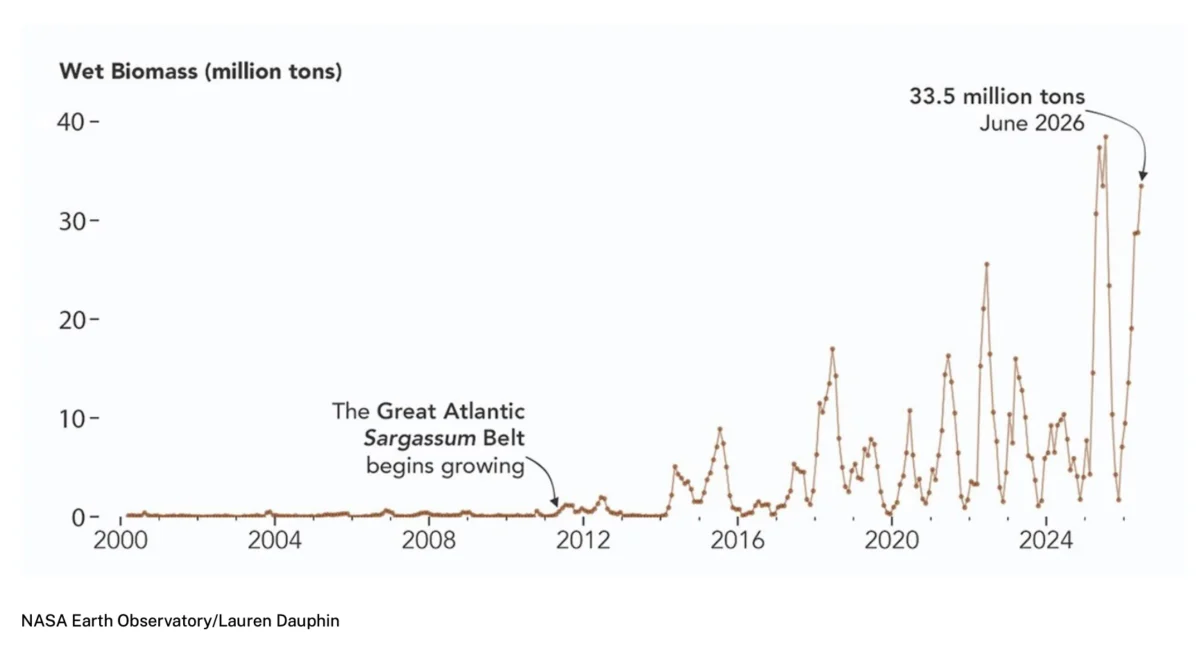
The most striking development in recent years is the emergence and expansion of the Great Atlantic Sargassum Belt (GASB). First identified by satellite observations in 2011, this massive accumulation of seaweed has grown into a transcontinental feature of the Atlantic Ocean. By the end of 2025, the belt was measured at approximately 8,800 kilometers in length, stretching across the tropical Atlantic from the coast of West Africa to the Gulf of Mexico. The biomass of this belt has surged to unprecedented levels, reaching an estimated 38 million metric tons. This represents a staggering 40% increase over the previous record set in 2022, highlighting an exponential growth trend that shows no signs of stabilizing.
The GASB is not merely a localized patch but a dynamic, shifting entity that follows the currents and winds of the Atlantic. Its presence has fundamentally altered the seascape of the Caribbean Sea and the West African coast. Unlike the traditional Sargasso Sea in the North Atlantic, which is bounded by four circulating currents, the GASB is a more transient and volatile formation. Its growth is fueled by a complex interplay of environmental factors that have turned the tropical Atlantic into a highly productive—and some say over-fertilized—environment for macroalgae.
The Ecological Duality of Sargassum
To understand the crisis, one must first recognize the biological importance of sargassum in its natural state. In the open ocean, sargassum serves as a primary producer, capturing carbon through photosynthesis and providing a complex structural habitat in an otherwise featureless blue expanse. Juvenile sea turtles spend their early years within these mats, finding both food and camouflage from predators. Endangered species and commercially important fish, such as tuna and billfish, rely on the sargassum food web.
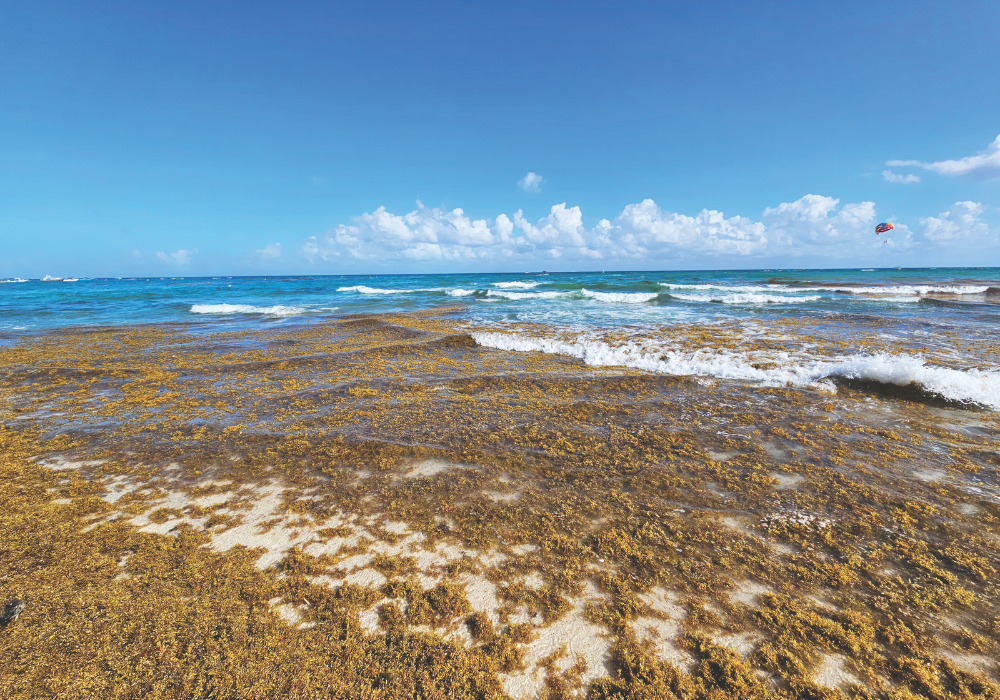
However, the "floating rainforest" becomes a "coastal pollutant" once it makes landfall. As the seaweed accumulates in shallow waters and onto beaches, it begins to decompose. This decomposition process consumes vast amounts of oxygen, leading to localized "dead zones" or hypoxic conditions that can suffocate coral reefs, seagrass beds, and nearshore fish populations. Furthermore, as the algae rots, it releases hydrogen sulfide gas, which produces a pungent odor similar to rotten eggs. This gas is not only a nuisance to residents and tourists but can also cause respiratory issues for those with underlying health conditions. The ecological damage extends to the physical blockage of nesting sites for sea turtles, who find it impossible to navigate through the thick, matted piles of vegetation to reach the sand.
Drivers of the Sargassum Surge
Scientific consensus suggests that there is no single catalyst for the explosion of sargassum, but rather a confluence of shifting environmental drivers linked to global climate change and human activity. Brian Lapointe, a principal investigator at the Harbor Branch Oceanographic Institute at Florida Atlantic University, has noted that the climate is having a significant effect on these blooms through various underlying mechanisms.
One primary factor is the increased nutrient runoff from major river systems. The Amazon, Orinoco, and Mississippi Rivers carry high concentrations of nitrogen and phosphorus from agricultural fertilizers and untreated wastewater into the ocean. These nutrients act as a fertilizer for the seaweed, allowing it to bloom at rates far beyond historical norms. Additionally, the deposition of iron-rich dust from the Sahara Desert, carried across the Atlantic by trade winds, provides further essential nutrients that stimulate sargassum growth.
Oceanographic changes also play a role. Rising sea surface temperatures have accelerated the metabolic rates of the algae, while shifts in ocean currents and wind patterns—driven by a warming atmosphere—help to aggregate the seaweed into the massive belt seen today. Extreme weather events, such as intense rainfall and droughts, further fluctuate the volume of nutrients entering the sea, creating "pulses" of growth that lead to record-breaking years.
The Paradox of the Sargasso Sea
While the Great Atlantic Sargassum Belt is flourishing, the traditional northern patch located in the Sargasso Sea—situated in the North Atlantic between Nova Scotia and Bermuda—is experiencing a diametrically opposed trend. Data indicates that this northern patch has dwindled by approximately 90% since 2015. Scientists attribute this decline primarily to the warming of the North Atlantic waters.
Sargassum has a specific thermal window in which it thrives; as the waters in the Sargasso Sea exceed these optimal temperatures, the seaweed’s health declines. This shift suggests a massive migration of the sargassum habitat southward, where conditions remain more favorable for growth, albeit in a different ecological configuration. The loss of sargassum in the North Atlantic is a significant concern for the species that have evolved to depend on that specific gyre, indicating that the entire Atlantic food web is being reshuffled by thermal changes.
Socio-Economic Impact and Regional Responses
The economic consequences of the sargassum influx are devastating for nations dependent on "sun, sand, and sea" tourism. In the Caribbean, where tourism accounts for a significant portion of the GDP, the sight and smell of rotting seaweed have led to mass cancellations and a decline in property values. Mexico’s Riviera Maya, including destinations like Cancun and Tulum, has spent millions of dollars annually on cleaning efforts, deploying naval vessels to intercept the seaweed at sea and hiring thousands of workers to rake the beaches manually.
In June 2025, President Luis Abinader of the Dominican Republic declared the sargassum invasion a "regional emergency." This declaration was a call to action for international cooperation, urging Caribbean nations and global powers to treat the seaweed not as a local sanitation issue, but as a shared environmental catastrophe. The Dominican Republic has been at the forefront of calling for a "Sargassum Fund" to finance research and the development of large-scale collection technologies.
The cost of management is prohibitive for many smaller island nations. Traditional removal methods, such as using heavy machinery on beaches, often lead to significant sand erosion and can damage the very ecosystems they are intended to protect. Consequently, there is an urgent need for offshore collection methods that can harvest the seaweed before it reaches the fragile coastline.
Technological Surveillance and NASA’s Role
The scale and speed of the sargassum evolution have necessitated the use of space-age technology. NASA has become a critical partner in tracking the bloom, using sensitive satellite instruments to monitor the "sargassum signature" from orbit. By utilizing the Moderate Resolution Imaging Spectroradiometer (MODIS) on the Terra and Aqua satellites, researchers can detect the infrared reflectance of the floating vegetation.
This satellite data allows for the creation of the Sargassum Watch System (SaWS), which provides near real-time maps of seaweed density. This forecasting capability is vital for coastal managers, allowing them to predict where the next major inundation will occur and to mobilize resources accordingly. It also helps scientists understand the long-term trends and movement patterns of the GASB, providing a clearer picture of how the belt interacts with global climate cycles like El Niño and the North Atlantic Oscillation.
A Chronology of the Sargassum Crisis
To understand the current state of the Atlantic, it is helpful to look at the timeline of the seaweed’s expansion:
- Pre-2011: Sargassum was largely confined to the Sargasso Sea and the Gulf of Mexico, with occasional, manageable amounts washing up on Caribbean shores.
- 2011: The first major anomalous bloom is detected in the tropical Atlantic, stretching from South America to Africa. This marks the birth of the Great Atlantic Sargassum Belt.
- 2014-2015: A significant increase in sargassum landings occurs across the Caribbean, causing the first major disruptions to tourism. Simultaneously, the northern Sargasso Sea begins to show signs of decline.
- 2018: A record-breaking year at the time, with the belt weighing an estimated 20 million metric tons. The impact on coral reefs and seagrass becomes a primary concern for marine biologists.
- 2022: Biomass levels reach new heights, prompting more aggressive intervention strategies from coastal governments.
- 2025: The GASB reaches 38 million metric tons and 8,800 kilometers in length. The Dominican Republic declares a regional emergency, and scientific reports confirm a 90% loss of sargassum in the traditional northern Sargasso Sea.
Future Implications and Potential Solutions
The persistence of the Great Atlantic Sargassum Belt suggests that this is the "new normal" for the Atlantic Ocean. As such, the focus is shifting from temporary cleanup to long-term adaptation and utilization. Researchers are exploring ways to turn the sargassum "waste" into a resource. Potential applications include the creation of biofuels, agricultural fertilizers, and even construction materials like "sargablocks"—bricks made from dried seaweed and clay.
However, challenges remain. Sargassum often contains high levels of heavy metals, such as arsenic and cadmium, absorbed from the ocean water, which can complicate its use in fertilizers or animal feed. Furthermore, the logistics of harvesting millions of tons of seaweed from the open ocean are daunting and require significant investment in maritime infrastructure.
The sargassum crisis is a poignant example of how human-induced changes—ranging from agricultural runoff to global warming—can trigger unforeseen biological responses on a planetary scale. The transformation of the Atlantic’s "floating rainforest" into a regional emergency serves as a stark reminder that the health of the ocean is inextricably linked to the health of the land and the stability of the global climate. Addressing the sargassum challenge will require a multi-national effort that combines satellite technology, ecological restoration, and innovative economic models to manage one of the largest biological shifts in modern history.
