

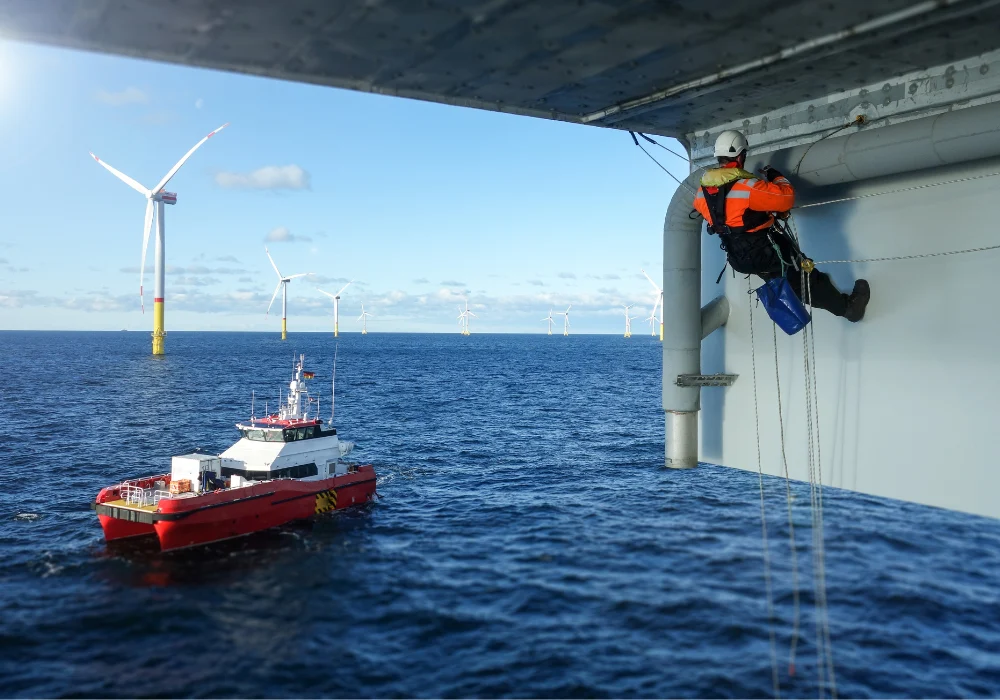
For Gerard Mullin, a specialized pile driver from Boston, the promise of the American offshore wind industry was more than just a job; it was a transformative economic engine that redefined his financial future. After years of standard onshore construction, Mullin transitioned to the burgeoning offshore sector, where he quickly adapted to the rigorous demands of laboring at sea. The rewards were immediate and substantial. In his first eight weeks working on projects off the coast of Massachusetts, Mullin earned more than he had managed to save in the previous five years combined. The work offered a unique rhythm—five weeks of intensive labor living on a vessel, followed by five weeks of rest at home—providing a level of consistency and compensation that seemed to signal a new era for the American working class.
However, that era has been abruptly curtailed. Mullin was preparing to depart for a five-week stint on the Empire Wind project in New York when a federal stop-work order issued by the administration of President Donald Trump left him stranded. The order was part of a broader, aggressive pivot in federal energy policy that has seen the halting of future permitting and the cancellation of 12 major offshore wind leases across the Atlantic and Pacific coasts. As the political winds shifted, the multi-billion dollar industry that was once billed as the backbone of a new "Blue Economy" has begun to evaporate, leaving thousands of highly trained workers and dozens of coastal communities in a state of economic limbo.
The Rapid Rise and Sudden Stalling of a Nascent Industry
The trajectory of the U.S. offshore wind industry has been marked by extreme volatility. While Europe has utilized offshore wind for decades, the United States only began to seriously explore the sector in 2011. A landmark study by the Obama administration that year suggested that offshore wind could be a cornerstone of the nation’s renewable energy portfolio, capable of generating thousands of construction and operational jobs while revitalizing aging port infrastructure.
The first domestic success came in 2016 with the Block Island Wind Farm off Rhode Island. Momentum accelerated significantly in 2021 when the Biden administration set an ambitious goal of deploying 30 gigawatts of offshore wind by 2030. This federal backing sparked a gold rush of investment. International energy giants like Ørsted, Equinor, and Avangrid secured leases, and states like New York, New Jersey, and Massachusetts committed billions in incentives to ensure they became the hubs for this new industrial frontier.
By 2024, however, the industry faced a perfect storm of high interest rates, supply chain disruptions, and, most decisively, a shift in federal hostility. President Trump, who has long expressed disdain for wind turbines—once describing a project near his Scottish golf course as "disgusting and inappropriate"—moved quickly to dismantle the regulatory framework supporting the sector. His administration has characterized renewable energy as unreliable and expensive, choosing instead to double down on fossil fuel production as a means of ensuring "energy dominance."
The Human Cost: A Workforce in Limbo
The most immediate impact of this policy shift is being felt by the laborers who were encouraged to "set their roots" in the industry. For workers like 42-year-old Joshua Grigsby, the high wages of offshore work allowed for life-changing milestones, such as taking his family on international vacations and purchasing a home. Natalie MacDonald, 26, reported that the industry allowed her to stop living paycheck to paycheck for the first time in her adult life.
Now, those same workers are facing a grim reality. Anthony Hibbard, who rose to the rank of foreman on the Coastal Virginia Offshore Wind project, has been forced to return to local onshore jobs in Portland, Maine. The financial disparity is staggering; Hibbard now earns roughly one-fifth of his previous offshore salary. While he makes enough to survive, the "financial freedom" he once enjoyed has vanished.
The loss of these roles is not merely a matter of lower hourly wages. Offshore positions typically involve massive amounts of overtime and employer-covered living expenses, allowing workers to accumulate wealth at a rate impossible in standard construction. When these projects are canceled or delayed indefinitely, the ripple effect extends to the local economy. John Dunderdale, a business manager for Piledrivers Local 56, noted that at least a dozen of his members used their offshore earnings to buy homes. "Now you have a member sitting home, collecting unemployment, because there’s no work," Dunderdale said. "You’re taking away their means of bringing back into the community."
Stranded Investments and Training Millions
The collapse of market confidence has also rendered millions of dollars in specialized training obsolete. Labor unions and community colleges across the Northeast spent years preparing a workforce for a ten-to-twenty-year pipeline of projects. Millwrights Local 1121, for instance, invested between $10,000 and $20,000 per person to certify workers for offshore conditions.
"We invested millions of dollars in training, and lots of hours went into putting all this together, and now that work is dried up for the foreseeable future," said Andy Benedetto, the union’s vice president and business manager. The sentiment is shared across the building trades. Ironworkers Local 7 in Massachusetts received a $300,000 state grant in 2022 to prepare for the boom, but as business agent Grant Provost noted, "the work never really came."
This creates a structural problem for organized labor. Apprenticeship programs rely on the existence of steady work to move trainees through the system. As Esther Rosario of Climate Jobs New York explained, "You can’t apprentice somebody into a job that doesn’t exist."
Data and Economic Projections: A Downward Spiral
The scale of the industry’s retraction is reflected in recent market data. At the height of the offshore wind push, market research firm BloombergNEF (BNEF) projected that the United States would successfully build 39 gigawatts of offshore wind capacity by 2035—enough to power approximately 13 million homes.
However, by the end of last year, BNEF drastically downgraded that forecast to just 6 gigawatts. This nearly 85% reduction in projected capacity represents tens of billions of dollars in lost private investment and a significant blow to state-level carbon reduction goals.
The manufacturing sector has also felt the sting. In January 2025, the Italian manufacturer Prysmian Group abandoned plans for a major offshore wind cable plant at Brayton Point, near New Bedford, Massachusetts. The plant was expected to be a cornerstone of the regional supply chain. Similarly, in August 2025, the Trump administration canceled a $34 million grant intended to build an offshore wind terminal in Salem, Massachusetts, a move that labor leaders say cost 800 construction jobs overnight.
Political Justifications and Official Responses
The administration remains steadfast in its position that the pivot away from offshore wind is an economic necessity. Taylor Rogers, a White House spokeswoman, defended the moves in a formal statement, framing the cancellation of wind projects as a victory for the American consumer.
"President Trump has delivered on his popular promise to reverse the Left’s costly Green New Scam to lower prices for families and businesses and strengthen our country’s energy security," Rogers said. She argued that by prioritizing "reliable, affordable, and secure" energy sources—namely oil, gas, and coal—the administration has restored U.S. energy dominance and created "thousands of good-paying energy jobs" in the fossil fuel sector.
This logic is fiercely contested by economic development officials who see the destruction of a new industry as a self-inflicted wound. Tim Sullivan, the former CEO of the New Jersey Economic Development Authority, expressed disbelief at the administration’s celebration of these cancellations. "I’ve never seen people cheering for job destruction, particularly elected officials," Sullivan remarked.
Broader Implications for the "Just Transition"
The current crisis in offshore wind raises fundamental questions about the viability of the "Just Transition"—the policy concept that workers in fading fossil fuel industries can be seamlessly transitioned into "green" careers. The workers currently being displaced from wind projects were often the pioneers of this transition, proving that renewable energy could indeed provide high-quality, unionized middle-class jobs.
For many of these workers, the feeling is one of being used as political pawns. They describe a sense of betrayal, having invested their time and safety into a sector that was then dismantled by federal decree. The unique culture of the offshore ships—where American crews worked alongside European experts in a "U.N.-like" atmosphere—has been replaced by the solitary reality of seeking short-term "gigs" back on land.
While five major U.S. wind farms, including Revolution Wind near Rhode Island, currently remain on track for completion, they represent the end of the current pipeline rather than the beginning of a new one. Experts warn that without a stable federal permitting process and long-term lease security, the specialized vessels and equipment required for these projects will leave U.S. waters for more stable markets in Europe and Asia.
For Gerard Mullin, the impact is personal. Although he was able to use his offshore earnings to buy a condo after his previous home was destroyed in a fire, he worries about the younger generation of tradespeople. "It’s just too bad because they were good jobs and people were happy with them," Mullin said. "And it really was just a fair day’s work for a fair day’s pay." As the horizon for offshore wind dims, the thousands of workers left behind are a stark reminder of how quickly industrial dreams can be dismantled by the stroke of a presidential pen.
