

A series of alarming drone sightings and explosions across Europe has triggered a significant security alert, raising fears that the ongoing conflict between Russia and Ukraine is increasingly spilling over into the territory of NATO member states. The most recent incidents, spanning from the Balkan Peninsula to the industrial heartland of Germany, have targeted critical energy infrastructure and sensitive military installations, prompting emergency investigations and a hardening of rhetoric between Western officials and the Kremlin.
In Bulgaria, a drone explosion occurred on Saturday near the strategic Trans-Balkan gas pipeline, a vital energy artery linking Turkey to Ukraine. Bulgarian Prime Minister Rumen Radev confirmed that the unmanned aerial vehicle (UAV) detonated in the immediate vicinity of the Kardam border crossing with Romania. According to official government reports, the blast took place approximately one kilometer (0.62 miles) from a compressor station that facilitates the flow of natural gas through the region. While Radev confirmed that there were no casualties, the proximity of the explosion to such critical infrastructure has underscored the vulnerability of European energy networks during the current geopolitical climate.
Simultaneously, Germany has reported a surge in unauthorized drone activity over high-security sites. On Thursday evening, military personnel at a Bundeswehr base in Mechernich, located in the state of North Rhine-Westphalia, spotted two drones hovering over the facility. The Mechernich site is considered a sensitive military asset, housing a high-security underground storage facility for hardware components and serving as a maintenance hub for personnel working on the U.S.-manufactured Patriot air defense systems—technology that has become central to Ukraine’s defense against Russian missile strikes.
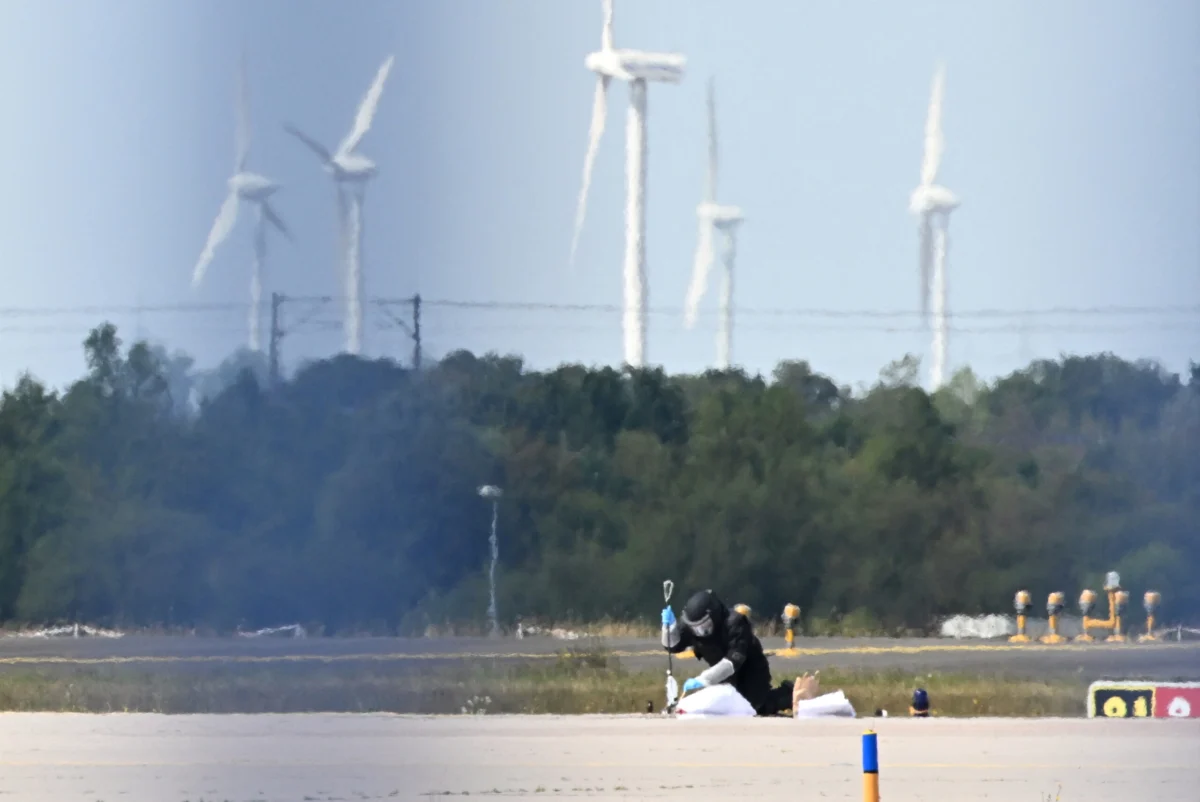
Further north, another drone was discovered earlier in the week at the Leipzig/Halle Airport. This location serves as a primary civilian freight center and a critical logistics hub for NATO operations. German media outlets reported that the drone was found near several Ukrainian-owned Antonov An-124 cargo aircraft, which are frequently used to transport heavy military equipment and humanitarian aid to Eastern Europe. These overlapping incidents have sparked an intensive debate within the European Union and NATO regarding the adequacy of current defense protocols against "gray zone" tactics and hybrid warfare.
Infrastructure Vulnerabilities and the Balkan Corridor
The explosion in Bulgaria is particularly significant due to the location’s strategic importance. The Trans-Balkan pipeline, once the primary route for Russian gas to reach Southeast Europe, has been repurposed to facilitate regional energy independence and reverse flows that now assist Ukraine. The Kardam border crossing is a focal point for cross-border energy transit, and any disruption to the compressor stations could have cascading effects on the energy security of both Bulgaria and Romania.
Security analysts suggest that the targeting—or accidental encroachment—of such facilities serves as a potent reminder of the fragility of the European energy grid. Since the sabotage of the Nord Stream pipelines in 2022, NATO nations have been on high alert for underwater and terrestrial infrastructure attacks. The Bulgarian incident, occurring so close to the Romanian border, also highlights the geographic risks faced by frontline states that share borders with the Black Sea or the Ukrainian conflict zone.
The Security Breach at Mechernich and Leipzig
The incidents in Germany have raised different, yet equally pressing, concerns regarding domestic sabotage and espionage. The Bundeswehr site in Mechernich is not a standard military barracks; it is a specialized technical facility. The presence of drones over a site dedicated to the maintenance of Patriot air defense systems suggests a level of premeditation aimed at monitoring or intimidating the logistical backbone of Western military support for Kyiv.
The Leipzig/Halle Airport discovery is similarly troubling for German security services. As a hub for NATO logistics, the airport is a frequent transit point for high-value military assets. The proximity of the drone to Antonov An-124 aircraft—the world’s largest civil cargo planes—indicates that the intruders may have been seeking intelligence on the types of equipment being moved to the front lines. German police and military counterintelligence (MAD) have taken over the investigations, though they have refrained from naming a specific perpetrator in the immediate aftermath of the sightings.
A Chronology of Increasing Incursions
The recent events are part of a broader pattern of escalating drone activity over NATO territory since the start of 2024. This timeline illustrates the increasing frequency and severity of these incursions:
- July 2024: A suspected Russian drone entered Romanian airspace during a massive strike on Ukrainian port infrastructure across the Danube. This prompted the Romanian Air Force to scramble F-16 fighter jets and led the European Commission to state that Russia had "crossed yet another line."
- August 2024: Multiple drone sightings were reported over industrial zones in northern Germany, specifically near chemical plants and energy terminals in Schleswig-Holstein.
- Late August 2024: Poland reported the entry of an "unidentified aerial object," likely a drone, into its airspace during a Russian missile barrage against Ukraine. The object disappeared from radar, sparking a multi-day search.
- September 2024 (Current): The explosion in Bulgaria and the dual sightings in Germany (Mechernich and Leipzig) represent a geographically diverse and synchronized set of threats.
Official Responses and Diplomatic Friction
The political fallout from these incidents has been swift. NATO Secretary-General Mark Rutte has characterized the surge in such activities as part of a broader campaign of Russian "reckless behavior" that poses a direct threat to the alliance. While NATO has not yet invoked Article 5—the collective defense clause—officials have signaled that the tolerance for these incursions is reaching a breaking point.
Matthew Whitaker, the United States Ambassador to NATO, reiterated the alliance’s commitment to territorial integrity, stating that the organization is prepared to "defend every inch" of member territory. However, the challenge for NATO lies in the "gray zone" nature of these events; drones are often difficult to attribute definitively, allowing the perpetrator to maintain plausible deniability while sowing fear and exhaustion among defense forces.
In Germany, the political response has been a mixture of caution and accusation. While the federal government has officially stated that investigations are ongoing and has not publicly indicted Moscow, prominent members of the Bundestag have been more direct. Several politicians from the governing coalition have pointed to the Kremlin’s history of hybrid warfare, including cyberattacks and disinformation, as evidence of a coordinated effort to destabilize Germany’s support for Ukraine.
Conversely, the Russian government has denied all involvement. The Russian Embassy in Berlin issued a sharp rebuttal regarding the Leipzig incident, calling it a "fabricated provocation." Moscow has consistently maintained that Western accusations of drone incursions are part of a "russophobic" narrative designed to justify further military escalation by NATO.
Strategic Implications and the Future of European Air Defense
The persistent presence of UAVs over European military and civilian sites is forcing a reevaluation of domestic security. Analysts note that the current incidents reveal three primary strategic objectives for those deploying the drones:
- Intelligence Gathering: Monitoring the movement of military hardware, particularly air defense systems like the Patriot, to identify vulnerabilities or supply chain bottlenecks.
- Psychological Warfare: Creating a sense of insecurity among the European public and demonstrating that the war is not confined to Ukrainian borders.
- Testing Response Times: Observing how quickly NATO member states detect, track, and respond to low-altitude, small-scale aerial incursions.
The proliferation of cheap, commercially available drone technology has made the task of securing large-scale infrastructure and military bases increasingly difficult. Many European nations are now looking to accelerate the procurement of specialized anti-drone systems, including electronic jammers, directed-energy weapons, and kinetic interceptors.
Furthermore, the Bulgarian explosion suggests that the risk of collateral damage is rising. Even if a drone is not intended to strike a NATO target, technical failures or electronic warfare interference can cause these devices to crash into sensitive areas, potentially triggering a major international crisis.
As the investigations in Bulgaria and Germany continue, the focus remains on whether these incidents represent isolated acts of espionage or a coordinated campaign of sabotage. For NATO, the challenge is to find a calibrated response that deters future incursions without escalating the conflict into a direct military confrontation with Russia. The coming months are likely to see increased surveillance, tighter security around critical infrastructure, and a push for a more unified European air defense strategy to counter the evolving threat of unmanned aerial systems.
