

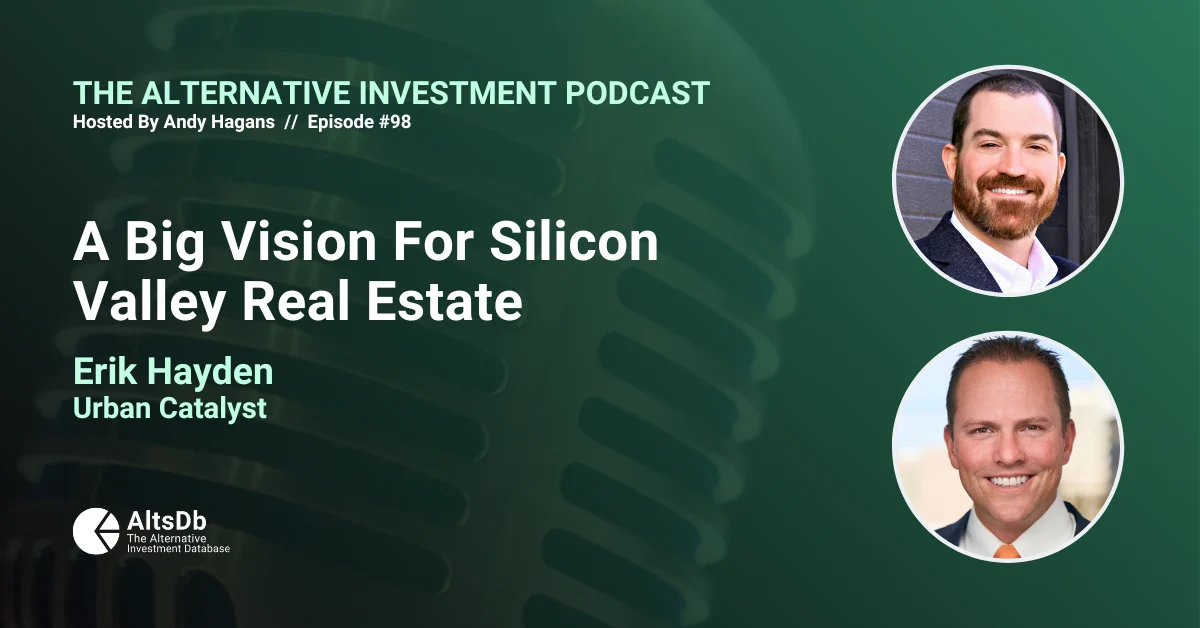
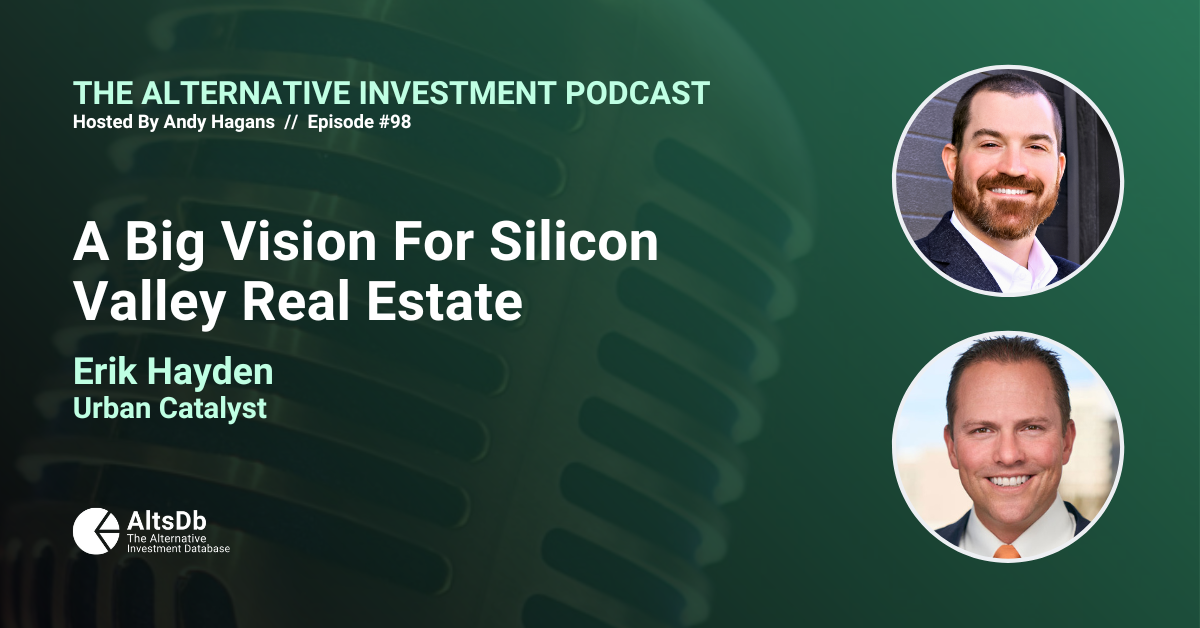
Erik Hayden, founder of Urban Catalyst and recognized as one of Silicon Valley’s 100 most powerful individuals, is optimistic about the region’s real estate future, countering prevailing "doom and gloom" narratives. In a recent interview on "The Alternative Investment Podcast," Hayden outlined his vision for how Silicon Valley can generate substantial, long-term wealth for investors through strategic real estate development and investment.
Urban Catalyst, as described by Hayden, operates as a real estate equity fund with deep expertise in both acquiring existing assets and undertaking ground-up development projects and building rehabilitations. The company has established itself as a significant player in the Opportunity Zone space, a federal program designed to incentivize investment in economically distressed communities.
The Genesis of Urban Catalyst and a Bold Vision
Hayden’s entrepreneurial journey began with extensive experience in ground-up development, particularly within the dynamic Silicon Valley market, with a focus on San Jose. Prior to founding Urban Catalyst in 2018, he led development for a significant project in Oakland and also engaged in consulting for other development firms. His decision to establish Urban Catalyst stemmed from a conviction in the potential for high returns within Silicon Valley’s real estate market and a keen observation of burgeoning development opportunities in downtown San Jose.
"When I started Urban Catalyst, I was the president of a development company doing a big project up in Oakland," Hayden shared. "I also, on the side, had my own business doing some consulting work with other development companies, and decided that I wanted to do more. Ground-up development, you know, with the type of returns that are associated with it, and really the real estate market in Silicon Valley, has always made a lot of sense to me."
The strategic focus on downtown San Jose was driven by a broader trend of tech migration within Silicon Valley. As the established tech hubs of Palo Alto, Menlo Park, and Mountain View reached capacity, companies began to expand southward. Sunnyvale, which experienced a development boom, became largely built out, leading to San Jose emerging as the next logical expansion point.
"If Palo Alto, Menlo Park, and Mountain View are kind of the center of the tech universe, they’re not really very big cities," Hayden explained. "So we’ve seen a lot of expansion. Of course, these, you know, companies, Google, Apple, Meta, they’re expanding all over the country, all over the world, but in the Valley, we’ve seen the slow migration southward from that center of Silicon Valley, towards San Jose."
This foresight proved accurate, as major tech corporations like Google, Apple, and Meta have since acquired land, opened offices, or announced significant expansion plans in San Jose. While other developers have also entered the downtown San Jose market, Urban Catalyst’s established relationships with property owners allowed them to secure key acquisitions early on.
Crucially, Hayden emphasized that the decision to focus on Opportunity Zones was a consequence of the market’s inherent viability, not the primary driver. "We wanted to be in San Jose, and San Jose was also an Opportunity Zone, and we became an Opportunity Zone fund, and it’s been working out pretty great for us," he stated. This approach underscores a strategy of identifying strong investment fundamentals first and then leveraging available incentives.
Navigating the Startup Phase: Capital, Risk, and Vision
Launching a company, particularly in a high-cost region like Silicon Valley, involves significant financial commitment and inherent risk. Hayden revealed that Urban Catalyst’s initial sponsor-level funding amounted to approximately $4.5 million, primarily sourced from friends and family who believed in his track record. This capital was essential for covering operational costs, legal fees for crucial documents like Private Placement Memorandums, and securing office space with a five-year lease.
"When we first started Urban Catalyst at our sponsor level, we raised around $4.5 million dollars. That was just to start us up, get the lights on and get everything going," Hayden said. "And that was mainly friends and family money for me. We didn’t use any, you know, venture money or large equity groups. It was friends and family money. Folks that believed in me, knew my track record, knew I was gonna put everything I had into it."
Hayden also addressed the perceived risk of entrepreneurship, drawing a parallel to employment. He argued that while starting a business carries its own challenges, being an employee is not inherently less risky, as an individual’s livelihood depends on the success of their employer. As an entrepreneur, one has direct control over their destiny.
A defining characteristic of Urban Catalyst’s inception, as highlighted by podcast host Andy Hagans, is its "big, bold vision" from the outset. Unlike some entrepreneurs who build incrementally through serial ventures, Hayden’s approach was to establish a substantial fund with ambitious projects from the start.
"Throughout my career, I’ve built these really big buildings, you know. Maybe my average building size has been about $100 million," Hayden explained. "The amount of work to build a hundred-million-dollar building or to flip a house is about the same amount of work. There’s just some extra zeros attached to the bigger buildings. And it’s similar at the fund level. Raising a $20 million fund and successfully deploying it or raising a $200 million fund, or even a $2 billion fund, it’s the same amount of work, and it’s just more zeros attached to it."
This philosophy extended to their fundraising strategy. Instead of relying solely on traditional broker-dealers and registered investment advisors, Urban Catalyst embraced digital marketing channels like Google, LinkedIn, and Facebook to reach investors directly. This innovative approach, leveraging new SEC regulations for 506(c) offerings, proved highly effective, enabling them to raise $50 million in their first year. This strategy was groundbreaking at the time and has since been emulated by others in the space.
Challenging Perceptions of California Real Estate
Despite widespread negative perceptions surrounding California’s real estate market, often characterized by political challenges and economic anxieties, Hayden presented a compelling counter-narrative rooted in data and economic realities. He pointed to California’s status as the world’s fourth-largest economy in 2021, surpassing Germany, with Silicon Valley being a major contributor to this economic might.
"If California was its own country, we just became the fourth-largest economy in the world. We just took over Germany," Hayden stated. "So that’s kind of the type of economic capital that we bring to the world stage. And a lot of that is Silicon Valley."
In 2021, Silicon Valley experienced one of its most robust years on record, with a surge in IPOs comparable to the dot-com era and unprecedented levels of venture capital funding. Notably, Menlo Park, a city of 45,000, attracted more venture capital than the entire state of Texas.
Regarding the narrative of people leaving California, Hayden acknowledged the trend but contextualized it within a longer historical perspective. He noted that while there was a slight population dip in 2020 and 2021, California’s population has consistently grown for over a century, with an influx of international immigrants offsetting domestic departures. The state’s appeal, from its climate to its economic opportunities, continues to draw individuals globally.
"Our population has gone up for over 100 years straight. We had, like, a little blip in 2020 and 2021, where we lost, like, less than half a percent of our population. And so far this year, we’re already back on track," Hayden explained. "People don’t take into account the amount of people from other countries that move to California, and that’s kind of the… You see all the people that live in California moving out because they can’t afford to live here, and you see the people from other countries that want to live in the United States, they want to live in California because it’s an amazing place, from the weather all the way to the economy."
The issue of housing affordability in California, particularly in Silicon Valley, was identified as a significant challenge. Hayden cited a stark imbalance: six jobs created for every housing unit built over the past 30 years. This chronic undersupply, exacerbated by regulatory hurdles, has driven median home prices in San Jose to between $1.6 and $1.7 million, making it one of the most expensive cities in the U.S. and the world. This housing crisis, while detrimental to residents, presents opportunities for developers who can navigate the complex landscape.
Urban Catalyst’s Development Projects and Opportunity Zone Fund
Urban Catalyst’s current flagship offering is its Opportunity Zone Fund II, which comprises four distinct projects in downtown San Jose: Echo, Icon, Keystone Hotel, and Gifford Place.
- Echo: A high-rise multi-family development with approximately 400 units.
- Icon: A substantial 500,000 square foot office building.
- Keystone Hotel: A 172-key Marriott Townplace Suites.
- Gifford Place: A senior living facility, specifically assisted living and memory care.
The company’s success in securing approvals for all eight projects across its two funds was attributed in part to the proactive and supportive approach of the San Jose city planning and economic development departments. Hayden noted that while state-level regulations can be challenging for development, local governments like San Jose have demonstrated a strong understanding of urban development needs and have facilitated progress.
"When we started the process, we didn’t have approvals. There were just pieces of land. You know, they had structures on ‘em. And that we went eight for eight with exactly what we wanted to build, exactly what we thought we could build, was approved by the city," Hayden remarked. "A lot of that is a testament to the city of San Jose, and I do wanna give them their props, because their planning and economic development department is top-notch, and they really understand urban development, and what a city should be, and how to facilitate that."
The development of the Icon office building is particularly noteworthy. Strategically located near the future BART station and within blocks of Google’s massive "Downtown West" campus, it is poised to be a premier office asset. Google’s $19 billion, 10-year development plan for its 80-acre site, which will create its largest global campus with 7 million square feet of office space and 6,000 residential units, is expected to generate significant synergy with Urban Catalyst’s projects.
Hayden emphasized the importance of integrating architectural vision with cost-effective construction. Urban Catalyst’s philosophy involves bringing together architects and general contractors from the initial design phase to ensure that projects are not only aesthetically pleasing and functional but also economically viable to build. This collaborative approach is considered a key value-add in ground-up development.
Addressing the Office Market and Economic Outlook
Despite negative headlines surrounding the office sector, Hayden remains cautiously optimistic about Silicon Valley’s office market. He noted that even during the COVID-19 pandemic, the region experienced strong office transactions and record prices, positioning it as a safe haven for institutional investors. While rents have seen minor adjustments and vacancy rates have slightly increased, major tech companies continue to lease significant space.
Hayden also provided a nuanced perspective on recent tech layoffs. He argued that while these events garner significant media attention, the scale of layoffs in Silicon Valley to date is relatively small compared to the hiring spree during the pandemic. Furthermore, major tech companies are consolidating their operations within Silicon Valley, indicating a continued commitment to the region.
"So far here in the Valley, we’ve laid off about 12,000. So not even, like, a blip on the radar," Hayden stated. "In fact, our unemployment rate is now at 2%. Six months ago, it was at 2.2%. So we actually have more jobs now than we had six months ago, despite all the layoffs and headlines."
He suggested that these layoffs are more about companies optimizing their workforce after over-hiring rather than a sign of a broader economic downturn. The labor market in Silicon Valley remains tight, underscoring the region’s underlying economic strength.
Expanding the Investment Platform: Delaware Statutory Trusts (DSTs)
Urban Catalyst is also diversifying its investment offerings by launching a Delaware Statutory Trust (DST) product. The inaugural DST focuses on an industrial property in Dallas, Texas, a departure from their core focus on Silicon Valley development.
"We wanted to expand our fund platform to provide more opportunities for our investors. Delaware Statutory Trust, I mean, it fits right in our wheelhouse. Tax-advantaged real estate. That is what we do here at Urban Catalyst," Hayden explained. "We raise funds for tax-advantaged real estate. We raise funds for properties that we can control."
The choice of an industrial property in Dallas was strategic. Industrial real estate, along with multi-family, is a common asset class for DSTs, driven by strong demand and potential for rent growth. Dallas-Fort Worth is identified as a rapidly growing metropolitan area with the second-largest industrial market in the country. The specific property benefits from a prime location near a major freight cargo airport and features a 10-year lease with 3% annual rent increases, providing a stable income stream and an exit strategy for investors.
"We wanted to go into a net lease environment, where we could have built-in rent increases into our leases. And so that’s what we found here with this property that we have," Hayden noted. "We have a 10-year lease, 3% built-in rent increases, so that we can show, in a contract with a quality tenant, that 10 years from now, we will have a value that is similar to the value that we’re selling the DST for now."
This expansion into DSTs reflects Urban Catalyst’s commitment to providing a broader range of tax-advantaged real estate investment opportunities for its growing investor base, leveraging their expertise in identifying high-growth markets and quality assets.
Investors interested in learning more about Urban Catalyst’s investment opportunities can visit their website at urbancatalyst.com.
