

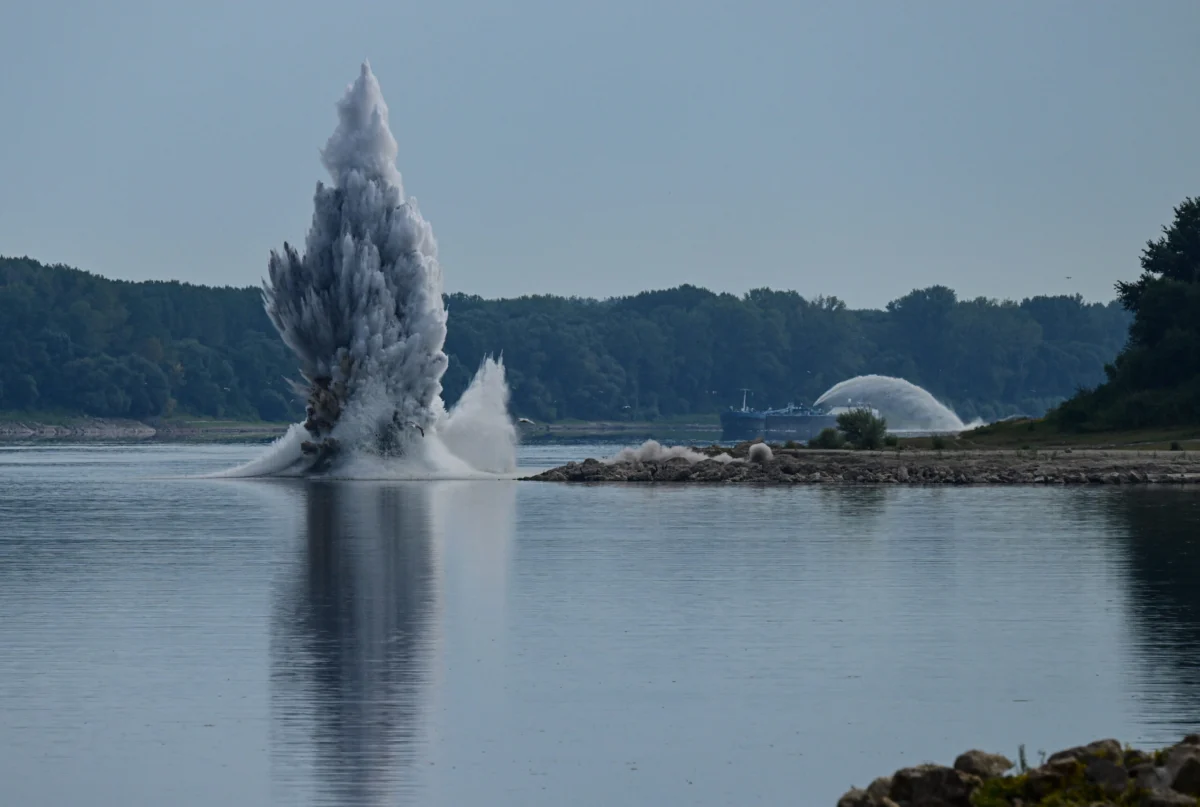
Europe is confronting an unprecedented water crisis as a relentless summer of extreme heat has driven major rivers, including the Rhine and the Danube, to historic low levels. This severe drought is not only jeopardizing economic growth across the continent but also forcing nations to resort to drastic and often costly measures, such as underwater detonations, to maintain essential functions like nuclear power generation and vital trade routes.
The Rhine River, often referred to as the economic artery of Europe, is experiencing its lowest water levels in nearly 150 years. In Germany, a critical hub for manufacturing and logistics, the reduced navigability of the Rhine is severely impacting supply chains and threatening to dampen economic output. On July 30, 2026, an aerial view near Neuss, western Germany, revealed a former eel fishing boat resting in thick, dried mud, a stark visual testament to the receding waters. The water level at Kaub, a crucial bottleneck for vessels traveling to southern Germany and Switzerland, plummeted to a record low of 24 centimeters on July 29th and 30th, according to official data compiled by ETH Zurich. This figure is significantly below the critical navigation threshold of 78 centimeters, forcing cargo barges to carry substantially less weight and driving up freight transportation costs and low-water surcharges.
"Major rivers like the Rhine and Danube are critical trade corridors and sources of water for industry and energy generation, so when water levels fall, the effects extend far beyond the waterways themselves," Liz Saccoccia, water security lead at the World Resources Institute, explained via email. "We’re already seeing that happen. Nuclear plants in Hungary, Romania and France, along with hydropower facilities in Serbia, have already had to reduce electricity generation because there isn’t enough water for cooling or driving turbines, increasing the risk of blackouts and costly electricity imports."
The ripple effects of this water scarcity are being felt across multiple sectors. Farmers are struggling to ship their crops along the Danube, and cruise ship operators are finding ports inaccessible, as noted by Saccoccia. "These are early examples of how increasingly unreliable water supplies can ripple through the economy, affecting trade, energy security, supply chains and local businesses," she added.
The economic implications for Germany are substantial. Stefan Kooths, professor of economics at the Kiel Institute for the World Economy (IfW), estimates that the low water levels on the Rhine could reduce Germany’s Gross Domestic Product (GDP) by as much as 0.2 percent in the third quarter of 2026. "Since water levels are unlikely to rise sharply back above the critical threshold in early August, transport capacity is likely to remain affected by the low water levels for some time in the coming month as well," Kooths stated in an email to CNBC. He further quantified the potential economic loss, estimating it between 1 to 2 billion euros ($1.15 billion to $2.3 billion) in the third quarter.
This situation highlights a broader environmental challenge: water scarcity. Southern Europe, in particular, is acutely affected, with an estimated 30% of its population residing in areas experiencing permanent water stress, where demand consistently outstrips available supply. The European Environment Agency has previously documented this trend, underscoring the growing vulnerability of these regions.
In a more dramatic response to the escalating crisis, Romania has been forced to take extraordinary measures to ensure the operational integrity of its sole working nuclear reactor, cooled by the Danube River. The Cernavoda Nuclear Power Plant faced a critical threat from the dwindling water levels. In a bid to increase water flow to the plant’s cooling systems, the Romanian navy undertook controlled underwater detonations on the riverbed in Izvoarele village on August 3, 2026. Images released from the operation showed naval forces blasting rocks in an effort to deepen the channel and enhance water diversion. This unprecedented action underscores the severity of the situation, where conventional solutions are proving insufficient.

The Paks Nuclear Plant in Hungary, a facility crucial for the nation’s energy supply, accounting for approximately 40% of its electricity, has also been threatened by low water levels on the Danube. Similarly, Serbia has had to curtail its hydropower generation due to the insufficient water flow. The interconnectedness of European energy infrastructure means that disruptions in one country can have cascading effects across the continent, potentially leading to increased reliance on imported energy and higher electricity prices for consumers.
Felix Schmidt, a senior economist at the private German bank Berenberg, suggested that while the Rhine’s low water levels might not have entirely caught businesses by surprise given the increasing frequency of such events due to climate change, the economic impact is undeniable. Many companies have proactively adapted by increasing inventory levels or rerouting some freight to rail or road transport. However, Schmidt noted that current freight rates have "gone through the roof," exacerbating existing inflationary pressures.
"Given that Germany is growing very little, obviously, if we grow 0.1 instead of 0.2 then this means we lose half of the growth, if you want to frame it like that," Schmidt commented during a phone interview. Germany’s economic growth was modest, expanding by 0.2% in the second quarter of 2026 compared to the previous three-month period, following a 0.4% increase in the first quarter. The continued strain from environmental factors like drought could easily erode these gains.
Schmidt further elaborated that drying rivers are merely one manifestation of Germany’s economic challenges amidst a deepening climate crisis. "Water levels are obviously one thing, but we had this heat wave in Germany a couple of weeks back, impacting big parts of northern Europe, which brings down productivity. You have infrastructure which gets destroyed by the heat. You have energy supply, which is affected, like the nuclear plants being shut down in Hungary, France and Switzerland," he stated. He also pointed to the "catastrophic development" of wildfires raging in southern Europe as another significant economic disruptor. "So, it’s affecting the economy in many, many ways," Schmidt concluded.
The current drought is not an isolated incident but rather an increasingly predictable consequence of climate change. Global warming is intensifying weather extremes, leading to more frequent and severe heatwaves and prolonged dry spells across Europe. The Intergovernmental Panel on Climate Change (IPCC) has repeatedly warned about the amplified risks of such phenomena in its assessment reports, projecting a future where water scarcity becomes a more common and impactful challenge for both natural ecosystems and human societies. The extreme heat experienced in 2026, with temperatures in some parts of Europe reaching as high as 55 degrees Celsius (131 degrees Fahrenheit) during a heatwave in August, serves as a stark validation of these scientific projections.
The long-term implications of such recurring environmental stresses are profound. Beyond the immediate economic disruptions, there are concerns about food security, as agricultural output is directly impacted by water availability. The strain on energy grids, particularly those reliant on hydropower or water-cooled nuclear plants, raises questions about energy security and the transition to renewable energy sources. Furthermore, the psychological and social impacts of living with such environmental instability, including the constant threat of resource shortages and extreme weather events, are yet to be fully understood.
As Europe grapples with these unprecedented challenges, the need for adaptive strategies and resilient infrastructure becomes increasingly paramount. This includes investing in water management technologies, promoting water conservation, diversifying energy sources, and implementing robust climate adaptation plans. The current crisis on the Rhine and Danube serves as a critical wake-up call, underscoring the urgency of addressing climate change and its far-reaching consequences on a global scale. The continent’s economic future, intertwined with the health of its vital waterways, hinges on its ability to navigate this evolving environmental landscape.
