

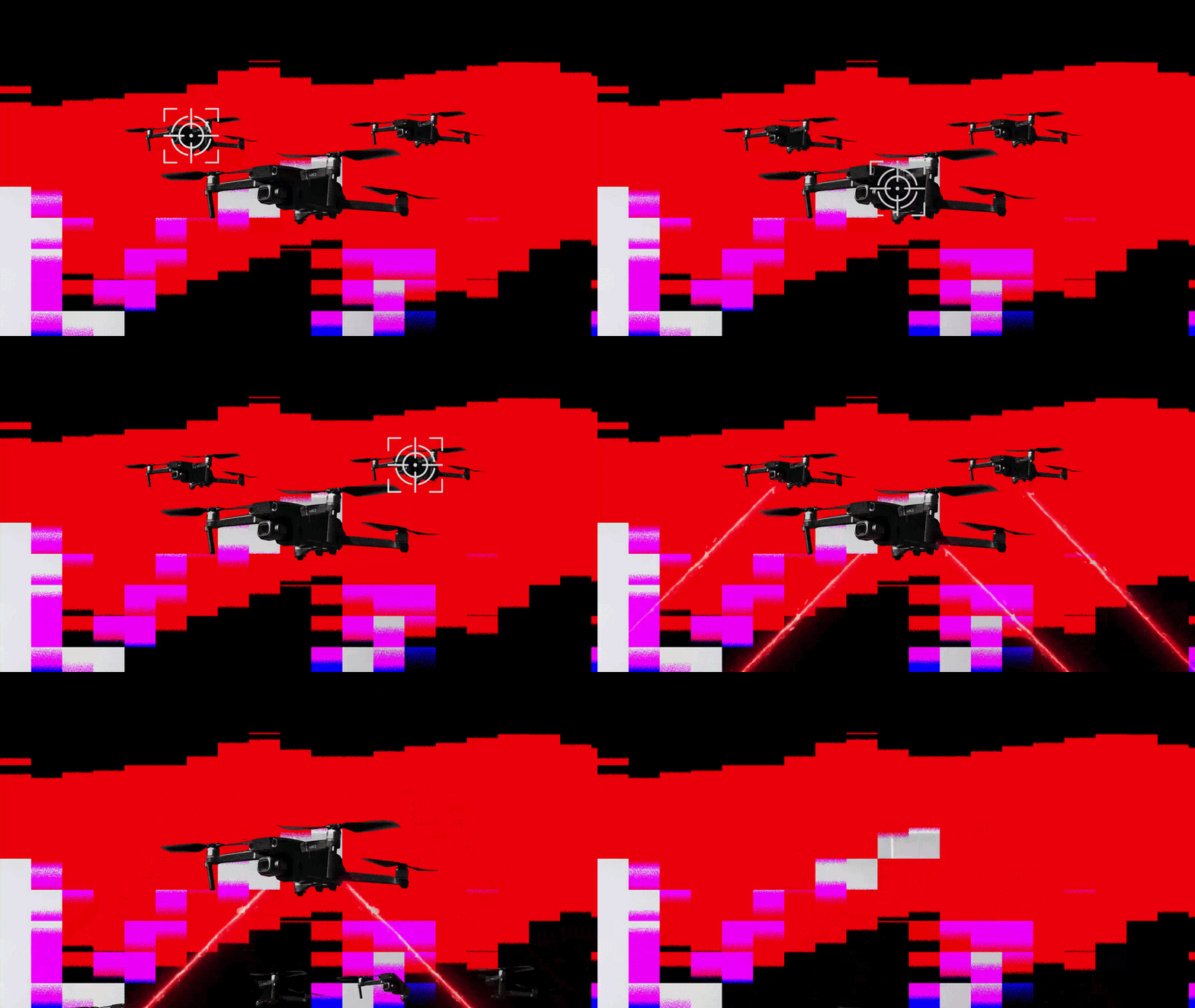
The United States Army is poised to finalize a landmark contract with defense contractor AeroVironment to acquire and deploy the Enduring High Energy Laser (E-HEL), signaling a fundamental shift in the Pentagon’s approach to air defense. For more than five decades, the promise of directed-energy weapons remained a tantalizing but elusive goal, characterized by ambitious prototypes that failed to survive the transition from the laboratory to the battlefield. From the 1970s-era experiments to the multi-billion dollar Airborne Laser program that attempted to fit a chemical laser into a modified Boeing 747, the history of American "ray guns" has been one of technical hurdles and fiscal frustration. However, the convergence of modern semiconductor technology, the urgent necessity created by drone-saturated battlefields in Ukraine and the Middle East, and a breakthrough in fiber-laser engineering has finally moved the technology into the realm of standard military equipment. The official designation of the E-HEL as a "program of record" marks the first time the U.S. military has formally integrated a laser weapon into its long-term budgetary and procurement architecture, ensuring that these systems will be produced in significant numbers and deployed to defend global installations.
The Economic Imperative: A War of Attrition
The primary driver behind the Army’s sudden acceleration of laser technology is not merely a desire for futuristic weaponry, but a cold calculation of economic sustainability. In recent conflicts involving Iran, Israel, and Ukraine, the proliferation of low-cost, one-way attack drones has fundamentally broken the traditional cost-exchange ratio of air defense. During the initial phases of the conflict in the Middle East, U.S. forces were frequently forced to intercept $35,000 Iranian-designed Shahed-136 drones using Patriot interceptor missiles, which carry a price tag of approximately $4 million per shot.
This disparity represents more than just a waste of taxpayer funds; it is a strategic vulnerability. The U.S. stockpile of high-end interceptors is finite, and the manufacturing lead times for these complex missiles are measured in years. In contrast, a laser weapon operates on the principle of a "limitless magazine." As long as the system has access to a power source—either through a vehicle engine or a portable generator—it can continue to fire. Mark J. Lewis, a former Air Force chief scientist, notes that the ability to fire repeatedly without the logistical burden of transporting heavy munitions is a "game-changer" for counter-drone operations. The cost per shot for a laser is estimated to be less than a dollar, representing the mere cost of the fuel or electricity required to generate the beam.
Technological Evolution: From Chemicals to Fibers
The failure of previous laser programs, such as the Tactical High Energy Laser (THEL) or the Airborne Laser, was largely due to the "gain medium" used to create the beam. Early high-power lasers relied on a volatile mixture of toxic chemicals, including chlorine, hydrogen peroxide, and iodine. These systems were massive, dangerous to handle, and required complex plumbing that made them impractical for mobile ground forces.
The E-HEL and its contemporary counterparts represent a move toward "solid-state" technology, specifically fiber lasers. These systems utilize bundles of glass fibers infused with rare-earth ions. By pumping energy into these fibers using semiconductor diodes—the same basic technology found in household LEDs—engineers can generate a highly stable, concentrated beam of light. These fiber lasers are significantly more efficient at dissipating heat and are far more compact than their chemical predecessors. The E-HEL system is designed to be small enough to fit within a standard four-by-seven-foot shipping container or mounted on the back of an Infantry Squad Vehicle (ISV) or a Joint Light Tactical Vehicle (JLTV).
Furthermore, advancements in adaptive optics and machine vision have solved the problem of "jitter." A laser must stay focused on a single point of a moving target for several seconds to burn through the casing or ignite the fuel supply. Modern sensors and rapidly flexing mirrors can now compensate for atmospheric turbulence and the vibrations of the vehicle, allowing the beam to remain "locked" on a drone’s most vulnerable components even at distances of several kilometers.
Chronology of the Laser’s Path to Deployment
The transition from experimentation to a program of record follows a period of intense testing and several high-profile, if occasionally problematic, field trials.
- September 2010: The U.S. successfully tests a 747-mounted laser against a ballistic missile, but the program is canceled shortly after due to exorbitant costs and logistical complexity.
- 2020-2023: The Navy begins installing "dazzlers," such as the Optical Dazzling Interdictor, Navy (ODIN), on destroyers to blind the sensors of reconnaissance drones.
- February 2024: An experimental laser system positioned along the southern U.S. border accidentally zapped a party balloon, leading to a brief closure of airspace around El Paso, Texas. Shortly after the airspace reopened, the system mistakenly shot down a U.S. Border Patrol drone, proving the weapon’s lethality while highlighting the need for better target identification protocols.
- March 1, 2024: An Iranian-backed drone strike on a U.S. base kills six service members, intensifying the political pressure to deploy more effective counter-UAS (Unmanned Aircraft Systems) technology.
- June 2024: Defense Secretary Pete Hegseth visits the White Sands Missile Range in New Mexico for a comprehensive demonstration of directed-energy capabilities, including the AeroVironment Locust system.
- Late 2024 (Projected): The formal signing of the E-HEL contract, worth hundreds of millions of dollars, establishing the laser as a permanent fixture of the U.S. Army’s arsenal.
Official Responses and Political Momentum
The move to codify laser weapons has garnered significant support from both military leadership and the executive branch. Lt. Gen. Frank Lozano, during a recent defense industry forum, emphasized that the AeroVironment system showed "extraordinary promise" during its most recent evaluations at White Sands. He noted that the Army is no longer looking for "science projects" but for "ruggedized, repeatable capabilities" that can be handed to a 19-year-old soldier in a combat zone.
Political support has been equally robust. During a press briefing at his Doral club in Florida, Donald Trump highlighted the incredible potential of the technology, stating that lasers would soon "do the work of the Patriots at a lot less cost." This bipartisan consensus reflects a broader realization that the U.S. cannot win a 21st-century war using 20th-century economic models of defense.
Industry leaders are also ramping up production in anticipation of the contract. Scott Keeney, CEO of nLight—a firm that provides the semiconductor components for these systems—noted that his company recently secured a $627 million contract to develop lasers capable of intercepting cruise missiles. "The engineering is largely done," Keeney said. "Now we are in the phase of proliferation and scaling."
Operational Challenges and Strategic Implications
Despite the enthusiasm, the deployment of the E-HEL is not a "silver bullet" that will render traditional missiles obsolete. Lasers face inherent physical limitations that require them to be part of a "layered defense" strategy.
One significant challenge is the "dwell time" required to neutralize a target. Unlike a missile, which explodes on impact, a laser must stay on target for three to five seconds to ensure a kill. This makes the system vulnerable to "swarm attacks," where dozens of drones approach simultaneously. If a laser takes five seconds to destroy one drone, it can only neutralize twelve drones per minute, a rate that could be overwhelmed by a massive, coordinated strike.
Environmental factors also remain a concern. Rain, fog, and smoke can scatter the laser beam, significantly reducing its effective range and power. Consequently, the Army intends to use lasers alongside traditional kinetic weapons, such as 30mm cannons and short-range missiles like the Coyote, which are unaffected by weather conditions.
There are also broader strategic risks. Because a laser beam does not stop once it hits its target—it continues to travel through the atmosphere and into space—there is a non-negligible risk of "fratricide" against satellites or high-altitude aircraft. This necessitates the development of sophisticated "de-confliction" software that can automatically shut down the laser if a friendly asset enters the line of fire.
Analysis of the Long-Term Impact
The establishment of the E-HEL as a program of record is a watershed moment for the global defense industry. It signals to contractors that there is a stable, long-term market for directed-energy components, which will likely drive down costs through economies of scale. We are moving from an era where each laser was a hand-built prototype to one where they are mass-produced on assembly lines.
Furthermore, the integration of lasers will force a redesign of military logistics. Bases that once required massive ammunition depots may instead prioritize high-capacity electrical grids and advanced cooling systems. This shift could also influence the design of future naval vessels and armored vehicles, making onboard power generation a primary metric of combat effectiveness.
As the U.S. Army prepares to deploy these systems to bases around the world, the message to adversaries is clear: the era of the "cheap kill" via low-cost drones is coming to an end. While the transition will not be without its hurdles—as seen in the accidental "balloon" incident—the commitment to the E-HEL marks the beginning of a new chapter in military history, where the speed of light becomes the new standard for air defense.
