

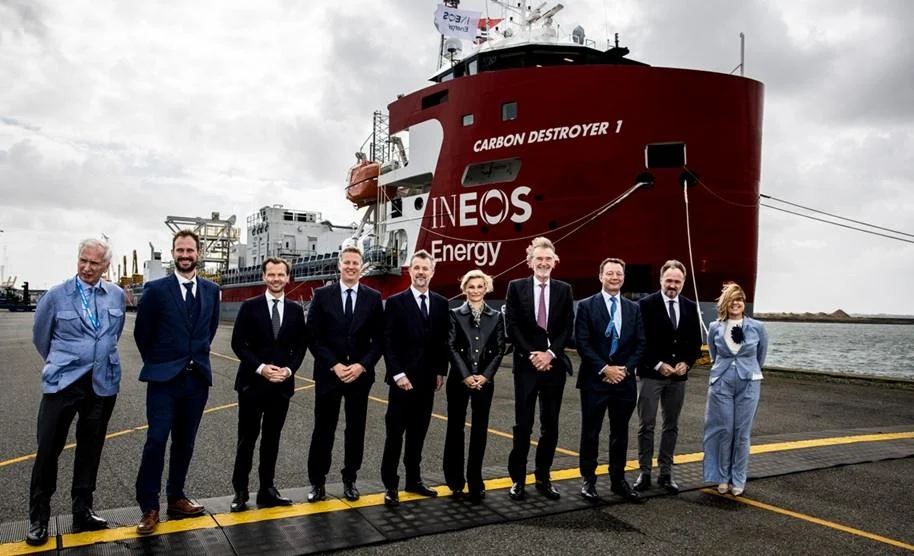
The industrial landscape of the European Union reached a historic milestone on September 18, 2026, as chemicals giant Ineos officially commenced operations at Project Greensand, the first full-scale facility for the permanent offshore storage of carbon dioxide within the bloc. Located in the Danish sector of the North Sea, the facility represents a critical leap from experimental pilot programs to a functional commercial infrastructure designed to mitigate industrial greenhouse gas emissions. With an initial injection capacity of 400,000 tonnes of CO2 per year and a roadmap to scale up to 8 million tonnes annually, the project is positioned as a cornerstone of Europe’s strategy to achieve its ambitious 2030 and 2050 climate targets.
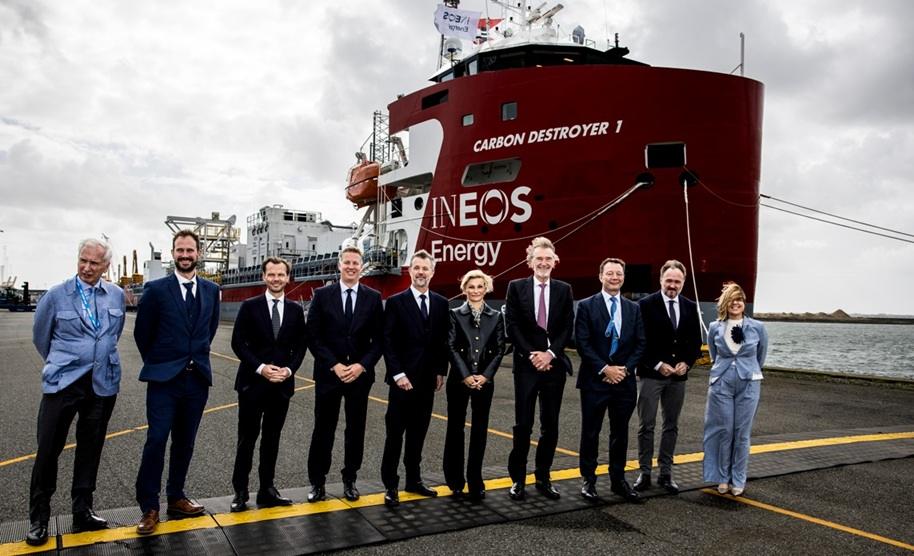
The inauguration ceremony, held at the Port of Esbjerg, was attended by a high-profile delegation including King Frederik X of Denmark, European Commissioner for Energy and Housing Dan Jørgensen, and Danish Minister of Finance Peter Hummelgaard. The event signaled not only a technical achievement but also a geopolitical shift toward utilizing the North Sea’s geological potential to serve as a "carbon sink" for the continent’s heavy industries.
Technical Architecture and Logistics
Project Greensand utilizes a sophisticated cross-border transport and storage value chain that begins at terrestrial emission sources and ends nearly two kilometers beneath the ocean floor. In its inaugural commercial phase, the project is primarily capturing CO2 from Danish biomethane plants. The process involves liquefying the captured gas at the source, after which it is transported by specialized trucks to a newly commissioned, dedicated CO2 terminal at the Port of Esbjerg.
From the terminal, the liquefied CO2 is loaded onto the "Carbon Destroyer 1," the European Union’s first purpose-built CO2 carrier vessel. This ship is designed to maintain the carbon dioxide at specific temperature and pressure levels to ensure stability during transit. The vessel travels approximately 250 kilometers offshore to the Nini West field, a depleted oil reservoir. Once on-site, the CO2 is injected into the reservoir through existing but repurposed infrastructure, settling into porous sandstone layers roughly 1,800 meters beneath the seabed.
The choice of depleted oil fields for storage is rooted in geological certainty. These fields have successfully trapped oil and gas for millions of years, providing a proven "cap rock" seal that prevents the injected CO2 from escaping back into the water column or the atmosphere. This geological security is a primary reason why the Danish North Sea has become the focal point for the EU’s early carbon capture and storage (CCS) efforts.
A Timeline of Development
The journey to the 2026 startup of Project Greensand began in 2021, when a consortium led by Ineos, in partnership with Harbour Energy and the Danish State Subsurface Resource Company Nordsøfonden, was formed. The project was initially conceived as a pilot to test the feasibility of transporting CO2 across borders—specifically from Ineos sites in Belgium to Denmark—and injecting it into the North Sea.
In early 2023, the project achieved its first successful "proof of concept" injection, which was hailed by the European Commission as a breakthrough for the "Net-Zero Industry Act." Following the success of the pilot phase, the consortium moved rapidly to secure environmental permits and upgrade the infrastructure at Port Esbjerg to handle commercial-scale volumes. The transition from a demonstration project to a fully operational business model in just five years reflects the urgency of the European climate mandate and the substantial capital investment provided by the private sector and the Danish government.
Alignment with EU Climate Policy
The activation of Project Greensand comes at a pivotal moment for European environmental policy. The EU’s Net-Zero Industry Act (NZIA) has established a target of at least 50 million tonnes of annual CO2 injection capacity by 2030. Furthermore, the European Commission’s long-term projections suggest that to meet the 2040 climate goals, the Union will need to capture and permanently store approximately 250 million tonnes of CO2 every year.
Currently, the gap between existing capacity and these targets remains wide. Project Greensand’s initial 400,000 tonnes represent less than 1% of the 2030 goal, highlighting the massive scale of infrastructure development required over the next four years. However, the project’s ability to scale to 8 million tonnes—representing roughly 16% of the 2030 target—provides a blueprint for other member states.
European Commissioner Dan Jørgensen emphasized the project’s role in the broader "Green Deal" framework during his speech at the opening. He noted that the transition from demonstration to deployment is the most difficult phase of the energy transition, and that Greensand serves as a "practical reality" that proves carbon storage is no longer just a theoretical ambition.
Economic Implications and Industrial Competitiveness
A central theme of the project’s launch was the preservation of Europe’s industrial base. Sir Jim Ratcliffe, Chairman of Ineos, addressed the tension between environmental regulations and industrial viability. He argued that the European Union cannot achieve net-zero emissions simply by de-industrializing or "exporting its jobs" to regions with looser environmental standards—a phenomenon known as carbon leakage.

By providing a viable offshore storage solution, Project Greensand allows "hard-to-abate" sectors—such as cement, steel, and chemical manufacturing—to continue operations within Europe while significantly reducing their net carbon footprint. For these industries, electrification is often technically impossible or prohibitively expensive in the short term. CCS offers a bridge that maintains employment and economic output while aligning with the Paris Agreement.
The project also creates a new economic sector in Denmark. The Port of Esbjerg, formerly a hub for oil and gas logistics, is rebranding itself as a center for the "blue economy" and carbon management. This transition is expected to sustain thousands of specialized engineering and maritime jobs that might otherwise have been lost as North Sea oil and gas production declines.
Collaborative Partnership and Funding
The success of Project Greensand is the result of a public-private partnership involving 23 diverse organizations. While Ineos and Harbour Energy provide the technical expertise in subsea operations and chemical engineering, the involvement of Nordsøfonden ensures that the Danish state maintains oversight and a financial stake in the infrastructure.
Funding for the project has been a mix of private equity and public subsidies. The Danish government has been a proactive supporter, viewing CCS as a vital component of its national goal to reach carbon neutrality by 2045. In 2022, the Danish Energy Agency awarded significant grants to the Greensand consortium to accelerate the development of the storage site, recognizing it as a "Project of Common Interest" (PCI) for the European Union.
Environmental Safety and Monitoring
Despite the enthusiasm from industry and government, offshore CO2 storage remains a subject of scrutiny regarding long-term environmental safety. To address these concerns, Project Greensand has implemented an intensive monitoring program. This includes seismic sensors on the seabed to detect any movement of the CO2 plume within the reservoir and chemical sensors to monitor the water quality around the injection wells.
Data from these sensors is shared with Danish regulatory authorities in real-time. Experts suggest that once injected, the CO2 will eventually undergo a process of mineralization, effectively turning into rock over centuries, which would make the storage permanent and irreversible.

Broader Impact and Future Outlook
The launch of Project Greensand is expected to trigger a "domino effect" across the North Sea region. Norway has already been a leader in the space with its "Northern Lights" project, and the United Kingdom is currently developing several "carbon clusters" in the East Coast and North West regions. The successful startup of Greensand provides a competitive pressure and a technical standard that is likely to accelerate these neighboring projects.
As the facility moves toward its full capacity of 8 million tonnes, the focus will shift toward international cooperation. While the current phase focuses on Danish emissions, the long-term viability of the project depends on accepting CO2 from other landlocked EU nations like Germany and Poland. This will require the development of a pan-European CO2 pipeline network, moving away from the current reliance on ship and truck transport.
In conclusion, the commencement of operations at Project Greensand marks the beginning of a new era for European climate technology. It transitions carbon capture and storage from a subsidized research endeavor into a functional component of the industrial economy. While the road to 250 million tonnes of annual storage by 2040 remains long and fraught with logistical challenges, the "Carbon Destroyer 1" delivering its first cargo to the Nini West field serves as tangible evidence that the European Union is prepared to deploy the massive infrastructure necessary to meet its existential climate commitments.
