

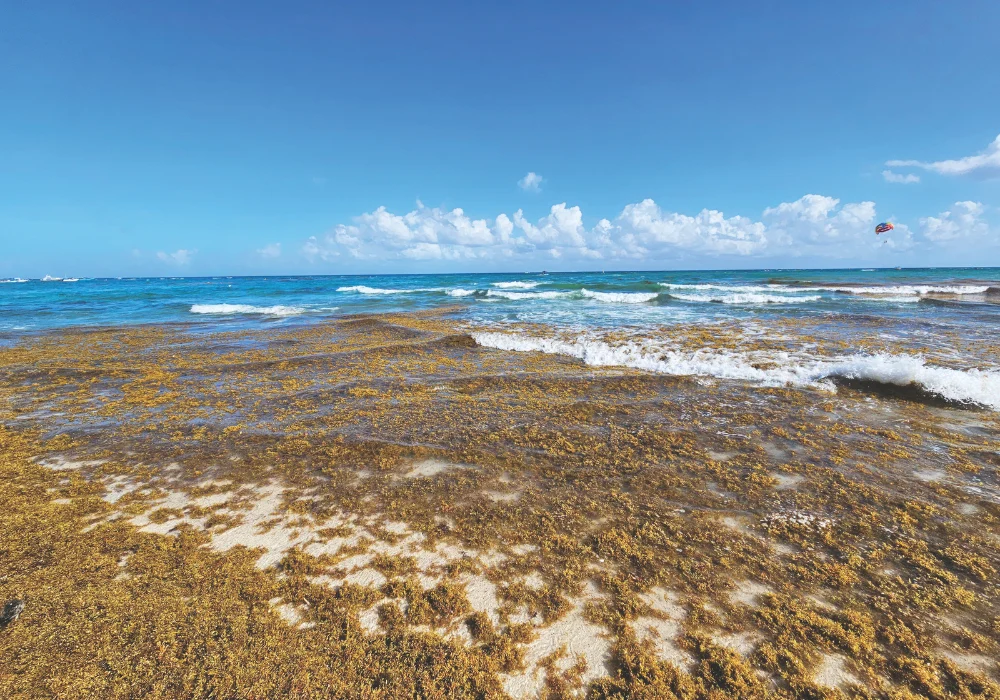
The Atlantic Ocean is currently witnessing a transformative shift in its marine composition as the Great Atlantic Sargassum Belt (GASB) continues to expand at an unprecedented rate. Once a vital component of the open ocean’s biodiversity, these massive accumulations of brown macroalgae have evolved into a recurring regional emergency for coastal nations spanning from West Africa to the Gulf of Mexico. Recent data indicates that the belt, which was first identified as a distinct and massive phenomenon in 2011, has grown to approximately 8,800 kilometers in length. By the conclusion of the most recent recording period, the biomass of this seaweed reached a staggering 38 million metric tons, representing a 40% increase over the previous record set in 2022.
The dual nature of Sargassum presents a complex challenge for scientists and policymakers alike. In the open sea, these floating mats are often referred to as a "floating rainforest." They provide a critical habitat for a diverse array of marine life, including sea turtles, crabs, shrimp, and numerous fish species that use the dense foliage for protection and foraging. However, when these massive quantities of vegetation are pushed toward the shore by winds and currents, the ecological benefits are replaced by severe environmental and economic liabilities. The sheer volume of the seaweed now threatening the coastlines of Florida, Mexico, and the Caribbean has forced governments to reconsider their maritime strategies and environmental protections.
The Evolution of a Global Marine Phenomenon
Historically, the most famous concentration of this seaweed was found in the Sargasso Sea, a region in the North Atlantic bounded by four currents. For centuries, this area remained relatively stable, serving as a biological nursery. However, since 2011, a new and much larger accumulation has formed further south, stretching across the tropical Atlantic. This new belt represents one of the most significant changes in the world’s oceans in recent decades.
While the Great Atlantic Sargassum Belt has flourished, the traditional northern patch in the Sargasso Sea has experienced a dramatic decline. Research published in 2025 indicates that the northern patch has dwindled by roughly 90% since 2015. Scientists attribute this localized collapse to rising water temperatures in the North Atlantic, which have exceeded the optimal growing conditions for the algae in that specific region. This shift suggests that while the species is resilient, its geographic distribution is highly sensitive to the thermal changes associated with global climate cycles.
The proliferation of the southern belt is not the result of a single environmental factor but rather a synergy of several drivers. Brian Lapointe, a principal investigator at Harbor Branch Oceanographic Institute at Florida Atlantic University, has noted that climate change acts as an umbrella for various underlying triggers. These include rising sea surface temperatures, extreme rainfall events that increase nutrient runoff from major river systems like the Amazon and the Mississippi, and shifts in Saharan dust deposition, which provides iron and phosphorus to the ocean surface.
Economic and Ecological Consequences for Coastal Regions
The arrival of Sargassum on beaches is no longer a minor seasonal nuisance; it has become a catastrophic event for local economies. In the Caribbean and the Yucatan Peninsula, the tourism industry—the lifeblood of the region—is under direct threat. When Sargassum reaches the shore, it begins to decompose, releasing hydrogen sulfide gas. This process creates a pungent odor, often compared to rotten eggs, which drives tourists away and poses respiratory risks to local residents and workers.
In 2024, President Luis Abinader of the Dominican Republic characterized the situation as a "regional emergency," calling for international cooperation to mitigate the impact. The Dominican Republic, along with neighbors like Jamaica and Barbados, has spent millions of dollars on manual and mechanical beach cleaning efforts. However, these measures are often temporary fixes, as the tide continues to bring in fresh layers of macroalgae daily during peak seasons.
Beyond the economic toll, the ecological damage to coastal ecosystems is profound. As the seaweed mats thicken near the shore, they block sunlight from reaching seagrass beds and coral reefs, which are essential for marine biodiversity. Furthermore, as the algae dies and sinks, the decomposition process consumes vast amounts of oxygen, leading to "hypoxic" or "dead zones" where fish and other marine organisms cannot survive. The physical barrier created by the mats also prevents sea turtle hatchlings from reaching the open ocean and hinders adult turtles from returning to beaches to nest.
Scientific Monitoring and the Role of Satellite Technology
The scale of the Great Atlantic Sargassum Belt is so vast that it can only be effectively monitored from space. This has led to a critical partnership between marine biologists and NASA. Using sensitive instruments on satellites, such as the Moderate Resolution Imaging Spectroradiometer (MODIS) and the Visible Infrared Imaging Radiometer Suite (VIIRS), scientists can track the "spectral signature" of the seaweed.
Sargassum has a unique way of reflecting light, particularly in the near-infrared spectrum, which allows satellite sensors to distinguish it from the surrounding blue water. NASA’s Earth Observatory has been instrumental in providing real-time data to coastal managers, allowing them to predict where the largest blooms are headed. This early warning system is vital for local municipalities to mobilize cleanup crews and deploy floating barriers, known as "booms," to prevent the seaweed from reaching the most sensitive beach areas.
The tracking data also reveals the seasonal nature of the blooms. Typically, the belt begins to grow in the spring, peaks in the summer months, and dissipates toward the end of the year. However, the data from the 2024-2025 cycle suggests that the growing season is extending, and the biomass is accumulating more rapidly than previously modeled.
Human Health and Infrastructure Implications
The presence of rotting Sargassum is not merely an aesthetic or olfactory problem; it is a public health concern. The hydrogen sulfide and ammonia produced during decomposition can cause headaches, nausea, and skin irritation. Long-term exposure for workers tasked with cleaning the beaches is a subject of ongoing medical study, with some reports indicating an increase in respiratory issues among coastal populations during peak Sargassum years.
Furthermore, the seaweed poses a significant threat to critical infrastructure. In some Caribbean nations, massive influxes of Sargassum have clogged the intake valves of desalination plants and power generation facilities that rely on seawater for cooling. The cost of repairing and maintaining this infrastructure in the face of persistent seaweed blooms adds another layer of financial strain to developing island nations.
Potential for Mitigation and Utilization
As the crisis deepens, researchers are exploring ways to turn the Sargassum problem into a sustainable solution. Because the seaweed is rich in nutrients and organic matter, there are ongoing efforts to harvest it for use as fertilizer, biofuel, or even as a component in construction materials and bioplastics.
However, utilizing Sargassum is fraught with challenges. The algae naturally absorbs heavy metals from the ocean, including arsenic and cadmium. If used as fertilizer for food crops, these toxins could potentially enter the human food chain. Consequently, any commercial application of harvested Sargassum requires rigorous chemical processing and testing, which currently remains expensive and difficult to scale.
International collaboration is also being ramped up. Organizations such as the Caribbean Community (CARICOM) are advocating for a unified regional response, seeking funding for large-scale offshore collection vessels. The goal is to intercept the seaweed before it reaches the shallow coastal waters, where it does the most damage and is hardest to remove.
Long-term Outlook and Environmental Analysis
The rapid expansion of the Great Atlantic Sargassum Belt serves as a visible indicator of the changing chemistry and temperature of the world’s oceans. The increase in nutrient loading—driven by agricultural expansion in the Americas and Africa—combined with a warming climate, has created a "perfect storm" for macroalgae growth.
The 40% increase in biomass recorded recently suggests that the Atlantic has reached a new "steady state" where large-scale Sargassum blooms are the norm rather than the exception. For the nations of the Atlantic basin, this requires a shift from reactive emergency management to long-term adaptation strategies. The "floating rainforest," while a marvel of nature in the deep sea, has become a symbol of the unintended consequences of global environmental shifts when it reaches the shore.
As the 2025 season progresses, the international community will continue to look toward satellite data and oceanographic research to understand the future of the GASB. The decline of the northern Sargasso Sea patch and the explosive growth of the southern belt highlight the dynamic and unpredictable nature of marine ecosystems in the 21st century. For now, the priority remains on protecting the fragile coastal ecosystems and the economies that depend on them from an ever-growing tide of brown vegetation.
