

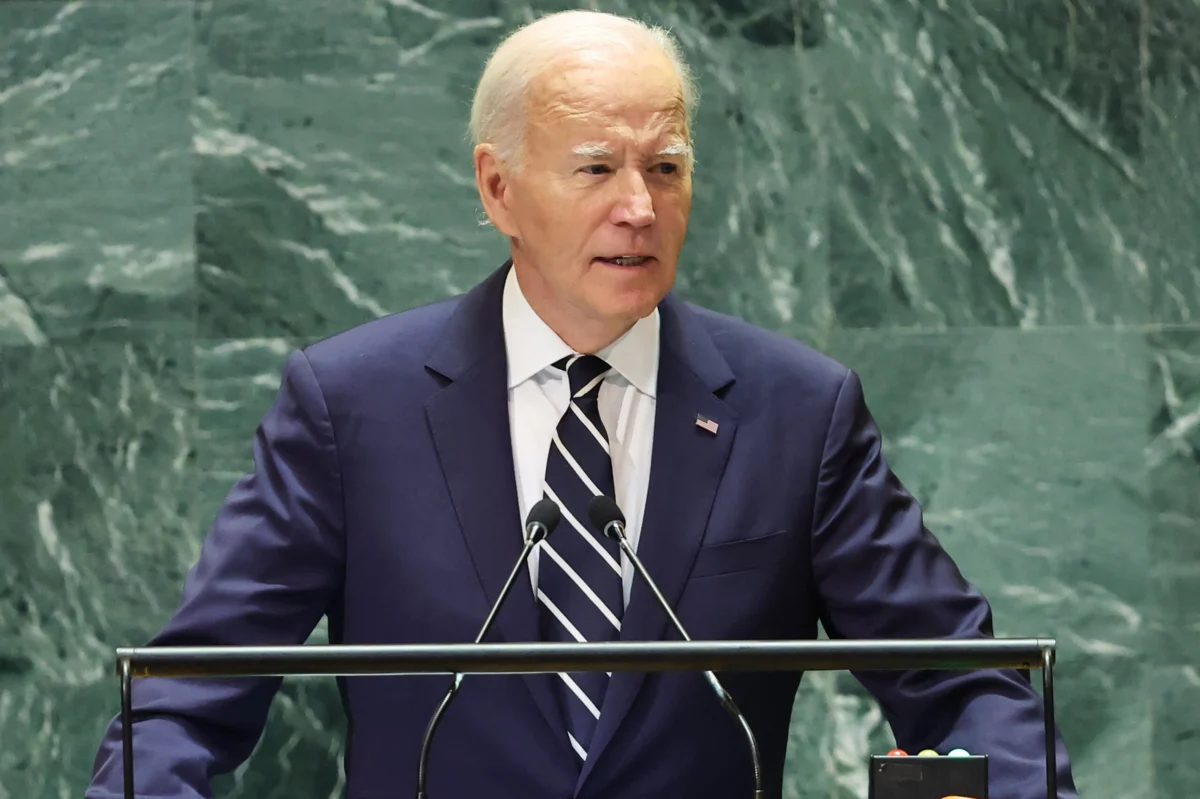
Standing before the green marble backdrop of the United Nations General Assembly for the final time as President of the United States, Joe Biden delivered a poignant address on Tuesday that sought to reconcile his administration’s vision of a rules-based international order with the chaotic reality of a world fractured by escalating wars. Addressing an audience of heads of state and global diplomats, Biden framed his fifty-year career in public service as a journey from the Cold War to the present day, arguing that while the world faces unprecedented peril in the Middle East, Ukraine, and Sudan, the capacity for collective action remains the only viable path forward.
The speech arrived at a pivotal juncture in Biden’s presidency, coming just four months before he is set to vacate the Oval Office and at a moment when the specter of a broader regional war in the Middle East looms larger than at any point in recent decades. For Biden, the address was more than a diplomatic obligation; it was an attempt to cement a legacy defined by the revitalization of alliances and a firm belief in multilateralism, even as those ideals are tested by the resurgence of authoritarianism and the limits of American influence.
A Vision of Hope Against a Backdrop of Despair
President Biden opened his remarks by acknowledging the pervasive sense of "despair" that has gripped the international community. He noted that many observers view the current geopolitical climate as one defined by irreparable division. However, Biden leaned into his decades of experience—spanning his time as a young senator during the Vietnam War to his role as Vice President and eventually Commander-in-Chief—to argue that progress is possible even in the darkest of times.
"I know many look at the world today and see difficulties and react with despair," Biden told the assembly. "But maybe because of all I’ve seen and all we have done together over the decades, I have hope." He reminded the audience that the United States and its partners have successfully navigated previous eras of "crisis and uncertainty," emphasizing that the current challenges, while formidable, are not insurmountable if the principles of the U.N. Charter are upheld.
The President’s rhetoric was designed to contrast with the isolationist "America First" philosophy of his predecessor and potential successor, Donald Trump. By highlighting the administration’s commitment to global AI principles, climate action, and humanitarian relief, Biden sought to present the United States as an indispensable, yet cooperative, leader on the world stage.
The Middle East: A Region on the Brink
A significant portion of the President’s address was dedicated to the volatile situation in the Middle East. Since Biden’s last UNGA address in September 2023, the region has been transformed by the October 7 Hamas attacks on Israel and the subsequent, devastating military campaign in the Gaza Strip. The conflict has recently expanded, with Israel and Hezbollah engaging in intensive cross-border strikes, raising fears of an all-out war in Lebanon.
Biden underscored the urgency of a ceasefire-and-hostage deal, a goal that has remained elusive despite months of mediation by the U.S., Egypt, and Qatar. "Now is the time for the parties to finalize its terms, bring the hostages home, to secure security for Israel and Gaza free from Hamas’ grip, ease the suffering in Gaza, and end this war," Biden declared.
Crucially, the President also addressed the deteriorating situation in the West Bank, where violence against innocent Palestinians has surged. He reiterated the long-standing U.S. commitment to a two-state solution, describing it as the only viable path toward a future where Israel enjoys full recognition and normalized relations with its neighbors, and Palestinians live in a state of their own characterized by "security, dignity, and self-determination."
Data from the United Nations and local health authorities highlight the gravity of the humanitarian crisis Biden referenced. In Gaza, the death toll has surpassed 41,000, with nearly the entire population of 2.3 million people displaced and facing acute shortages of food, water, and medical supplies. In the West Bank, the U.N. has documented a sharp rise in settler violence and military incursions, complicating any future prospects for a sovereign Palestinian state.
Ukraine and the Defense of Sovereignty
Turning to Eastern Europe, Biden reaffirmed his unwavering support for Ukraine as it enters its third year of defending against Russia’s full-scale invasion. The President framed the conflict not merely as a regional dispute, but as a fundamental assault on the U.N. Charter and the principle of territorial integrity.
"We could have stood by and merely protested," Biden said, referring to the initial invasion in February 2022. "But Vice President [Kamala] Harris and I understood that that was an assault on everything this institution was supposed to stand for." He highlighted the expansion of NATO—which recently welcomed Finland and Sweden into its ranks—as a direct consequence of Russian President Vladimir Putin’s miscalculations.
However, Biden’s call for continued support comes at a time of domestic political friction. In the U.S. Congress, a vocal faction of the Republican Party has become increasingly skeptical of providing further multi-billion-dollar aid packages to Kyiv. Biden used the international stage to send a message to both his domestic critics and his global partners: "You cannot grow weary. You cannot look away. We will not let up on our support for Ukraine, not until Ukraine wins a just and durable peace."

Sudan and Forgotten Crises
While the Middle East and Ukraine dominate the headlines, Biden also took the opportunity to shine a light on the civil war in Sudan, which has created one of the world’s worst humanitarian disasters. Since fighting broke out in April 2023 between the Sudanese Armed Forces (SAF) and the Rapid Support Forces (RSF), more than 10 million people have been displaced, and the country is facing the imminent threat of widespread famine.
Biden’s inclusion of Sudan in his address was an attempt to signal that American foreign policy remains focused on humanitarian crises beyond the primary theaters of geopolitical competition. The administration has been pushing for increased aid access and a cessation of hostilities, though diplomatic efforts have so far failed to produce a lasting truce.
The "New Generation" and the Transition of Power
Perhaps the most personal moment of the speech occurred when Biden addressed his decision to withdraw from the 2024 presidential race. In July, following a period of intense internal party pressure and concerns over his age, Biden announced he would not seek re-election, instead endorsing Vice President Kamala Harris.
"As much as I love the job, I love my country more," Biden told the General Assembly. "I decided, after 50 years of public service, it’s time for a new generation of leadership to take my nation forward." He framed this decision as a model for other world leaders, stating, "My fellow leaders, let us never forget: Some things are more important than staying in power."
This statement resonated deeply in a hall filled with leaders from countries where the peaceful transition of power is often contested or nonexistent. It also served as a tacit acknowledgement of the political reality in the United States, where the upcoming election in November represents a crossroads for American foreign policy.
A Dense Diplomatic Calendar
The UNGA address was the centerpiece of a week of intense "marathon diplomacy" for the President. The administration’s schedule reflects an effort to institutionalize partnerships that can survive beyond the current term.
- September 21: Biden hosted a Quad summit in Wilmington, Delaware, with the leaders of Australia, India, and Japan. The meeting focused on maritime security in the Indo-Pacific and countering China’s growing influence.
- September 23: Biden met with UAE President Mohamed bin Zayed Al Nahyan in Washington to discuss regional stability and the burgeoning tech partnership between the two nations.
- September 25: A scheduled meeting with President Tô Lâm of Vietnam aims to strengthen the "Comprehensive Strategic Partnership" established last year.
- September 26: Biden will host Ukrainian President Volodymyr Zelenskyy at the White House to discuss a "victory plan" and further military assistance.
The Shadow of the 2024 Election
While Biden occupied the podium, the presence of his potential successors was felt throughout the halls of the United Nations. Foreign diplomats are increasingly looking past the current administration to gauge the future of U.S. engagement.
Vice President Kamala Harris, seeking to bolster her commander-in-chief credentials, held her own high-level meetings, including a session with the UAE president and a planned meeting with President Zelenskyy. Simultaneously, former President Donald Trump’s campaign confirmed that he is expected to meet with several world leaders, including Zelenskyy, Indian Prime Minister Narendra Modi, and Polish President Andrzej Duda.
This "dual-track" diplomacy highlights the uncertainty felt by U.S. allies. Many fear that a change in administration could lead to a retreat from international commitments, particularly regarding NATO and climate change agreements. Biden’s speech was, in many ways, an argument for the continuity of the internationalist path he has championed.
Implications and Analysis
Biden’s final UNGA address marks the end of an era for a leader whose political identity has been inextricably linked to the American-led international order established after World War II. His legacy will likely be judged by whether the alliances he strengthened—such as NATO and the Quad—are resilient enough to withstand the populist pressures mounting within the United States and abroad.
The President’s emphasis on "hope" served as a rhetorical bridge between the successes of his administration, such as the unified Western response to the invasion of Ukraine, and the unresolved crises in Gaza and Sudan. However, the effectiveness of his "lame duck" diplomacy remains to be seen. With the world watching the U.S. election polls as closely as the battlefield maps, Biden’s ability to influence the behavior of Netanyahu, Putin, or Xi Jinping is increasingly constrained by time.
As he concluded his remarks, Biden left the assembly with a plea for the preservation of democracy and the international institutions that he has spent half a century defending. For a president who came to office promising to "restore the soul of America" and its place in the world, the 79th General Assembly was a final opportunity to argue that, despite the chaos of the present, the global community remains "the masters of its own fate."
