

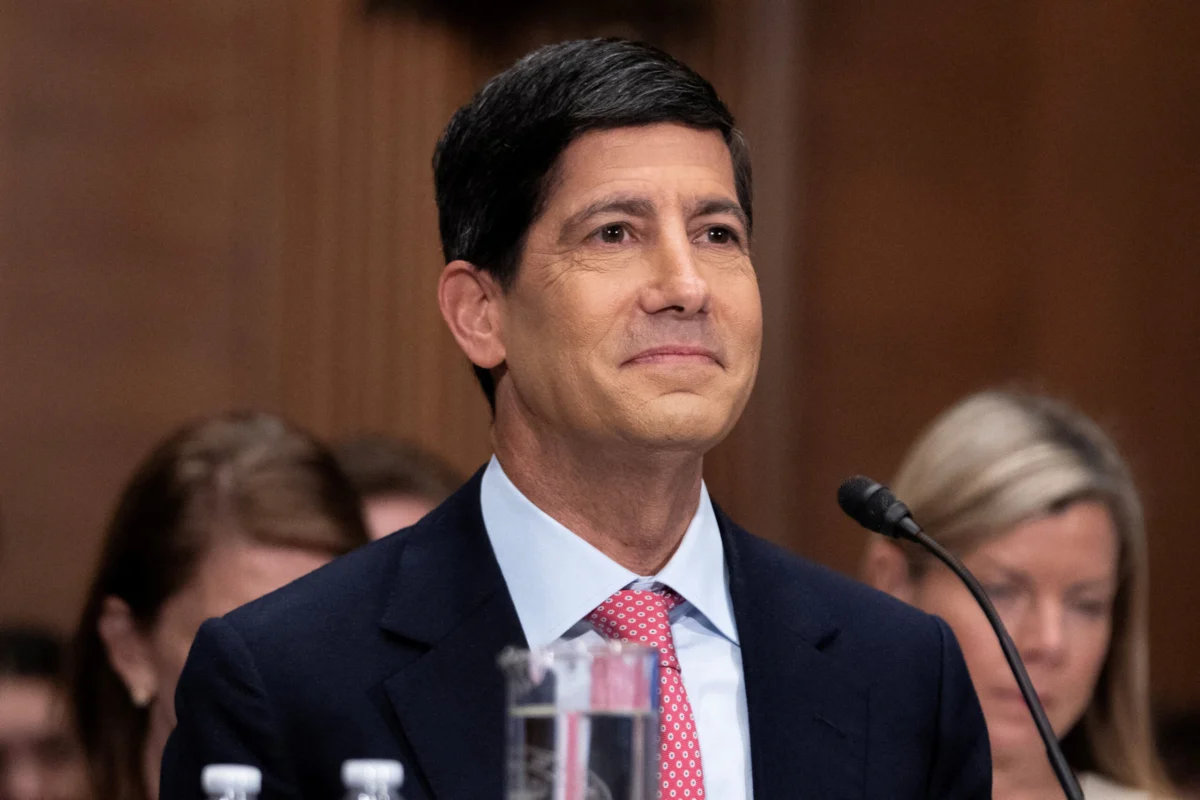
The United States Federal Reserve announced on Wednesday its decision to maintain the federal funds rate at a range of 350 to 375 basis points, marking the second monetary policy meeting under the leadership of the newly appointed Chairman, Kevin Warsh. The decision to hold rates steady comes at a precarious moment for the American economy, as the central bank attempts to balance a cooling labor market against persistent inflationary pressures exacerbated by escalating tensions between the United States and Iran. Despite significant pressure from some corners of the financial sector for a preemptive rate hike to curb rising energy costs, the Federal Open Market Committee (FOMC) opted for a "wait-and-see" approach, prioritizing the observation of long-term data trends over immediate reactionary shifts.
In its official statement, the central bank acknowledged that while progress has been made, inflation remains significantly above the Committee’s long-standing 2 percent target. The Fed specifically pointed toward supply-side shocks, particularly in the energy sector, as a primary driver of the current price volatility. "Inflation remains elevated relative to the Committee’s 2 percent goal, in part reflecting supply shocks that have driven price increases in certain sectors, including energy," the statement read. The Committee reiterated its unwavering commitment to delivering price stability, suggesting that while rates were held steady this month, the door remains open for future tightening should the inflationary trajectory fail to align with the Fed’s objectives.
A Divided Committee and the End of Forward Guidance
The decision to maintain the current rate was not unanimous, reflecting a growing divide within the 12-member FOMC regarding the appropriate path for monetary policy in a post-pandemic, high-conflict global economy. Three members—Beth M. Hammack, Neel Kashkari, and Lorie K. Logan—voted against the majority, instead advocating for a 25-basis-point increase that would have brought the range to 375-400 basis points. The dissenters reportedly argued that the risks of entrenched inflation, fueled by the ongoing energy crisis, outweigh the risks of a potential economic slowdown.
This meeting was particularly scrutinized by Wall Street due to Chairman Warsh’s recent decision to scrap "forward guidance." For more than a decade, the Federal Reserve has utilized forward guidance—explicit communication about the future path of interest rates—to provide markets with a sense of predictability. By removing this tool, Warsh has effectively forced investors and journalists to rely solely on real-time economic data, a shift that many analysts have described as "flying blind."
During a press conference following the announcement, Warsh defended this tactical shift. "My colleagues and I considered the economic shocks of recent years, strained supply chains arising from the pandemic, military conflicts, energy supply disruptions, substantial increases in tariff rates, and yes, the surge in AI-related investment," Warsh told reporters. He emphasized that the Committee is moving away from a reliance on single data points. "We are not relying on any one individual piece of data as cover or as an excuse, or as validation. What I care about and what I think the Committee cares about is trends on the data."
Geopolitical Turmoil and the Energy Factor
The most immediate threat to price stability remains the volatile situation in the Middle East. Since the initial military exchanges between the United States, Israel, and Iran on February 28, energy markets have been in a state of constant flux. The conflict has disrupted shipping lanes and heightened fears of a broader regional war that could take significant oil production offline.
The impact of these tensions is most visible at the petrol pump, where American consumers are feeling a renewed sense of financial strain. According to data from the American Automobile Association (AAA), the average price for a gallon of petrol has climbed to $4.09 ($1.08 per liter). This represents a 3-cent increase from just one week ago and a significant jump from the $3.86 ($1.02 per liter) recorded last month. To put the current prices in perspective, petrol was averaging $2.98 ($0.78 per liter) prior to the escalation of hostilities on February 28.
These rising costs are a major component of the Consumer Price Index (CPI), which remains a point of concern for the Fed. While the most recent report from the Bureau of Labor Statistics showed a 0.4 percent decline in consumer inflation for the month of June—the first monthly decline since the onset of the COVID-19 pandemic in April 2020—the annual rate remains stubbornly high at 3.5 percent. This is a cooling from the 4.2 percent seen in May, but it remains well above the 2 percent "gold standard" the Fed seeks to maintain. Analysts suggest that the June decline was largely a correction from May’s 0.5 percent surge, rather than the start of a sustained downward trend.
Market Speculation and Analyst Reactions
The lack of forward guidance has led to a divergence in market expectations. Leading up to the Wednesday announcement, the CME FedWatch Tool indicated a 66.3 percent probability that the Fed would hold rates steady, while a significant 33.7 percent of market participants braced for a hike.
The uncertainty has put immense pressure on private-sector economists to interpret the "Warsh Doctrine." Analysts at Barclays noted that without a clear reaction function from the new Chairman, markets are increasingly filling the void with speculation. Some suggested that Warsh might have used this meeting to execute a "surprise hike" to cement his reputation as a hawk and bolster the Fed’s anti-inflation credibility. Conversely, S&P Global analysts correctly predicted the hold, citing the need for the Fed to observe how the recent moderation in CPI data plays out over the summer months.
In contrast, Citadel Securities had forecast a rate increase, arguing that the "no tolerance" policy for inflation previously signaled by Warsh would necessitate a more aggressive stance in the face of rising energy costs and the massive influx of capital into artificial intelligence infrastructure, which some believe is creating a new inflationary bubble in the tech sector.
The Consumer Sentiment Slump
While the Fed focuses on macro-level data, the micro-economic reality for American households is darkening. The Conference Board reported on Tuesday that consumer confidence has slumped for the third consecutive month. The index reflects a growing pessimism regarding future business conditions, job availability, and personal income prospects.
Dana M. Peterson, Chief Economist at The Conference Board, noted that the persistent high cost of living is weighing heavily on the public psyche. "Consumers anticipate little improvement in business conditions over the next six months," Peterson stated. The combination of high interest rates, which make mortgages and car loans more expensive, and high energy prices, which drain daily disposable income, has created a "pincer effect" on the American middle class.
Political Pressures and the Independence of the Fed
Adding another layer of complexity to the Fed’s decision-making process is the highly charged political atmosphere in Washington. The relationship between the White House and the central bank has been fraught with tension. President Trump has historically been a vocal critic of high interest rates, frequently lambasting former Chairman Jerome Powell for what he perceived as a policy that stifled economic growth. This friction escalated to the point where the Department of Justice initiated investigations into Powell’s tenure, an unprecedented move that many saw as an assault on the central bank’s independence.
However, the dynamic appears to have shifted with the appointment of Kevin Warsh. On Monday, while speaking to reporters on board Air Force One, President Trump offered a rare endorsement of the Fed leadership. "Kevin is fantastic," Trump said, though he quickly pivoted to criticize the rest of the FOMC. "He’s got a board, and the board members are very political."
Despite the President’s praise for Warsh, the Fed maintains its longstanding commitment to political neutrality. The challenge for Warsh will be to maintain this perceived independence while navigating a policy path that satisfies neither the "cut now" demands of the executive branch nor the "hike now" demands of the hawks within his own committee.
Future Implications and Economic Outlook
As the Federal Reserve moves into the second half of the year, the trajectory of interest rates remains the most significant variable for global markets. The "Warsh era" is clearly defined by a return to traditional, data-driven central banking, shorn of the communicative safety nets of the previous decade.
If the geopolitical situation between the US and Iran stabilizes, energy prices may retreat, providing the Fed with the "room to breathe" necessary to consider rate cuts later in the year. However, if the conflict intensifies or if the AI-driven investment surge continues to overheat the labor and capital markets, the three dissenting votes seen this Wednesday may soon become the majority.
For now, the American economy remains in a state of suspended animation. The Fed has signaled that it will not be bullied by market speculation or political rhetoric, but the 2 percent inflation target remains a distant goal. As Chairman Warsh concluded in his remarks, the Committee is looking at the long-term trend—and currently, that trend suggests that the era of high interest rates is far from over. Consumers and investors alike must now prepare for a period of prolonged uncertainty, where every monthly CPI and jobs report carries the weight of a potential policy pivot.
