

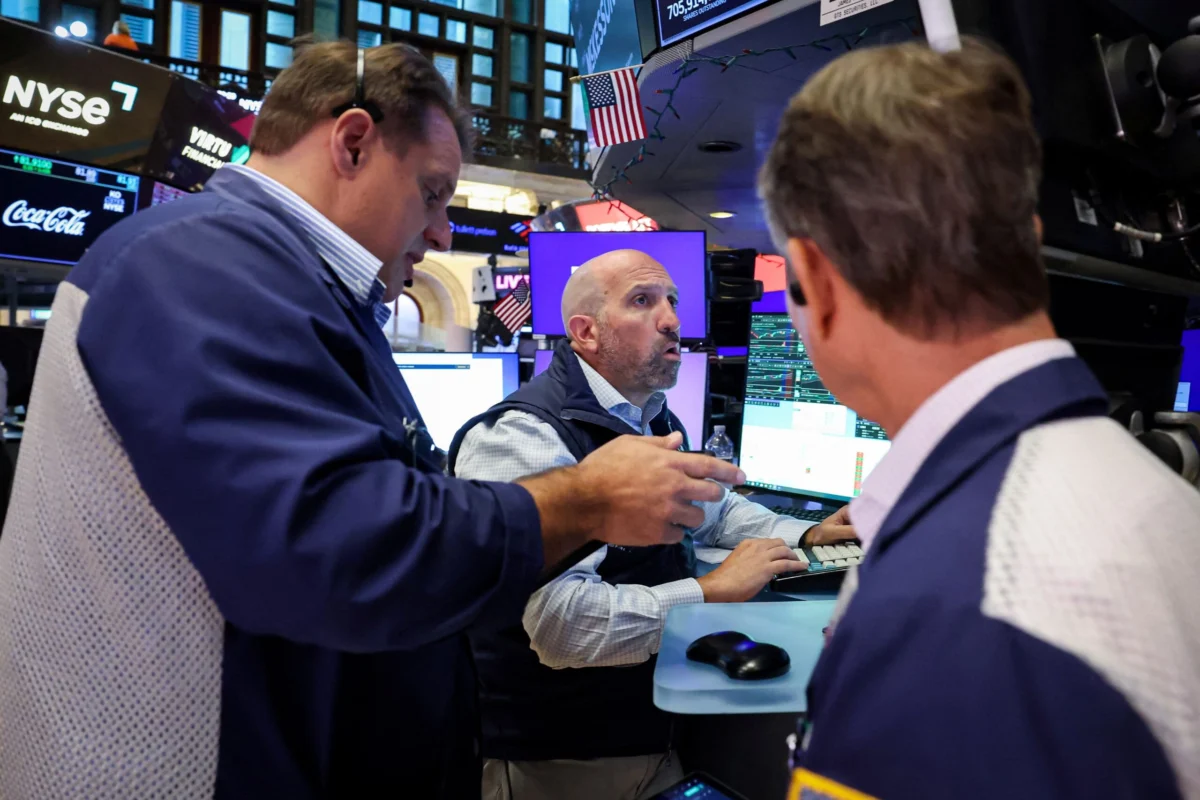
New York, July 24, 2026 – Major U.S. stock indexes experienced a precipitous decline on Thursday, as investors abruptly shifted their focus to the escalating ramifications of a renewed and prolonged conflict in the Middle East. The S&P 500, a key barometer of market health, was poised for its steepest single-day drop in a month, reflecting profound apprehension across equity markets. This dramatic turnaround followed a period where U.S. equities had largely appeared resilient to mounting geopolitical tensions, even as oil prices and Treasury yields had shown preliminary signs of upward pressure.
The market’s complacency shattered as Brent Crude futures surged past the critical $100 per barrel threshold, a psychological and economic benchmark not seen with such sustained intensity in over a year. Simultaneously, the benchmark 10-year Treasury yield pierced through 4.7%, reaching its highest point since January 2025, while the 30-year Treasury yield solidly eclipsed 5%. These movements were directly precipitated by alarming reports of attacks against oil tankers off the coast of Saudi Arabia, signaling a dangerous intensification of the conflict between the United States and Iran. For twelve consecutive nights, the U.S. military has conducted strikes against Iran, a relentless campaign that had already nudged energy markets higher. However, the latest incidents at sea provided undeniable evidence that the conflict, which officially commenced in March 2026, was not merely simmering but rapidly approaching a full boil, forcing a comprehensive re-evaluation of risk across financial sectors.
A Tipping Point for Investor Sentiment
Until Thursday, the prevailing sentiment among many investors was one of cautious optimism, or at least a belief that the conflict’s economic fallout could be contained. This perspective was largely informed by the market’s initial reaction to the U.S.-Iran war’s commencement in March 2026. At that time, while the S&P 500 did fall more than 7.5% at its low point and oil surged nearly 70%, concerns about 1970s-style stagflation — a toxic combination of high inflation and stagnant economic growth — were eventually tempered. Analysts noted that the U.S. economy appeared to be in better shape to handle energy shocks compared to previous eras, pointing to increased domestic energy production and a more diversified global supply chain.
However, the recent developments have eroded that confidence. Steve Sosnick, chief strategist at Interactive Brokers, articulated this shift starkly: "These problems became too big to ignore. It’s too hard to ignore $100 oil. It’s too hard to ignore 10-year rates that are above 4.70%. It’s too hard for the stock market to ignore 30-year rates that are solidly above 5%." His comments underscore the market’s realization that the geopolitical premium on energy and borrowing costs has now reached levels that fundamentally alter the economic outlook.
Western Texas Intermediate (WTI) Crude futures mirrored Brent’s ascent, jumping 6% on Thursday to reach $92 per barrel. This represents a staggering increase of more than 28% from lows below $70 per barrel observed earlier this month, highlighting the speed and intensity of the rebound in crude prices. Since the U.S. began its consecutive evening strikes on July 12, the S&P 500 has now declined approximately 2%, a relatively modest figure given the severity of the conflict, but one that masks the heightened anxiety now gripping traders.
Chronology of Conflict and Market Reaction
The geopolitical narrative underpinning the market’s volatility began in earnest in March 2026, with the official commencement of hostilities between the United States and Iran. This initial phase saw a significant market correction, with the S&P 500 registering a decline of over 7.5% from its peak, driven by fears of widespread economic disruption and a resurgence of inflation. Oil prices, reacting swiftly to the threat of supply disruptions in the critical Strait of Hormuz, surged by almost 70%, leading to widespread discussions among economists and investors about the potential for stagflation. The memory of the 1970s energy crises, which led to prolonged periods of economic malaise, loomed large.
However, a period of perceived de-escalation followed in April and May 2026. Reports of potential "de-escalation announcements" and the outlining of a "roadmap" for a final deal between the two nations, facilitated by diplomatic talks reportedly held in Switzerland, offered a glimmer of hope. These diplomatic overtures, coupled with a "reignited faith in the artificial intelligence (AI) trade" — which saw a significant influx of capital into tech stocks — fueled a ferocious rebound in the S&P 500. This rally allowed the index to recover much of its earlier losses, demonstrating the market’s eagerness to price in a more benign outcome, even as "hostilities at various times continued" in the background.
The market’s underlying assumption during this rebound was a strategic bet on President Donald Trump’s ability to find an "off-ramp" to end the war, thereby avoiding the severe economic and political consequences of a prolonged conflict. JPMorgan equity strategists, in a note earlier this month, had consistently advised clients to "use the equity weakness brought on by the Iran conflict to buy into, as the off-ramp and the eventual deal were likely, in our view." They acknowledged "the risks of renewed flareups remain, but we believe one should keep using any dips on the back of adverse geopolitical headlines in order to add." This sentiment reflected a widespread belief that a political solution would eventually prevail, mitigating the worst economic scenarios.
The situation dramatically shifted in July 2026. From July 12 onwards, the U.S. military initiated a sustained campaign of strikes against Iran, continuing for twelve consecutive nights. While these actions maintained a baseline level of tension, the market largely absorbed them without significant panic, still clinging to the "off-ramp" narrative.
The pivotal moment arrived on Thursday, July 24, 2026. Reports of attacks on oil tankers off the coast of Saudi Arabia served as a stark reminder of the conflict’s potential for immediate, tangible economic disruption. This event triggered the market’s sharp reaction, pushing Brent Crude above $100 per barrel and the 10-year Treasury yield above 4.7%, fundamentally altering the risk assessment and unraveling the previous optimism.

Implications for Monetary Policy and the Broader Economy
The renewed escalation of the Middle East conflict presents a formidable challenge for the Federal Reserve. The sudden surge in oil prices and Treasury yields has significantly altered the landscape for monetary policy. According to CME’s FedWatch tool, the chances for a rate hike by the Federal Reserve next week have soared to almost 38%, a dramatic increase from approximately 12% just a week ago. Furthermore, the odds for a hike at the central bank’s September meeting are now above 80%, up from 53%.
This rapid repricing of interest rate expectations indicates that the market is now anticipating a tighter borrowing environment, driven by renewed inflationary pressures and the Fed’s mandate to maintain price stability. Higher energy costs directly translate into higher input costs for businesses and increased expenses for consumers, potentially reigniting inflation that the Fed has worked assiduously to contain over the preceding years.
Sameer Samana, head of global equities and real assets at Wells Fargo Investment Institute, emphasized this concern, stating that traders now "need to reconsider the economic fears they had in March." He warned that investors should be worried about both higher inflation and the potentially crippling impact higher gas prices may have on consumer spending, which is a significant driver of the U.S. economy. Samana explicitly added that the reignited conflict is a compelling reason to prepare for a larger drawdown in equities, signaling a more pessimistic outlook than the market had recently embraced.
Sosnick further elaborated on the implications for companies, noting that stocks on Thursday were also likely pricing in a tighter borrowing environment. Higher interest rates increase the cost of capital for corporations, impacting investment decisions, profitability, and ultimately, corporate valuations. Companies with significant debt loads or those reliant on continuous access to affordable credit could face considerable headwinds.
Stagflationary Pressures and Consumer Impact
The specter of stagflation, previously a concern in March, has returned with renewed intensity. Stagflation, characterized by slow economic growth, high unemployment, and rising prices, poses a unique challenge for policymakers. Historically, the 1970s saw such a phenomenon, largely triggered by oil price shocks. The current situation, with Brent Crude breaching $100 and WTI at $92, mirrors those conditions in terms of energy cost escalation.
If sustained, these elevated energy prices could indeed reignite inflation across a broad range of goods and services, not just at the gas pump. Transportation costs for goods, manufacturing expenses, and even agricultural production would all feel the ripple effect. Simultaneously, the increased cost of living due to higher energy prices could weigh heavily on consumer spending, forcing households to allocate a larger portion of their budgets to essential energy needs and leaving less for discretionary purchases. This reduction in consumer demand, coupled with higher corporate borrowing costs, could decelerate economic growth, fulfilling the "stagnation" component of the stagflation equation.
The $120 Threshold and Long-Term Outlook
Despite the immediate market turmoil, some analysts still maintain a degree of cautious optimism regarding the longer-term economic resilience. Michael Tanney, CEO at investment advisory firm Pereon Wealth, echoed a sentiment similar to the initial market reaction in March. He stated, "In the short term, the elevated spike is more meaningful to the headlines than client portfolios." Tanney suggested that a more critical "breaking point" for widespread economic disruption would be a sustained price above $120 per barrel. "If we have a sustained price above $120, that’s the breaking point where you’ll see serious trickle down effects," he elaborated. This threshold implies that while $100 oil is a significant concern, the global economy might still have some capacity to absorb the shock, provided prices do not climb much higher and remain there for an extended period.
However, the geopolitical landscape remains highly unpredictable. The attacks on tankers, the ongoing U.S. strikes, and the lack of a clear diplomatic resolution suggest that the "off-ramp" once envisioned by investors may now be a distant prospect. The Strait of Hormuz, a critical choke point for global oil shipments, remains a focal point of concern, with any disruption there capable of sending oil prices spiraling further.
As the conflict prolongs and intensifies, the direct and indirect economic consequences become increasingly difficult to ignore. The initial market resilience, fueled by hopes of de-escalation and the allure of the AI trade, has given way to a stark recognition of the tangible economic threats. Investors are now forced to grapple with a complex interplay of geopolitical risk, inflationary pressures, and a potentially more hawkish Federal Reserve, all conspiring to create a volatile and uncertain outlook for U.S. equities. The coming weeks will be crucial in determining whether the current market downturn is a temporary correction or the harbinger of a more prolonged period of economic instability.
