

The global transition toward renewable energy is currently facing a paradoxical bottleneck. While the demand for solar energy is reaching record highs and capital is flowing into decarbonization projects at an unprecedented rate, the physical capacity to build this infrastructure is lagging. On Tuesday, Gritt, a San Francisco-based startup, emerged from stealth mode with a $26 million Series A funding round aimed at solving this critical labor shortage through advanced robotics and artificial intelligence. Led by Obvious Ventures, the round also saw participation from Union Square Ventures and Active Impact Investment, bringing the company’s total funding to $34 million.
Gritt’s emergence comes at a pivotal moment for the energy sector. As nations race to meet climate targets set by the Paris Agreement and bolstered by domestic policies like the U.S. Inflation Reduction Act (IRA), the solar industry is struggling to find the human workforce necessary to install millions of panels across remote and often inhospitable environments. Gritt’s solution—an intelligent software layer that can be integrated into existing industrial hardware—promises to multiply the productivity of installation crews by nearly five times, potentially reshaping the economics of large-scale solar farms.
The Technological Core: Physical AI in Unstructured Environments
Founded by Carnegie Mellon-trained roboticists Puneet Puri (CEO) and Vishal Dugar (CTO), Gritt is built on the premise that the next frontier for artificial intelligence is the "unstructured" world. Traditionally, industrial robots have been confined to factory floors where every movement is programmed and the environment is perfectly controlled. However, construction sites are chaotic, dusty, and subject to changing weather conditions—variables that have historically rendered robots ineffective.
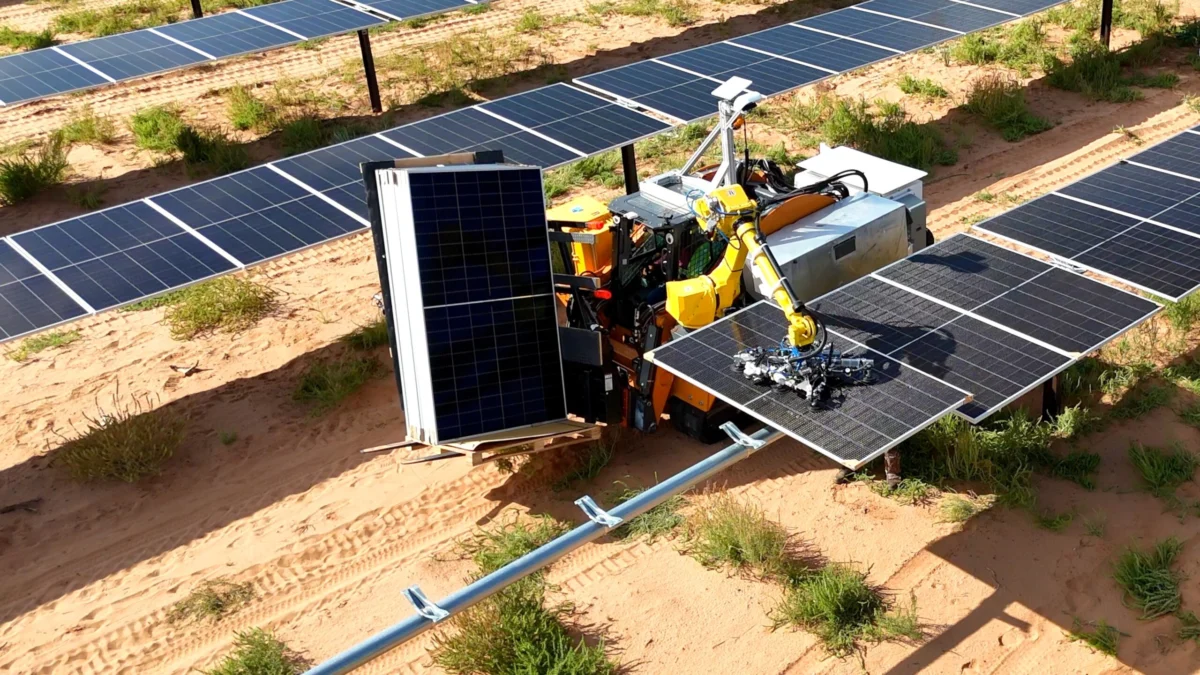
Gritt’s innovation lies in its "Physical AI" platform. Rather than engineering bespoke, expensive hardware from the ground up, the company utilizes off-the-shelf machinery, such as rented skidders and robotic arms from manufacturers like Kawasaki. By layering their proprietary AI and computer vision models onto this existing hardware, Gritt enables machines to perceive their surroundings with sub-millimeter precision.
The system’s primary task currently involves the heavy lifting of solar installation: unloading heavy, fragile glass panels, transporting them to metal racking systems, and positioning them with extreme accuracy so that human workers can secure them. This "man-and-machine" collaboration allows for a seamless workflow where the robot handles the dangerous and repetitive physical strain, while humans focus on the final mechanical fastening and electrical connections.
Solving the Solar Labor Crisis and Workforce Safety
The solar industry’s growth is currently outstripping the available labor pool. According to the Solar Energy Industries Association (SEIA), the U.S. solar workforce needs to grow from approximately 250,000 workers today to over 800,000 by 2030 to meet decarbonization goals. This demand is compounded by the fact that many utility-scale solar projects are located in remote desert regions where attracting and retaining labor is notoriously difficult.
Gritt’s data suggests a massive leap in efficiency that could alleviate this pressure. In a traditional setting, an eight-person crew typically installs approximately 800 panels per day. By integrating Gritt’s autonomous systems, that same eight-person crew can increase their output to between 3,000 and 4,000 panels per day. This 400% to 500% increase in productivity allows developers to complete projects months ahead of schedule, significantly reducing the cost of capital and accelerating the delivery of green energy to the grid.
Safety is another driving factor for the adoption of Gritt’s technology. Solar panels often weigh around 100 pounds and must be lifted repeatedly, often in high temperatures. One Gritt customer, an executive at a major power construction firm who spoke on the condition of anonymity, noted that the reduction in musculoskeletal injuries is a primary selling point. "It’s hard to find people willing to lift 100-pound glass sheets over their heads for eight hours a day in 100-degree heat," the customer stated. "Automating that specific task doesn’t just speed things up; it makes the job site safer and more sustainable for our workers."
Strategic Funding and Market Traction
The $26 million Series A round, which followed an earlier seed round backed by First Round Capital, Climactic, Congruent Ventures, and VSC Ventures, will be used to scale Gritt’s operations and expand its fleet. The company already has two systems deployed in the field and has secured contracts to assist in the installation of 2.8 gigawatts of solar capacity over the next 18 months.
The startup’s business model—focusing on software and off-the-shelf hardware—distinguishes it from competitors like Luminous Robotics, Cosmic, and China-based Trinabot. While those companies often develop specialized, proprietary robotic hardware, Gritt’s reliance on standard vehicles allows it to scale more rapidly with lower capital expenditure. This "asset-light" approach to robotics is increasingly favored by venture capitalists who have seen hardware-heavy startups struggle with the costs of maintenance and manufacturing.
Andrew Beebe, a partner at Obvious Ventures who led the Series A, highlighted the founders’ pragmatic approach. "There are people who used to build rockets that went into space and had infinite budget… and then there are people who know what it means to get into dirty, dull, and dangerous jobs and scale them like mad," Beebe said. "These guys are in the second camp."
A Timeline of Development and Future Expansion
The journey of Gritt reflects the rapid advancement of generative AI and foundation models over the last few years. According to CEO Puneet Puri, the company’s ability to generalize tasks has been the "game-changer." Five years ago, training a robot to handle a single specific task in a specific environment was a multi-month engineering feat. Today, thanks to the evolution of AI pipelines, Gritt can adapt its systems to new tasks with remarkable speed.
For instance, Puri noted that while training the initial system to stack cinder blocks took several weeks of development, a subsequent demonstration for a completely different task—tying rebar—took only a single day using the same underlying software architecture. This ability to generalize "dexterous manipulation" is what Gritt believes will allow it to expand beyond solar into the broader construction industry.
In the near term, Gritt plans to operate 48 systems within the next six months. The roadmap for the technology includes expanding the robots’ capabilities to include fastening the solar panels, drilling foundation posts, and even assembling the metal racks. Long-term, the company aims to tackle other labor-intensive infrastructure tasks, such as rebar tying for concrete foundations, which remains one of the most physically demanding and slow processes in modern construction.
Broader Implications: The Rise of the Autonomous Job Site
Gritt’s vision extends beyond mere mechanical labor. The founders envision their systems acting as an "intelligence layer" for the entire construction site. Because the robots are equipped with an array of sensors, cameras, and GPS modules, they collect vast amounts of real-time data about the progress of a project.
This data can be used to improve site management and decision-making. For example, the AI could detect if a trench has been left open and alert the management team to cover it before an approaching storm causes erosion or damages electrical components. It could also provide automated inventory tracking, flagging missing components before they lead to work stoppages.
"Gritt becomes this layer of physical AI," Puri explained. "It’s doing the dextrous, labor-intensive task, but it’s also helping you make decisions on the site."
The implications for the global energy transition are profound. If the "soft costs" of solar—which include labor, permitting, and construction—can be drastically reduced through automation, solar energy will become even more competitive against fossil fuels. Furthermore, by de-risking the construction phase of massive renewable projects, Gritt could help unlock more institutional investment for the "green build-out" required to meet mid-century net-zero goals.
As Gritt exits stealth, the company stands at the intersection of two of the most significant trends in the modern economy: the urgent need for climate-resilient infrastructure and the rapid maturation of artificial intelligence. By applying high-level "brain power" to the "muscle" of construction, Gritt is positioning itself as a foundational player in the effort to build the future of civilization faster, safer, and more efficiently.
